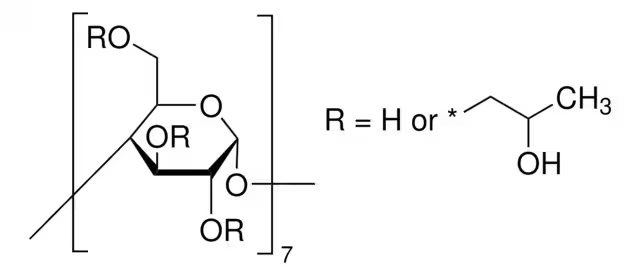
CAS Number128446-35-5
Synonyms(2-Hydroxypropyl)-Beta-Cyclodextrin; EINECS 420-920-1; MFCD00069372; Hydroxypropyl-beta-cyclodextrin; (2-HYDROXYPROPYL)-β-CYCLODEXTRIN; (2-Hydroxypropyl)-Beta-Cyclodextri; Hydroxypropyl-β-cyclodextrin
Molecular FormulaC63H112O42
Molecular Weight1541.538
Purity≥98 (TLC)%
Density1.4±0.1 g/cm3
Boiling Point1521.9±60.0 °C at 760 mmHg
Melting Point278ºC (dec.)
Appearancepowder
EINECS420-920-1
Symbol
Signal WordWarning
| Chemical & Physical Properties | |
|---|---|
| CAS Number | 128446-35-5 |
| Catalog No. | 2A-9008935 |
| Chinese Name | 羟丙基-β-环糊精 |
| Synonyms | (2-Hydroxypropyl)-Beta-Cyclodextrin; EINECS 420-920-1; MFCD00069372; Hydroxypropyl-beta-cyclodextrin; (2-HYDROXYPROPYL)-β-CYCLODEXTRIN; (2-Hydroxypropyl)-Beta-Cyclodextri; Hydroxypropyl-β-cyclodextrin |
| Molecular Formula | C63H112O42 |
| Molecular Weight | 1541.538 |
| Purity | ≥98 (TLC) |
| Density | 1.4±0.1 g/cm3 |
| Boiling Point | 1521.9±60.0 °C at 760 mmHg |
| Melting Point | 278ºC (dec.) |
| Appearance | powder |
| Water Solubility | H2O: 45 % (w/v) | Soluble in water. |
| Storage Condition | Keep the receptacle sealed, stored in a cool, dry |
| Application | (2-Hydroxypropyl)-β-cyclodextrin is a widely used drug delivery vehicle that improves stability and availability. |
| EINECS | 420-920-1 |
| PubChem ID | 24895425 |
| SMILES | CC(O)COCC1OC2OC3C(COCC(C)O)OC(OC4C(COCC(C)O)OC(OC5C(COCC(C)O)OC(OC6C(COCC(C)O)OC(OC7C(COCC(C)O)OC(OC8C(COCC(C)O)OC(OC1C(OCC(C)O)C2OCC(C)O)C(OCC(C)O)C8OCC(C)O)C(OCC(C)O)C7OCC(C)O)C(OCC(C)O)C6OCC(C)O)C(OCC(C)O)C5OCC(C)O)C(OCC(C)O)C4OCC(C)O)C(OCC(C)O)C3OCC(C)O |
| InChI | 1S/C63H112O42/c1-22(64)8-85-15-29-50-36(71)43(78)57(92-29)100-51-30(16-86-9-23(2)65)94-59(45(80)38(51)73)102-53-32(18-88-11-25(4)67)96-61(47(82)40(53)75)104-55-34(20-90-13-27(6)69)98-63(49(84)42(55)77)105-56-35(21-91-14-28(7)70)97-62(48(83)41(56)76)103-54-33(19-89-12-26(5)68)95-60(46(81)39(54)74)101-52-31(17-87-10-24(3)66)93-58(99-50)44(79)37(52)72/h22-84H,8-21H2,1-7H3/t22?,23?,24?,25?,26?,27?,28?,29-,30-,31?,32?,33?,34?,35?,36?,37-,38?,39-,40+,41+,42+,43?,44+,45?,46+,47+,48+,49+,50+,51+,52-,53-,54-,55-,56-,57+,58-,59+,60-,61-,62-,63-/m1/s1 |
| InChI Key | ODLHGICHYURWBS-RYJYQAAZSA-N |
| NACRES Code | NA.77 |
| UNSPSC | 12352201 |
| Hazard Symbols | Transport |
| MSDS | msds/8935_1_128446_35_5.pdf |
| Bioactivity | (2-Hydroxypropyl)-β-cyclodextrin is a widely used drug delivery vehicle to improve the stability and bioavailability. Related Catalog Signaling Pathways >> Apoptosis >> Apoptosis Signaling Pathways >> Autophagy >> Autophagy Research Areas >> Cancer In Vitro Cell treatment with (2-Hydroxypropyl)-β-cyclodextrin results in the activation of the transcription factor EB, a master regulator of lysosomal function and autophagy, and in enhancement of the cellular autophagic clearance capacity[1]. (2-Hydroxypropyl)-β-cyclodextrin treatment reduces intracellular cholesterol resulting in significant leukemic cell growth inhibition through G2/M cell-cycle arrest and apoptosis. The IC50 values for (2-Hydroxypropyl)-β-cyclodextrin after 72 hours exposure are in the range of 3.86-10.09 mM. (2-Hydroxypropyl)-β-cyclodextrin also shows anticancer effects against CML cells expressing a T315I BCR-ABL mutation (that confers resistance to most ABL tyrosine kinase inhibitors), and hypoxia-adapted CML cells that have characteristics of leukemic stem cells. In addition, colony forming ability of human primary AML and CML cells is inhibited by (2-Hydroxypropyl)-β-cyclodextrin[2]. In Vivo (2-Hydroxypropyl)-β-cyclodextrin administration promotes transcription factor EB-mediated clearance of proteolipid aggregates that accumulate due to inefficient activity of the lysosome-autophagy system in cells derived from a patient with a lysosomal storage disorder[1]. Intraperitoneal injection of (2-Hydroxypropyl)-β-cyclodextrin significantly improves survival in leukemia mouse models. Systemic administration of (2-Hydroxypropyl)-β-cyclodextrin to mice has no significant adverse effects[2]. Cell Assay Cells are incubated with (2-Hydroxypropyl)-β-cyclodextrin at various concentrations (5, 7.5, 10, 15, 20 mM) for 72 hours. Cell viability is assessed using a trypan blue dye exclusion method and cell proliferation is evaluated using a modified methyl-thiazol-diphenyl- tetrazolium (MTT) assay[2]. Animal Admin Mice: Mice are intraperitoneally injected with 200 μL vehicle (saline) or (2-Hydroxypropyl)-β-cyclodextrin (50 or 150 mM) for 20 consecutive days 3 days after transplantation, and survival is monitored daily. Leukemic cell engraftment is confirmed by detection of GFP-positive cells in the recipient's BM using flow cytometry[2]. References [1]. Song W, et al. 2-Hydroxypropyl-β-cyclodextrin promotes transcription factor EB-mediated activation of autophagy: implications for therapy. J Biol Chem. 2014 Apr 4;289(14):10211-22. [2]. Yokoo M, et al. 2-Hydroxypropyl-β-Cyclodextrin Acts as a Novel Anticancer Agent. PLoS One. 2015 Nov 4;10(11):e0141946. Chemical & Physical Properties Density 1.4±0.1 g/cm3 Boiling Point 1521.9±60.0 °C at 760 mmHg Melting Point 278ºC (dec.) Molecular Formula C63H112O42 Molecular Weight 1541.538 Flash Point 874.2±32.9 °C Exact Mass 1540.662842 PSA 618.66000 LogP -6.23 Vapour Pressure 0.0±0.6 mmHg at 25°C Index of Refraction 1.545 InChIKey ODLHGICHYURWBS-FOSILIAISA-N SMILES CC(O)COCC1OC2OC3C(COCC(C)O)OC(OC4C(COCC(C)O)OC(OC5C(COCC(C)O)OC(OC6C(COCC(C)O)OC(OC7C(COCC(C)O)OC(OC8C(COCC(C)O)OC(OC1C(O)C2O)C(O)C8O)C(O)C7O)C(O)C6O)C(O)C5O)C(O)C4O)C(O)C3O Storage condition 2-8°C Water Solubility H2O: 45 % (w/v) | Soluble in water. |
| Use of | (2-Hydroxypropyl)-β-cyclodextrin is a widely used drug delivery vehicle to improve the stability and bioavailability. Properties Articles19 Name (2-Hydroxypropyl)-β-cyclodextrin Synonym More Synonyms Hydroxypropyl-β-cyclodextrin Biological Activity Description (2-Hydroxypropyl)-β-cyclodextrin is a widely used drug delivery vehicle to improve the stability and bioavailability. Related Catalog Signaling Pathways >> Apoptosis >> Apoptosis Signaling Pathways >> Autophagy >> Autophagy Research Areas >> Cancer In Vivo (2-Hydroxypropyl)-β-cyclodextrin administration promotes transcription factor EB-mediated clearance of proteolipid aggregates that accumulate due to inefficient activity of the lysosome-autophagy system in cells derived from a patient with a lysosomal storage disorder[1]. Intraperitoneal injection of (2-Hydroxypropyl)-β-cyclodextrin significantly improves survival in leukemia mouse models. Systemic administration of (2-Hydroxypropyl)-β-cyclodextrin to mice has no significant adverse effects[2]. References [1]. Song W, et al. 2-Hydroxypropyl-β-cyclodextrin promotes transcription factor EB-mediated activation of autophagy: implications for therapy. J Biol Chem. 2014 Apr 4;289(14):10211-22. [2]. Yokoo M, et al. 2-Hydroxypropyl-β-Cyclodextrin Acts as a Novel Anticancer Agent. PLoS One. 2015 Nov 4;10(11):e0141946. Chemical & Physical Properties Molecular Formula C63H112O42 Exact Mass 1540.662842 PSA 618.66000 LogP -6.23 Index of Refraction 1.545 InChIKey ODLHGICHYURWBS-FOSILIAISA-N Water Solubility H2O: 45 % (w/v) | Soluble in water. |
| Transport Info | Product name: Purity: 97.0% |
| MSDS Transport Info | Module 14. Shipping information 14.1 UN dangerous goods number European Land Transport Dangerous Regulations: -International Maritime Dangerous Regulations: -International Air Transport Dangerous Regulations: - 14.2 Names specified by the United Nations (UN) European Land Transport Dangerous Regulations: Non-dangerous goods IMDG Code: Non-dangerous goods International air transport dangerous goods regulations: non-dangerous goods 14.3 Transport hazard categories European Land Transport Dangerous Regulations: -International Maritime Dangerous Regulations: -International Air Transport Dangerous Regulations: - 14.4 Package group European Land Transport Dangerous Regulations: -International Maritime Dangerous Regulations: -International Air Transport Dangerous Regulations: - 14.5 Environmental hazards European Land Transport Dangerous Regulations: No International Maritime Transport Dangerous Regulations Maritime Pollutants: No International Air Transport Risk Regulations: No 14.6 Special reminder to users No data available |
| Related Products in Specialty Chemicals | ||
|---|---|---|
| (+)-Isopulegol | 104870-56-6 | 2A-9008929 |
| (+)-Ketamine | 3643-47-9 | 2A-9008930 |
| (+)-Trans-chlordane | 5103-74-2 | 2A-9008931 |
| (+/-)-Sulfinpyrazone | 57-96-5 | 2A-9008933 |
| (+/-)-Thiopental | 76-75-5 | 2A-9008934 |
| (3-Bromo-2,4,6-trimethylphenylcarbamoyl)methyliminodiacetic acid | 78266-06-5 | 2A-9008936 |
| (Sar1,Val5,Ala8)-Angiotensin II | 34273-10-4 | 2A-9008950 |
| [4-Chloro-6-(2,3-xylidino)-2-pyrimidinylthio]acetic acid | 50892-23-4 | 2A-9008951 |
| 10-Hydroxycamptothecin | 19685-09-7 | 2A-9008953 |
| 10-Hydroxycamptothecine | 67656-30-8 | 2A-9008954 |
| Browse all Specialty Chemicals products » | ||
Phone:
630-322-8886
630-322-8887
Email:
Office Locations:
Chicago, IL, USA
San Francisco, CA, USA


 EN
EN


 SDS
SDS