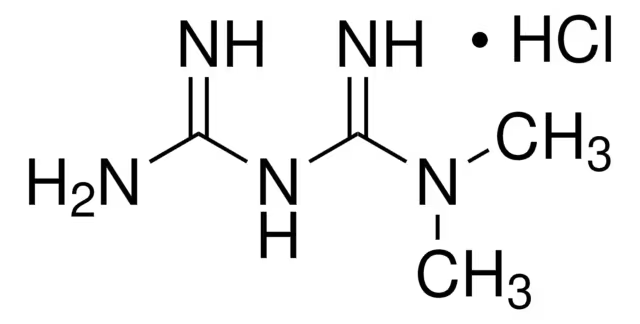
CAS Number1115-70-4
SynonymsMetformin HCl; 1,1-Dimethylbiguanide hydrochloride,Metformin; 3-(diaminomethylidene)-1,1-dimethylguanidine,hydrochloride; Imidodicarbonimidic diamide, N,N-dimethyl-, hydrochloride (1:1); 1,1-Dimethylbiguanide hydrochloride; MFCD00012582; N,N-Dimethylimidodicarbonimidic diamide hydrochloride (1:1); N1,N1-Dimethylbiguanide hydrochloride; Metformin hydrochloride; EINECS 214-230-6; Metformin (hydrochloride)
Molecular FormulaNH2C(=NH)NHC(=NH)N(CH3)2 · HCl
Molecular Weight165.62
Purity98%
Boiling Point224.1ºC at 760 mmHg
Melting Point223-226 °C (lit.)
Appearancecrystalline solid
EINECS214-230-6
Symbol
Signal WordWarning
| Chemical & Physical Properties | |
|---|---|
| CAS Number | 1115-70-4 |
| Catalog No. | 2A-9007542 |
| Chinese Name | 盐酸二甲双胍 |
| Synonyms | Metformin HCl; 1,1-Dimethylbiguanide hydrochloride,Metformin; 3-(diaminomethylidene)-1,1-dimethylguanidine,hydrochloride; Imidodicarbonimidic diamide, N,N-dimethyl-, hydrochloride (1:1); 1,1-Dimethylbiguanide hydrochloride; MFCD00012582; N,N-Dimethylimidodicarbonimidic diamide hydrochloride (1:1); N1,N1-Dimethylbiguanide hydrochloride; Metformin hydrochloride; EINECS 214-230-6; Metformin (hydrochloride) |
| Molecular Formula | NH2C(=NH)NHC(=NH)N(CH3)2 · HCl |
| Molecular Weight | 165.62 |
| Purity | 98 |
| Boiling Point | 224.1ºC at 760 mmHg |
| Melting Point | 223-226 °C (lit.) |
| Appearance | crystalline solid |
| Water Solubility | Water solubility: completely soluble; very slightl |
| Storage Condition | Store in a cool, dry place |
| Application | Metformin (hydrochloride) is an FDA-approved first-line drug for the treatment of type 2 diabetes. Metformin reduces hepatic glucose production primarily through mild and transient inhibition of mitoc |
| EINECS | 214-230-6 |
| HTC | 2925290090 |
| PubChem ID | 329823106 |
| MDL Number | MFCD00012582 |
| SMILES | Cl[H].CN(C)C(=N)NC(N)=N |
| InChI | 1S/C4H11N5.ClH/c1-9(2)4(7)8-3(5)6;/h1-2H3,(H5,5,6,7,8);1H |
| InChI Key | OETHQSJEHLVLGH-UHFFFAOYSA-N |
| NACRES Code | NA.24 |
| UNSPSC | 41116107 |
| Hazard Symbols | Xn |
| Risk Codes | R22;R36/38 |
| Safety Description | S26;S36 |
| MSDS | msds/7542_1_1115_70_4.pdf |
| Bioactivity | Metformin (hydrochloride) is an FDA approved first-line drug for the treatment of type 2 diabetes. Metformin decreases hepatic glucose production, mostly through a mild and transient inhibition of the mitochondrial respiratory-chain complex 1. Related Catalog Signaling Pathways >> Epigenetics >> AMPK Signaling Pathways >> PI3K/Akt/mTOR >> AMPK Signaling Pathways >> Autophagy >> Autophagy Signaling Pathways >> Autophagy >> Mitophagy Research Areas >> Cancer Target AMPK Autophagy Mitophagy In Vitro Metformin inhibits proliferation of ESCs in a concentration-dependent manner. The IC50 is 2.45 mM for A-ESCs and 7.87 mM for N-ESCs. Metformin shows pronounced effects on activation of AMPK signaling in A-ESCs from secretory phase than in cells from proliferative phase[3]. Metformin (0-500 μM) decreases glycogen synthesis in a dose-dependent manner with an IC50 value of 196.5 μM in cultured rat hepatocytes[4]. Metformin shows cell viability and cytotoxic effects on PC-3 cells with IC50 of 5 mM[5]. In Vivo Metformin (100 mg/kg, p.o.) alone, and metformin (25, 50, 100 mg/kg) with isoproterenol groups attenuates myocyte necrosis through histopathological analysis[1]. Metformin (> 900 mg/kg/day, p.o.) results in moribundity/mortality and clinical signs of toxicity in Crl:CD(SD) rats[2]. Cell Assay ESCs are plated in 96-well plates at a concentration of 1×10³cells/well. After attachment, cells are treated with different doses of metformin/compound C for 0 min, 15 min, 1 h, and 24 h. MTT assays are performed as described previously. In brief, MTT (5 mg/mL) is added to the 96-well plates at a volume of 10 μL/well, and the plates are incubated for 4 h. The MTT reaction is terminated by removal of the culture medium containing MTT, and 100 μL DMSO per well are added and incubated at RT on a shaker for 10 min to ensure that the crystals had dissolved sufficiently. Absorbance values are measured at 595 nm. Cell proliferation (percentage of control) is calculated as follows: absorbance (experimental group)/absorbance (control group). Cell proliferation inhibition (percentage of control) is calculated as follows: 100%−cell proliferation (percentage of control). Each experiment is performed in duplicate and repeated six times to assess result consistency. Animal Admin The animals are randomized into six groups consisting of six rats each. Rats in group 1 (control) receives a subcutaneous injection of physiological saline (0.5 mL) and are left untreated for the entire experimental period. Rats in group 2 receives an oral administration of metformin (100 mg/kg; twice daily) for 2 days and are subcutaneously injected with saline at an interval of 24 h for 2 consecutive days. Rats in group 3 (MI control) receives an oral administration of saline (twice daily) for 2 days and are sc injected with isoproterenol (100 mg/kg) daily for 2 consecutive days at an interval of 24 h. Rats in groups 4 to 6 are treated with metformin at 25, 50, and 100 mg/kg. Metformin is dissolved in saline and is gavaged at a volume of 0.25-0.5 mL twice a day at an interval of 12 h, started immediately before isoproterenol injection. References [1]. Soraya H, et al. Acute treatment with metformin improves cardiac function following isoproterenol induced myocardial infarction in rats. Pharmacol Rep. 2012;64(6):1476-84. [2]. Quaile MP, et al. Toxicity and toxicokinetics of metformin in rats. Toxicol Appl Pharmacol. 2010 Mar 15;243(3):340-7. [3]. Xue J, et al. Metformin inhibits growth of eutopic stromal cells from adenomyotic endometrium via AMPK activation and subsequent inhibition of AKT phosphorylation: a possible role in the treatment of adenomyosis. Reproduction. 2013 Aug 21;146(4):397-406. [4]. Otto M, et al. Metformin inhibits glycogen synthesis and gluconeogenesis in cultured rat hepatocytes. Diabetes Obes Metab. 2003 May;5(3):189-94. [5]. Avci CB, et al. Therapeutic potential of an anti-diabetic drug, metformin: alteration of miRNA expression in prostate cancer cells. Asian Pac J Cancer Prev. 2013;14(2):765-8. [6]. Nie L, et al. The Landscape of Histone Modifications in a High-Fat Diet-Induced Obese (DIO) Mouse Model. Mol Cell Proteomics. 2017 Jul;16(7):1324-1334. [7]. Zhang D, et al. Metformin ameliorates BSCB disruption by inhibiting neutrophil infiltration and MMP-9 expression but not direct TJ proteins expression regulation. J Cell Mol Med. 2017 Jul 12. Chemical & Physical Properties Boiling Point 224.1ºC at 760 mmHg Melting Point 223-226 °C(lit.) Molecular Formula C4H12ClN5 Molecular Weight 165.625 Flash Point 89.3ºC Exact Mass 165.078125 PSA 88.99000 LogP 1.05850 Vapour Pressure 0.0929mmHg at 25°C InChIKey OETHQSJEHLVLGH-UHFFFAOYSA-N SMILES CN(C)C(=N)N=C(N)N.Cl Storage condition Store at RT |
| Use of | Metformin (hydrochloride) is an FDA approved first-line drug for the treatment of type 2 diabetes. Metformin decreases hepatic glucose production, mostly through a mild and transient inhibition of the mitochondrial respiratory-chain complex 1. Properties Articles81 Name Metformin Hydrochloride Synonym More Synonyms Metformin HCl Biological Activity Description Metformin (hydrochloride) is an FDA approved first-line drug for the treatment of type 2 diabetes. Metformin decreases hepatic glucose production, mostly through a mild and transient inhibition of the mitochondrial respiratory-chain complex 1. Related Catalog Signaling Pathways >> Epigenetics >> AMPK Signaling Pathways >> PI3K/Akt/mTOR >> AMPK Signaling Pathways >> Autophagy >> Autophagy Signaling Pathways >> Autophagy >> Mitophagy Research Areas >> Cancer References [1]. Soraya H, et al. Acute treatment with metformin improves cardiac function following isoproterenol induced myocardial infarction in rats. Pharmacol Rep. 2012;64(6):1476-84. [2]. Quaile MP, et al. Toxicity and toxicokinetics of metformin in rats. Toxicol Appl Pharmacol. 2010 Mar 15;243(3):340-7. [3]. Xue J, et al. Metformin inhibits growth of eutopic stromal cells from adenomyotic endometrium via AMPK activation and subsequent inhibition of AKT phosphorylation: a possible role in the treatment of adenomyosis. Reproduction. 2013 Aug 21;146(4):397-406. [4]. Otto M, et al. Metformin inhibits glycogen synthesis and gluconeogenesis in cultured rat hepatocytes. Diabetes Obes Metab. 2003 May;5(3):189-94. [5]. Avci CB, et al. Therapeutic potential of an anti-diabetic drug, metformin: alteration of miRNA expression in prostate cancer cells. Asian Pac J Cancer Prev. 2013;14(2):765-8. [6]. Nie L, et al. The Landscape of Histone Modifications in a High-Fat Diet-Induced Obese (DIO) Mouse Model. Mol Cell Proteomics. 2017 Jul;16(7):1324-1334. [7]. Zhang D, et al. Metformin ameliorates BSCB disruption by inhibiting neutrophil infiltration and MMP-9 expression but not direct TJ proteins expression regulation. J Cell Mol Med. 2017 Jul 12. Chemical & Physical Properties Exact Mass 165.078125 PSA 88.99000 LogP 1.05850 InChIKey OETHQSJEHLVLGH-UHFFFAOYSA-N SMILES CN(C)C(=N)N=C(N)N.Cl Storage condition Store at RT |
| Tax Rebate | 9.0% |
| Supervision | none |
| Transport Info | Product name: Purity: 97.0% |
| MSDS Transport Info | Module 14. Shipping information United Nations classification: inconsistent with United Nations classification standards UN number: not specified |
| Related Products in API & Advanced Intermediates | ||
|---|---|---|
| Colchicine, [ring C, methoxy-14C] | 2A-107439 | 2A-9007439 |
| Cyclophosphamide | 6055-19-2 | 2A-9007467 |
| D,L-Venlafaxine | 93413-69-5 | 2A-9007501 |
| Desogestrel | 54024-22-5 | 2A-9007528 |
| Dexamethasone | 50-02-2 | 2A-9007530 |
| Diazepam | 439-14-5 | 2A-9007548 |
| Diclofenac resinate | 2A-107556 | 2A-9007556 |
| Drospirenone | 67392-87-4 | 2A-9007668 |
| Enalaprilat | 76420-72-9 | 2A-9007676 |
| Erythromycin-9-oxime | 13127-18-9 | 2A-9007681 |
| Browse all API & Advanced Intermediates products » | ||
Phone:
630-322-8886
630-322-8887
Email:
Office Locations:
Chicago, IL, USA
San Francisco, CA, USA


 EN
EN


 SDS
SDS