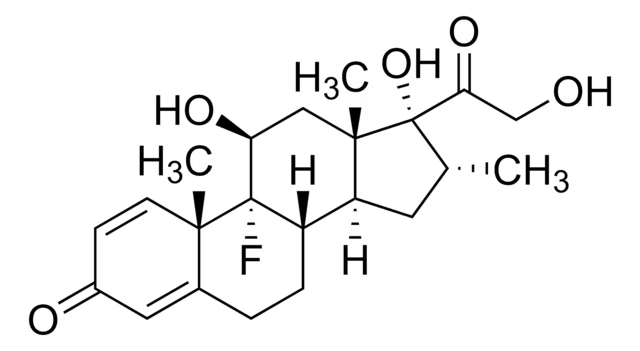
CAS Number50-02-2
SynonymsAuxiron; Corson; Hl-dex; (11b,16a)-9-fluoro-11,17,21-trihydroxy-16-methylpregna-1,4-diene-3,20-dione; Adexone; 16a-Methyl-9a-fluoroprednisolone; MFCD00064136; Dezone; 16a-Methyl-9a-fluoro-D1-hydrocortisone; Dexamethasone Base; Dexamonozon; Dexone; (11β,16α)-9-Fluoro-11,17,21-trihydroxy-16-methylpregna-1,4-diene-3,20-dione; 1-Dehydro-16a-methyl-9a-fluorohydrocortisone; Dexamethasone; 9α-Fluoro-16α-methylprednisolone; mk125; Dexa-Mamallet; Dexa; 16α-Methyl-9α-fluoroprednisolone; Aphthasolone; EINECS 200-003-9; 9a-Fluoro-16a-methylprednisolone; 16a-Methyl-9a-fluoro-1,4-pregnadiene-11b,17a,21-triol-3,20-dione; 1-Dehydro-16α-methyl-9α-fluorohydrocortisone; Decacort; DXM; Dxms; 9-Fluoro-11-β,17,21-trihydroxy-16-α-methylpregna-1,4-diene-3,20-dione
Molecular FormulaC22H29FO5
Molecular Weight392.46
Purity≥97%
Density1.3±0.1 g/cm3
Boiling Point568.2±50.0 °C at 760 mmHg
Melting Point262-264 °C (lit.)
Appearancepowder
EINECS200-003-9
Symbol
Signal WordWarning
| Chemical & Physical Properties | |
|---|---|
| CAS Number | 50-02-2 |
| Catalog No. | 2A-9007530 |
| Chinese Name | 地塞米松 |
| Synonyms | Auxiron; Corson; Hl-dex; (11b,16a)-9-fluoro-11,17,21-trihydroxy-16-methylpregna-1,4-diene-3,20-dione; Adexone; 16a-Methyl-9a-fluoroprednisolone; MFCD00064136; Dezone; 16a-Methyl-9a-fluoro-D1-hydrocortisone; Dexamethasone Base; Dexamonozon; Dexone; (11β,16α)-9-Fluoro-11,17,21-trihydroxy-16-methylpregna-1,4-diene-3,20-dione; 1-Dehydro-16a-methyl-9a-fluorohydrocortisone; Dexamethasone; 9α-Fluoro-16α-methylprednisolone; mk125; Dexa-Mamallet; Dexa; 16α-Methyl-9α-fluoroprednisolone; Aphthasolone; EINECS 200-003-9; 9a-Fluoro-16a-methylprednisolone; 16a-Methyl-9a-fluoro-1,4-pregnadiene-11b,17a,21-triol-3,20-dione; 1-Dehydro-16α-methyl-9α-fluorohydrocortisone; Decacort; DXM; Dxms; 9-Fluoro-11-β,17,21-trihydroxy-16-α-methylpregna-1,4-diene-3,20-dione |
| Molecular Formula | C22H29FO5 |
| Molecular Weight | 392.46 |
| Purity | ≥97 |
| Density | 1.3±0.1 g/cm3 |
| Boiling Point | 568.2±50.0 °C at 760 mmHg |
| Melting Point | 262-264 °C (lit.) |
| Appearance | powder |
| Storage Condition | 2~8°C |
| Application | Dexamethasone is a glucocorticoid receptor agonist. |
| EINECS | 200-003-9 |
| HTC | 2937210000 |
| PubChem ID | 24893906 |
| MDL Number | MFCD00064136 |
| SMILES | C[C@@H]1C[C@H]2[C@@H]3CCC4=CC(=O)C=C[C@]4(C)[C@@]3(F)[C@@H](O)C[C@]2(C)[C@@]1(O)C(=O)CO |
| InChI | 1S/C22H29FO5/c1-12-8-16-15-5-4-13-9-14(25)6-7-19(13,2)21(15,23)17(26)10-20(16,3)22(12,28)18(27)11-24/h6-7,9,12,15-17,24,26,28H,4-5,8,10-11H2,1-3H3/t12-,15+,16+,17+,19+,20+,21+,22+/m1/s1 |
| InChI Key | UREBDLICKHMUKA-CXSFZGCWSA-N |
| Beilstein/REAXYS | 2066651 |
| NACRES Code | NA.75 |
| UNSPSC | 12352209 |
| Hazard Symbols | Transport |
| Risk Codes | R40 |
| Safety Description | S45 |
| MSDS | msds/7530_1_50_02_2.pdf |
| Bioactivity | Dexamethasone is a glucocorticoid receptor agonist. Related Catalog Signaling Pathways >> Autophagy >> Autophagy Signaling Pathways >> GPCR/G Protein >> Glucocorticoid Receptor Signaling Pathways >> Autophagy >> Mitophagy Research Areas >> Inflammation/Immunology Target Glucocorticoid receptor[1] In Vitro Dexamethasone regulates several transcription factors, including activator protein-1, nuclear factor-AT, and nuclear factor-kB, leading to the activation and repression of key genes involved in the inflammatory response[1]. Dexamethasone potently inhibits granulocyte-macrophage colony stimulating factor (GM-CSF) release from A549 cells with EC50 of 2.2 nM. Dexamethasone (EC50=36 nM) induces transcription of the β2-receptor is found to correlate with glucocorticoid receptor (GR) DNA binding and occurred at 10-100 fold higher concentrations than the inhibition of GM-CSF release. Dexamethasone (IC50=0.5 nM) inhibits a 3×κB (NF-κB, IκBα, and I-κBβ), which is associated with inhibition of GM-CSF release[2]. In Vivo It has previously been reported that treatment with Dexamethasone at a dose of 2×5 mg/kg efficiently inhibits lipopolysaccharide (LPS)-induced inflammation. In our experimental system, treatment with a single dose of Dexamethasone 10 mg/kg (i.p.) significantly decreases recruitment of granulocytes as well as spontaneous production of oxygen radicals compared with animals expose to LPS and injected with solvent alone (saline). The effects are statistically significant when administered both 1 h before and 1 h after inhalation of LPS. The number of granulocytes in BALF decreased to levels comparable to healthy animals (given an aerosol of water)[3]. Rats treated with Dexamethasone consume less food and weighed less than control rats. Treated rats also weigh less than pair-fed animals though their food intake is similar. Five days of Dexamethasone injection result in a significant increase in both the liver mass (+42%) and the liver to body weight ratio (+65%). The wet weight of gastrocnemius muscle decreases 20% after 5 days of treatment, but it remains unaffected relative to body weight (g/100 g body weight), indicating that muscle weight loss paralleled body weight loss[4]. Animal Admin Mice[3] Female C57Bl/6JBom mice (age 10-12 weeks) are used in all experiments. Dexamethasone is administered as a single injection of 1 or 10 mg/kg. Dexamethasone is dissolved in saline and 400 μL are injected intraperitoneally, either 1 h before or 1 h after LPS exposure. In one experiment, N-acetylcysteine (NAC) (100 and 500 mg/kg) is injected successively every 4•5 h, starting 1 h before challenge (five injections in total). A control group of LPS-exposed animals are injected intraperitoneally with solvent alone (saline). Intratracheal administration is performed by instillation of 100 μL NAC (50, 100 or 500 mg/kg) or Dexamethasone (10 mg/kg) into the lungs of mice anaesthetized with 15 mg/kg Rapinovet (i.v.). Rats[4] Male Sprague-Dawley rats are used.Dexamethasone-treated rats are injected intraperitoneally once daily with Dexamethasone (1.5 mg/kg body weight) for 5 days and are allowed to feed ad libitum. The Dexamethasone dose (1.5 mg/kg/day) and the duration of treatment (5 days) are specifically chosen as this treatment induced a reproducible and marked catabolic state. Control rats received no treatment and are fed ad libitum. In order to take into account the decrease in food intake induced by Dexamethasone treatment, a third group of pair-fed rats are used. These rats are provided with the same amount of food as Dexamethasone-injected rats and are treated with a daily isovolumic intraperitoneal injection of NaCl (0.9%) for 5 days. After the final injection of Dexamethasone or NaCl, the animals are fasted overnight prior to being killed by decapitation. References [1]. LaLone CA, et al. Effects of a glucocorticoid receptor agonist, Dexamethasone, on fathead minnow reproduction, growth, and development. Environ Toxicol Chem. 2012 Mar;31(3):611-22. [2]. Adcock IM, et al. Ligand-induced differentiation of glucocorticoid receptor (GR) trans-repression and transactivation: preferential targetting of NF-kappaB and lack of I-kappaB involvement. Br J Pharmacol. 1999 Jun;127(4):1003-11 [3]. Rocksén D, et al. Differential anti-inflammatory and anti-oxidative effects of Dexamethasone and N-acetylcysteine in endotoxin-induced lung inflammation. Clin Exp Immunol. 2000 Nov;122(2):249-56 [4]. Roussel D, et al. Dexamethasone treatment specifically increases the basal proton conductance of rat liver mitochondria. FEBS Lett. 2003 Apr 24;541(1-3):75-9. [5]. Maher HM, et al. Simultaneous determination of selected tyrosine kinase inhibitors with corticosteroids and antiemetics in rat plasma by solid phase extraction and ultra-performance liquid chromatography-tandem mass spectrometry: Application to pharmacokinetic interaction studies. J Pharm Biomed Anal. 2016 May 30;124:216-27. Chemical & Physical Properties Density 1.3±0.1 g/cm3 Boiling Point 568.2±50.0 °C at 760 mmHg Melting Point 255-264ºC Molecular Formula C22H29FO5 Molecular Weight 392.461 Flash Point 297.5±30.1 °C Exact Mass 392.199890 PSA 94.83000 LogP 1.87 Vapour Pressure 0.0±3.5 mmHg at 25°C Index of Refraction 1.592 InChIKey UREBDLICKHMUKA-CXSFZGCWSA-N SMILES CC1CC2C3CCC4=CC(=O)C=CC4(C)C3(F)C(O)CC2(C)C1(O)C(=O)CO Storage condition 2~8°C |
| Use of | Dexamethasone is a glucocorticoid receptor agonist. Properties Articles1765 Name dexamethasone Synonym More Synonyms Dexamethasone Biological Activity Description Dexamethasone is a glucocorticoid receptor agonist. Related Catalog Signaling Pathways >> Autophagy >> Autophagy Signaling Pathways >> GPCR/G Protein >> Glucocorticoid Receptor Signaling Pathways >> Autophagy >> Mitophagy Research Areas >> Inflammation/Immunology Glucocorticoid receptor[1] References [1]. LaLone CA, et al. Effects of a glucocorticoid receptor agonist, Dexamethasone, on fathead minnow reproduction, growth, and development. Environ Toxicol Chem. 2012 Mar;31(3):611-22. [2]. Adcock IM, et al. Ligand-induced differentiation of glucocorticoid receptor (GR) trans-repression and transactivation: preferential targetting of NF-kappaB and lack of I-kappaB involvement. Br J Pharmacol. 1999 Jun;127(4):1003-11 [3]. Rocksén D, et al. Differential anti-inflammatory and anti-oxidative effects of Dexamethasone and N-acetylcysteine in endotoxin-induced lung inflammation. Clin Exp Immunol. 2000 Nov;122(2):249-56 [4]. Roussel D, et al. Dexamethasone treatment specifically increases the basal proton conductance of rat liver mitochondria. FEBS Lett. 2003 Apr 24;541(1-3):75-9. [5]. Maher HM, et al. Simultaneous determination of selected tyrosine kinase inhibitors with corticosteroids and antiemetics in rat plasma by solid phase extraction and ultra-performance liquid chromatography-tandem mass spectrometry: Application to pharmacokinetic interaction studies. J Pharm Biomed Anal. 2016 May 30;124:216-27. Chemical & Physical Properties Molecular Formula C22H29FO5 Exact Mass 392.199890 PSA 94.83000 Index of Refraction 1.592 InChIKey UREBDLICKHMUKA-CXSFZGCWSA-N |
| Transport Info | Shipping Name: UN |
| MSDS Transport Info | Module 14. Shipping information 14.1 UN dangerous goods number European Land Transport Dangerous Regulations: -International Maritime Dangerous Regulations: -International Air Transport Dangerous Regulations: - 14.2 United Nations shipping name European Land Transport Dangerous Regulations: Non-dangerous goods IMDG Code: Non-dangerous goods International air transport dangerous goods regulations: non-dangerous goods 14.3 Transport hazard categories European Land Transport Dangerous Regulations: -International Maritime Dangerous Regulations: -International Air Transport Dangerous Regulations: - 14.4 Package group European Land Transport Dangerous Regulations: -International Maritime Dangerous Regulations: -International Air Transport Dangerous Regulations: - 14.5 Environmental hazards European Land Transport Danger Regulations: No International Maritime Danger Regulations International Air Transport Danger Regulations: No Marine pollutants (yes/no): No 14.6 Special reminder to users No data available |
| Related Products in API & Advanced Intermediates | ||
|---|---|---|
| Colchicine salicylate | 2A-107438 | 2A-9007438 |
| Colchicine, [ring C, methoxy-14C] | 2A-107439 | 2A-9007439 |
| Cyclophosphamide | 6055-19-2 | 2A-9007467 |
| D,L-Venlafaxine | 93413-69-5 | 2A-9007501 |
| Desogestrel | 54024-22-5 | 2A-9007528 |
| 1,1-Dimethylbiguanide hydrochloride; Metformin hydrochloride | 1115-70-4 | 2A-9007542 |
| Diazepam | 439-14-5 | 2A-9007548 |
| Diclofenac resinate | 2A-107556 | 2A-9007556 |
| Drospirenone | 67392-87-4 | 2A-9007668 |
| Enalaprilat | 76420-72-9 | 2A-9007676 |
| Browse all API & Advanced Intermediates products » | ||
Phone:
630-322-8886
630-322-8887
Email:
Office Locations:
Chicago, IL, USA
San Francisco, CA, USA


 EN
EN


 SDS
SDS