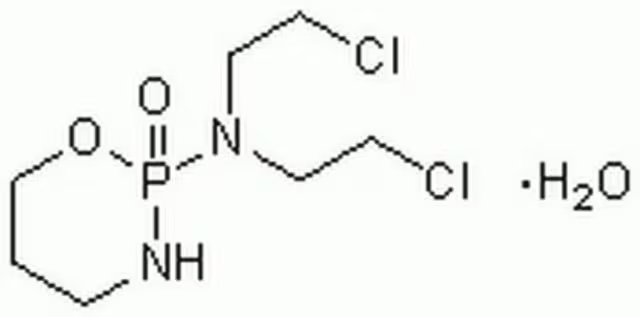
CAS Number6055-19-2
SynonymsCCRIS 7469 {Hydrate}; MFCD00149395; Cytoxan; N,N-bis(2-chloroethyl)-1,3,2-oxazaphosphinan-2-amine 2-oxide hydrate; 2H-1,3,2-Oxazaphosphorine, 2-[bis(2-chloroethyl)amino]tetrahydro-, 2-oxide, monohydrate; Cyclophosphamide Monohydrate; EINECS 200-015-4; UNII-8N3DW7272P; 2H-1,3,2-Oxazaphosphorin-2-amine, N,N-bis(2-chloroethyl)tetrahydro-, 2-oxide, hydrate (1:1); CYCLOPHOSPHAMIDE HYDRATE; N,N-Bis(2-chloroethyl)-1,3,2-oxazaphosphinan-2-amine 2-oxide hydrate (1:1); Endoxon; N,N-bis(2-chloroethyl)-2-oxo-1,3,2λ<sup>5</sup>-oxazaphosphinan-2-amine,hydrate; Cyclophosphamide (hydrate)
Molecular FormulaC7H17Cl2N2O3P
Molecular Weight261.09 (anhydrous basis)
Purity≥98 (HPLC)%
Boiling Point336.1ºC at 760 mmHg
Melting Point49-51 °C(lit.)
Appearancesolid
Symbol
Signal WordWarning
| Chemical & Physical Properties | |
|---|---|
| CAS Number | 6055-19-2 |
| Catalog No. | 2A-9007467 |
| Chinese Name | 环磷酰胺,一水 |
| Synonyms | CCRIS 7469 {Hydrate}; MFCD00149395; Cytoxan; N,N-bis(2-chloroethyl)-1,3,2-oxazaphosphinan-2-amine 2-oxide hydrate; 2H-1,3,2-Oxazaphosphorine, 2-[bis(2-chloroethyl)amino]tetrahydro-, 2-oxide, monohydrate; Cyclophosphamide Monohydrate; EINECS 200-015-4; UNII-8N3DW7272P; 2H-1,3,2-Oxazaphosphorin-2-amine, N,N-bis(2-chloroethyl)tetrahydro-, 2-oxide, hydrate (1:1); CYCLOPHOSPHAMIDE HYDRATE; N,N-Bis(2-chloroethyl)-1,3,2-oxazaphosphinan-2-amine 2-oxide hydrate (1:1); Endoxon; N,N-bis(2-chloroethyl)-2-oxo-1,3,2λ<sup>5</sup>-oxazaphosphinan-2-amine,hydrate; Cyclophosphamide (hydrate) |
| Molecular Formula | C7H17Cl2N2O3P |
| Molecular Weight | 261.09 (anhydrous basis) |
| Purity | ≥98 (HPLC) |
| Boiling Point | 336.1ºC at 760 mmHg |
| Melting Point | 49-51 °C(lit.) |
| Appearance | solid |
| Water Solubility | 40 g/L |
| Storage Condition | Keep away from light, cool and dry place, sealed a |
| Packaging | II |
| Application | Cyclophosphamide hydrate is a synthetic DNA Alkylator, chemically related to nitrogen mustards, and has anti-tumor and immunosuppressive activities. |
| HTC | 2924299090 |
| UN(IATA) | UN3464 |
| MDL Number | MFCD00149395 |
| SMILES | [P]1(=O)(NCCCO1)N(CCCl)CCCl.O |
| InChI | 1S/C7H15Cl2N2O2P.H2O/c8-2-5-11(6-3-9)14(12)10-4-1-7-13-14;/h1-7H2,(H,10,12);1H2 |
| InChI Key | PWOQRKCAHTVFLB-UHFFFAOYSA-N |
| NACRES Code | NA.77 |
| UNSPSC | 51112507 |
| Hazard Symbols | 6.1 |
| Risk Codes | R25;R36/37/38;R45;R46;R61 |
| Safety Description | S26;S37/39;S45;S53 |
| MSDS | msds/7467_1_6055_19_2.pdf |
| Bioactivity | Cyclophosphamide hydrate is a synthetic alkylating agent chemically related to the nitrogen mustards with antineoplastic and immunosuppressive activities. Related Catalog Signaling Pathways >> Cell Cycle/DNA Damage >> DNA Alkylator/Crosslinker Research Areas >> Cancer In Vitro Cyclophosphamide induces outer membrane blebbing, leads to DNA fragmentation, as revealed by TUNEL staining of free 3'-OH DNA ends, and induces cleavage of the caspase 3 and caspase 7 substrate PARP in 9L/P450 cells. Bcl-2 expression fully blocks the activation of both initiator caspases as well as the effector caspase 3 in cells treated with activated Cyclophosphamide. Bcl-2 inhibits the cytotoxic effects but not the cytostatic effects of activated Cyclophosphamide[1]. Cyclophosphamide inhibits the AChE reversibly with an IC50 of 511 μM[2]. Carbon tetrachloride does not affect the direct cytotoxicity of cyclophosphamide or 4-hydroxycyclophosphamide to cells in culture[3]. Kinase Assay 9L cells are treated with drug for the times indicated in each experiment. Floating and attached cells are collected, pooled, resuspended in lysis buffer (10 mM HEPES buffer, pH 7.4, containing 2 mM EDTA, 0.1% CHAPS detergent, 5 mM DTT, 350 ng/mL phenylmethylsulfonyl fluoride, 10 ng/mL pepstatin A, 10 ng/mL aprotinin, and 20 ng/mL leupeptin) and lysed by three freeze-thaw cycles (alternating between a dry ice isopropanol bath and a 37°C water bath). Lysates are spun in a bench top centrifuge at full speed for 15 min and the supernatant (cell extract) fraction transferred to a new tube. Cell extracts (20 μL) are assayed for caspase 9, caspase 8, and caspase 3 activity by incubation at 37°C for either 1 h (caspase 3) or 3 h (caspase 9 and caspase 8) in 500 μL of reaction buffer (10 mM HEPES, pH 7.4, 2 mM EDTA, 0.1% CHAPS, and 5 mM DTT) containing 50 μM caspase form-selective substrate: Ac-LETD-AFC for caspase 8; Ac-LEHD-AFC for caspase 9; and Ac-DEVD-AMC for caspase 3. Background activity is determined for each sample as follows. Cell extracts are preincubated for 15 min at room temperature, with or without caspase form-selective inhibitor: 1 μM z-LETD-FMK for caspase 8, 1 μM z-LEHD-FMK for caspase 9, and 5 μL of Casputin for caspase 3. Caspase activity measured in the absence of inhibitor is divided by the background caspase activity measured in the presence of inhibitor. A value of 1 is subtracted from each measured activity, such that a caspase activity of 0 corresponds to no increase in the specific caspase activity with drug treatment. Fluorescence of the caspase product (excitation at 395 nm and emission at 525 nm for AFC substrates, and excitation at 380 nm and emission at 460 nm for the AMC substrate) is measured using a Shimadzu model RF-1501 spectrofluorophotometer and the manufacturer's PC-1501 software package. Cell Assay 9L/pBabe, 9L/Bax, and 9L/Bcl-2 cells are treated with 12, 24, or 50 μM MFA for 72 h. Cells remaining on the plates at 0, 24, 48, and 72 h are washed twice with cold PBS and then stained for 5 min with crystal violet [1.25 g of crystal violet dissolved in a solution containing 50 mL of 37% formaldehyde and 450 mL of methanol]. The stained cells are washed three times in tap water and the plates are allowed to dry. The stain is eluted from the cells with 70% ethanol and the absorbance is then read at 595 nm. The staining intensity of each drug-treated sample (A 595) is then graphed as a percentage of the staining intensity at the 0-h time point. References [1]. Schwartz PS, et al. Cyclophosphamide induces caspase 9-dependent apoptosis in 9L tumor cells. Mol Pharmacol. 2001 Dec;60(6):1268-1279. [2]. al-Jafari AA, et al. Inhibition of human acetylcholinesterase by cyclophosphamide. Toxicology. 1995 Jan 19;96(1):1-6. [3]. Harris RN, et al. Carbon tetrachloride-induced increase in the antitumor activity of cyclophosphamide in mice: a pharmacokineticstudy. Cancer Chemother Pharmacol. 1984;12(3):167-72. Chemical & Physical Properties Boiling Point 336.1ºC at 760 mmHg Melting Point 49-51 °C(lit.) Molecular Formula C7H17Cl2N2O3P Molecular Weight 279.101 Flash Point >230 °F Exact Mass 278.035370 PSA 60.61000 LogP 2.14850 InChIKey PWOQRKCAHTVFLB-UHFFFAOYSA-N SMILES O.O=P1(N(CCCl)CCCl)NCCCO1 Storage condition 2-8°C Water Solubility 40 g/L |
| Use of | Cyclophosphamide hydrate is a synthetic alkylating agent chemically related to the nitrogen mustards with antineoplastic and immunosuppressive activities. Properties Articles155 Name cyclophosphamide hydrate Synonym More Synonyms Cyclophosphamide (hydrate) Biological Activity Description Cyclophosphamide hydrate is a synthetic alkylating agent chemically related to the nitrogen mustards with antineoplastic and immunosuppressive activities. Related Catalog Signaling Pathways >> Cell Cycle/DNA Damage >> DNA Alkylator/Crosslinker Research Areas >> Cancer References [2]. al-Jafari AA, et al. Inhibition of human acetylcholinesterase by cyclophosphamide. Toxicology. 1995 Jan 19;96(1):1-6. [3]. Harris RN, et al. Carbon tetrachloride-induced increase in the antitumor activity of cyclophosphamide in mice: a pharmacokineticstudy. Cancer Chemother Pharmacol. 1984;12(3):167-72. Chemical & Physical Properties Exact Mass 278.035370 PSA 60.61000 LogP 2.14850 InChIKey PWOQRKCAHTVFLB-UHFFFAOYSA-N SMILES O.O=P1(N(CCCl)CCCl)NCCCO1 |
| Tax Rebate | 13.0% |
| Supervision | None. MFN tariff: 6.5%. Ordinary tariff: 20.0% |
| Transport Info | Shipping Name: UN |
| MSDS Transport Info | Module 14. Shipping information 14.1 UN dangerous goods number European Land Transport Danger Regulations: 3464 International Maritime Transport Danger Regulations: 3464 International Air Transport Danger Regulations: 3464 14.2 United Nations shipping name European land transport hazard regulations: ORGANOPHOSPHORUS COMPOUND, SOLID, TOXIC, N.O.S. (Cyclophosphamide monohydrate) IMDG Code: ORGANOPHOSPHORUS COMPOUND, SOLID, TOXIC, N.O.S. (Cyclophosphamide monohydrate) International air transport hazard regulations: Organophosphorus compound, solid, toxic, n.o.s. (Cyclophosphamide monohydrate) 14.3 Transport hazard categories European Land Transport Danger Regulations: 6.1 International Maritime Transport Danger Regulations: 6.1 International Air Transport Danger Regulations: 6.1 14.4 Package group European Land Transport Danger Regulations: III International Maritime Transport Danger Regulations: III International Air Transport Danger Regulations: III 14.5 Environmental hazards European Land Transport Danger Regulations: No International Maritime Danger Regulations International Air Transport Danger Regulations: No Marine pollutants (yes/no): No 14.6 Special reminder to users No data available |
| Related Products in API & Advanced Intermediates | ||
|---|---|---|
| 8-Hydroxywarfarin | 17834-04-7 | 2A-9007026 |
| 9-Dihydroestradiol | 791-69-5 | 2A-9007043 |
| Clindamycin 3,4-isopropylidene | 2A-107431 | 2A-9007431 |
| Colchicine salicylate | 2A-107438 | 2A-9007438 |
| Colchicine, [ring C, methoxy-14C] | 2A-107439 | 2A-9007439 |
| D,L-Venlafaxine | 93413-69-5 | 2A-9007501 |
| Desogestrel | 54024-22-5 | 2A-9007528 |
| Dexamethasone | 50-02-2 | 2A-9007530 |
| 1,1-Dimethylbiguanide hydrochloride; Metformin hydrochloride | 1115-70-4 | 2A-9007542 |
| Diazepam | 439-14-5 | 2A-9007548 |
| Browse all API & Advanced Intermediates products » | ||
Phone:
630-322-8886
630-322-8887
Email:
Office Locations:
Chicago, IL, USA
San Francisco, CA, USA


 EN
EN


 SDS
SDS