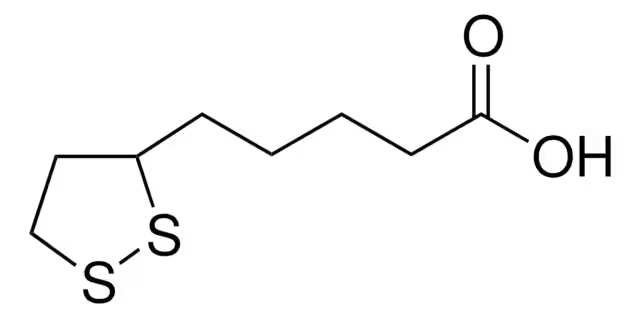
CAS Number1077-28-7
Synonyms(S)-5-(1,2-Dithiolan-3-yl)pentanoic acid; Thioctic acid; 5-[(3S)-Dithiolan-3-yl]pentanoic acid; (S)-6,8-Thioctic acid (S)-1,2-Dithiolane-3-pentanoic acid; DL-Thioctic acid; 5-(1,2-Dithiolan-3-yl)pentanoic acid; DL-α-Lipoic acid; (±)-α-Lipoic acid; 5-(dithiolan-3-yl)pentanoic acid; 6,8-Dithiooctanoic acid; MFCD00005474; 1,2-Dithiolane-3-pentanoic acid; (±)-1,2-Dithiolane-3-pentanoic acid; (±)-1,2-Dithiolane-3-valeric acid; 6,8-Dihydrothioctic acid; lipoic acid; UNII:73Y7P0K73Y; DL-6,8-Thioctic acid; EINECS 214-071-2; α-Lipoic Acid
Molecular FormulaC8H14O2S2
Molecular Weight206.33
Purity≥98.0 (HPLC)%
Density1.2±0.1 g/cm3
Boiling Point>286 °C/1.013 hPa
Melting Point60-62 °C
Appearancesolid
EINECS214-071-2
Symbol
Signal WordWarning
| Chemical & Physical Properties | |
|---|---|
| CAS Number | 1077-28-7 |
| Catalog No. | 2A-0202056 |
| Chinese Name | 硫辛酸 |
| Synonyms | (S)-5-(1,2-Dithiolan-3-yl)pentanoic acid; Thioctic acid; 5-[(3S)-Dithiolan-3-yl]pentanoic acid; (S)-6,8-Thioctic acid (S)-1,2-Dithiolane-3-pentanoic acid; DL-Thioctic acid; 5-(1,2-Dithiolan-3-yl)pentanoic acid; DL-α-Lipoic acid; (±)-α-Lipoic acid; 5-(dithiolan-3-yl)pentanoic acid; 6,8-Dithiooctanoic acid; MFCD00005474; 1,2-Dithiolane-3-pentanoic acid; (±)-1,2-Dithiolane-3-pentanoic acid; (±)-1,2-Dithiolane-3-valeric acid; 6,8-Dihydrothioctic acid; lipoic acid; UNII:73Y7P0K73Y; DL-6,8-Thioctic acid; EINECS 214-071-2; α-Lipoic Acid |
| Molecular Formula | C8H14O2S2 |
| Molecular Weight | 206.33 |
| Purity | ≥98.0 (HPLC) |
| Density | 1.2±0.1 g/cm3 |
| Boiling Point | >286 °C/1.013 hPa |
| Melting Point | 60-62 °C |
| Appearance | solid |
| Water Solubility | ethanol: 50 mg/mL | 0.9 g/L (20 ºC) |
| Storage Condition | Sealed and refrigerated |
| Application | Alpha-Lipoic Acid is an antioxidant and an important cofactor for mitochondrial enzyme complexes. α-Lipoic Acid inhibits NF-κB-dependent HIV-1 LTR activation. |
| EINECS | 214-071-2 |
| HTC | 2934999090 |
| PubChem ID | 57651855 |
| MDL Number | MFCD00005474 |
| SMILES | [OC(=O)CCCCC1CCSS1] |
| InChI | [1S/C8H14O2S2/c9-8(10)4-2-1-3-7-5-6-11-12-7/h7H,1-6H2,(H,9,10)] |
| InChI Key | [AGBQKNBQESQNJD-UHFFFAOYSA-N] |
| Beilstein/REAXYS | 81853 |
| NACRES Code | NA.21 |
| UNSPSC | 12352100 |
| Hazard Symbols | Transport |
| Risk Codes | R22 |
| Safety Description | S24/25 |
| MSDS | msds/7099_1_1077_28_7.pdf |
| Bioactivity | α-Lipoic Acid is an antioxidant, which is an essential cofactor of mitochondrial enzyme complexes. α-Lipoic Acid inhibits NF-κB-dependent HIV-1 LTR activation. Related Catalog Signaling Pathways >> Anti-infection >> HIV Signaling Pathways >> Metabolic Enzyme/Protease >> Mitochondrial Metabolism Natural Products >> Acids and Aldehydes Research Areas >> Cancer Research Areas >> Inflammation/Immunology Research Areas >> Infection Target NF-κB HIV Mitochondrial bioenergetics In Vitro The long terminal repeat (LTR) of HIV-1 is the target of cellular transcription factors such as NF-κB, and serves as the promoter-enhancer for the viral genome when integrated in host DNA[1]. α-Lipoic Acid (Alpha-Lipoic acid, ALA), a naturally occurring dithiol compound, plays an essential role in mitochondrial bioenergetics. α-Lipoic Acid reduces lipid accumulation in the liver by regulating the transcriptional factors SREBP-1, FoxO1, and Nrf2, and their downstream lipogenic targets via the activation of the SIRT1/LKB1/AMPK pathway. Treatment of cells with α-Lipoic Acid (250, 500 and 1000 μM) significantly increases the NAD+/NADH ratio in HepG2 cells (P<0.05 or P<0.01). Treatment with α-Lipoic Acid (50, 125, 250 and 500 μM) increases SIRT1 activity in HepG2 cells. α-Lipoic Acid (50, 125, 250, 500 and 1000 μM) increases phosphorylation of AMPK and acetyl-CoA carboxylase (ACC) in HepG2 cells in a dose-dependent fashion[1]. In Vivo C57BL/6J mice, divided into four groups, are fed an high-fat diet (HFD) for 24 weeks to induce nonalcoholic fatty liver disease (NAFLD) followed by daily administration of α-Lipoic Acid. Then, the effects of α-Lipoic Acid on hepatic lipid accumulation in long-term HFD-fed mice are assessed. Administration of α-Lipoic Acid (100 mg/kg or 200 mg/kg) markedly reduces visceral fat mass in mice. In addition, α-Lipoic Acid (100 mg/kg or 200 mg/kg) treatment inhibits the appetite and causes a dramatic weight loss (all P<0.05)[1]. Cell Assay The human hepatocellular carcinoma (HepG2) cell line is cultured in Dulbecco's modified Eagle's medium containing 10% fetal bovine serum at 37°C and 5% CO2. HepG2 cells are treated with AMPK inhibitor (CC, 20 μM, 0.5 h), SIRT1 inhibitor (NA, 10 mM, 12 or 24 h), and AMPK activator (AICAR, 2 mM, 1 h), Palmitate (PA, 125 μM, 12 h) and α-Lipoic Acid (250 μM, 6 or 12 h)[1]. Animal Admin Mice[1] Male C57BL/6J mice (6-week-old; body weight: 22-24 g) are allowed ad libitum access to normal diet and water for 2 weeks before dividing into four groups (n=8): normal diet (ND) (10% energy from fat), high-fat diet (HFD) (60% energy from fat) and HFD plus α-Lipoic Acid (100 mg/kg or 200 mg/kg). After 24 weeks of treatment, blood samples are collected after the eyeballs of the mice are extracted for serum preparation by centrifugation at 2000×g for 10 min at 4°C. The liver tissues are harvested in liquid nitrogen and stored at -80°C. References [1]. Xiao L, et al. Activity of the dietary antioxidant ergothioneine in a virus gene-based assay for inhibitors of HIV transcription. Biofactors. 2006;27(1-4):157-65. [2]. Yang Y, et al. Alpha-lipoic acid improves high-fat diet-induced hepatic steatosis by modulating the transcription factors SREBP-1, FoxO1 and Nrf2 via the SIRT1/LKB1/AMPK pathway. J Nutr Biochem. 2014 Nov;25(11):1207-1217. [3]. Lei D, et al. Synergistic neuroprotective effect of rasagiline and idebenone against retinal ischemia-reperfusion injury via the Lin28-let-7-Dicer pathway. Oncotarget. 2018 Jan 30;9(15):12137-12153. Chemical & Physical Properties Density 1.2±0.1 g/cm3 Boiling Point 362.5±11.0 °C at 760 mmHg Melting Point 60-62ºC Molecular Formula C8H14O2S2 Molecular Weight 206.326 Flash Point 173.0±19.3 °C Exact Mass 206.043518 PSA 87.90000 LogP 2.16 Vapour Pressure 0.0±1.7 mmHg at 25°C Index of Refraction 1.562 InChIKey AGBQKNBQESQNJD-UHFFFAOYSA-N SMILES O=C(O)CCCCC1CCSS1 Storage condition 2-8°C Stability Stable. Incompatible with strong oxidizing agents. Water Solubility ethanol: 50 mg/mL | 0.9 g/L (20 ºC) |
| Use of | Properties Articles39 Name DL-Thioctic Acid Synonym More Synonyms α-Lipoic Acid Biological Activity Related Catalog Signaling Pathways >> Anti-infection >> HIV Signaling Pathways >> Metabolic Enzyme/Protease >> Mitochondrial Metabolism Natural Products >> Acids and Aldehydes Research Areas >> Cancer Research Areas >> Inflammation/Immunology Research Areas >> Infection Mitochondrial bioenergetics References [1]. Xiao L, et al. Activity of the dietary antioxidant ergothioneine in a virus gene-based assay for inhibitors of HIV transcription. Biofactors. 2006;27(1-4):157-65. [3]. Lei D, et al. Synergistic neuroprotective effect of rasagiline and idebenone against retinal ischemia-reperfusion injury via the Lin28-let-7-Dicer pathway. Oncotarget. 2018 Jan 30;9(15):12137-12153. Chemical & Physical Properties Molecular Formula C8H14O2S2 Exact Mass 206.043518 PSA 87.90000 Index of Refraction 1.562 InChIKey AGBQKNBQESQNJD-UHFFFAOYSA-N Stability Stable. Incompatible with strong oxidizing agents. |
| Tax Rebate | 13.0% |
| Supervision | None. MFN tariff: 6.5%. Ordinary tariff: 20.0% |
| Transport Info | Product name: Purity: 98.0% |
| MSDS Transport Info | Module 14. Shipping information 14.1 UN dangerous goods number European Land Transport Dangerous Regulations: -International Maritime Dangerous Regulations: -International Air Transport Dangerous Regulations: - 14.2 Names specified by the United Nations (UN) European Land Transport Dangerous Regulations: Non-dangerous goods IMDG Code: Non-dangerous goods International air transport dangerous goods regulations: non-dangerous goods 14.3 Transport hazard categories European Land Transport Dangerous Regulations: -International Maritime Dangerous Regulations: -International Air Transport Dangerous Regulations: - 14.4 Package group European Land Transport Dangerous Regulations: -International Maritime Dangerous Regulations: -International Air Transport Dangerous Regulations: - 14.5 Environmental hazards European Land Transport Dangerous Regulations: No International Maritime Transport Dangerous Regulations Maritime Pollutants: No International Air Transport Risk Regulations: No 14.6 Special reminder to users No data available |
| Related Products in Nutritional Ingredients | ||
|---|---|---|
| 4-Iodo-L-phenylalanine | 24250-85-9 | 2A-9005910 |
| 4-Methoxy-L-phenylalanine | 6230-11-1 | 2A-9005938 |
| 4-Oxo-4-(5-oxo-1,4-diazepan-1-yl)butanoic acid | 397244-77-8 | 2A-9006075 |
| 5-Oxo-[1,4]diazepane-1-carboxylic acid benzylester | 18158-16-2 | 2A-9006638 |
| N-Acetyl-DL-tryptophan; Ac-DL-Trp-OH | 87-32-1 | 2A-9007054 |
| Ascorbic acid 2-phosphate magnesium ester | 113170-55-1 | 2A-9007124 |
| Bucladesine | 16980-89-5 | 2A-9007348 |
| Calcium phosphorylcholine chloride | 4826-71-5 | 2A-9007357 |
| Carbamyl-beta-methylcholine chloride | 590-63-6 | 2A-9007361 |
| Choline chloride | 67-48-1 | 2A-9007402 |
| Browse all Nutritional Ingredients products » | ||
Phone:
630-322-8886
630-322-8887
Email:
Office Locations:
Chicago, IL, USA
San Francisco, CA, USA


 EN
EN


 SDS
SDS