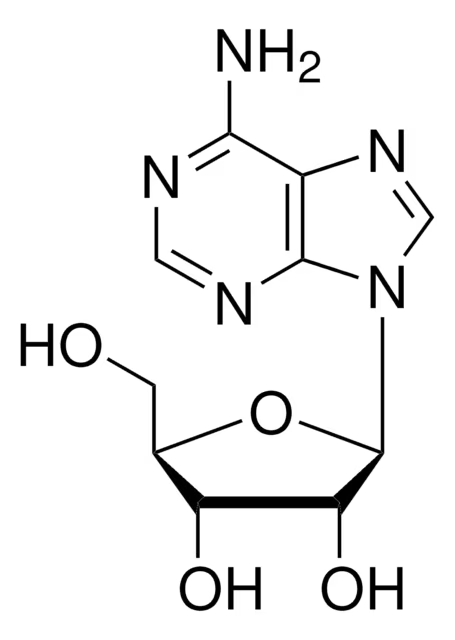
CAS Number58-61-7
Synonyms(2R,3R,4S,5R)-2-(6-amino-9H-purin-9-yl)-5-(hydroxymethyl)tetrahydrofuran-3,4-diol; Adenosin; 9β-D-ribofuranosyl-9H-Purin-6-amine; Adesine; 1-(6-amino-9H-purin-9-yl)-1-deoxy-β-D-Ribofuranose; 6-Amino-9-b-D-ribofuranosyl-9H-purine; Adenocor; Sandesin; (2R,3R,4S,5R)-2-(6-Amino-9H-purin-9-yl)-5-(hydroxymethyl)tetrahydro-3,4-furandiol; 9-β-δ-Ribofuranosidoadenine; (-)-adenosine; 9-β-δ-Ribofuranosyl-9H-purin-6-amine; (-)-adenosine; 9-b-D-Ribofuranosidoadenine; D-Adenosine; MFCD00005752; Adenosine; Adenine-9-beta-D-ribofuranoside; Adrekar; 9-β-D-Ribofuranosyladenine; 9-beta-D-Ribofuranosyladenine; 9-b-D-Ribofuranosyl-9H-purin-6-amine; Boniton; Adenine riboside; Adenoscan; adenine-9β-D-Ribofuranoside; Adenocard; EINECS 200-389-9; 9-β-D-Arabinofuranosyladenine; Myocol
Molecular FormulaC10H13N5O4
Molecular Weight267.24
Purity≥99%
Density2.1±0.1 g/cm3
Boiling Point676.3±65.0 °C at 760 mmHg
Melting Point234-236 °C (lit.)
Appearancepowder
EINECS200-389-9
Symbol
Signal WordWarning
| Chemical & Physical Properties | |
|---|---|
| CAS Number | 58-61-7 |
| Catalog No. | 2A-9007075 |
| Chinese Name | 腺苷 |
| Synonyms | (2R,3R,4S,5R)-2-(6-amino-9H-purin-9-yl)-5-(hydroxymethyl)tetrahydrofuran-3,4-diol; Adenosin; 9β-D-ribofuranosyl-9H-Purin-6-amine; Adesine; 1-(6-amino-9H-purin-9-yl)-1-deoxy-β-D-Ribofuranose; 6-Amino-9-b-D-ribofuranosyl-9H-purine; Adenocor; Sandesin; (2R,3R,4S,5R)-2-(6-Amino-9H-purin-9-yl)-5-(hydroxymethyl)tetrahydro-3,4-furandiol; 9-β-δ-Ribofuranosidoadenine; (-)-adenosine; 9-β-δ-Ribofuranosyl-9H-purin-6-amine; (-)-adenosine; 9-b-D-Ribofuranosidoadenine; D-Adenosine; MFCD00005752; Adenosine; Adenine-9-beta-D-ribofuranoside; Adrekar; 9-β-D-Ribofuranosyladenine; 9-beta-D-Ribofuranosyladenine; 9-b-D-Ribofuranosyl-9H-purin-6-amine; Boniton; Adenine riboside; Adenoscan; adenine-9β-D-Ribofuranoside; Adenocard; EINECS 200-389-9; 9-β-D-Arabinofuranosyladenine; Myocol |
| Molecular Formula | C10H13N5O4 |
| Molecular Weight | 267.24 |
| Purity | ≥99 |
| Density | 2.1±0.1 g/cm3 |
| Boiling Point | 676.3±65.0 °C at 760 mmHg |
| Melting Point | 234-236 °C (lit.) |
| Appearance | powder |
| Storage Condition | Store in an argon-sealed, dry, and dark place at 4 |
| Inventory | 2 x 20kg |
| EINECS | 200-389-9 |
| HTC | 2934999090 |
| PubChem ID | 24277685 |
| MDL Number | MFCD00005752 |
| SMILES | Nc1ncnc2n(cnc12)[C@@H]3O[C@H](CO)[C@@H](O)[C@H]3O |
| InChI | 1S/C10H13N5O4/c11-8-5-9(13-2-12-8)15(3-14-5)10-7(18)6(17)4(1-16)19-10/h2-4,6-7,10,16-18H,1H2,(H2,11,12,13)/t4-,6-,7-,10-/m1/s1 |
| InChI Key | OIRDTQYFTABQOQ-KQYNXXCUSA-N |
| Beilstein/REAXYS | 93029 |
| NACRES Code | NA.77 |
| eCl@ss | 32160413 |
| UNSPSC | 12352200 |
| Hazard Symbols | Transport |
| MSDS | msds/7075_1_58_61_7.pdf |
| Bioactivity | Adenosine is a nucleoside composed of a molecule of adenine attached to a ribose sugar molecule (ribofuranose) moiety via a β-N9-glycosidic bond.Target: Nucleoside antimetabolite/analogAdenosine plays an important role in biochemical processes, such as energy transfer - as adenosine triphosphate (ATP) and adenosine diphosphate (ADP) - as well as in signal transduction as cyclic adenosine monophosphate, cAMP. It is also an inhibitory neurotransmitter, believed to play a role in promoting sleep and suppressing arousal. Adenosine also plays a role in regulation of blood flow to various organs through vasodilation.Adenosine is an endogenous purine nucleoside that modulates many physiological processes. Cellular signaling by adenosine occurs through four known adenosine receptor subtypes. Extracellular adenosine concentrations from normal cells are approximately 300 nM; however, in response to cellular damage (e.g. in inflammatory or ischemic tissue), these concentrations are quickly elevated (600-1,200 nM). Thus, in regard to stress or injury, the function of adenosine is primarily that of cytoprotection preventing tissue damage during instances of hypoxia, ischemia, and seizure activity. Activation of A2A receptors produces a constellation of responses that in general can be classified as anti-inflammatory. Related Catalog Signaling Pathways >> Autophagy >> Autophagy Signaling Pathways >> Cell Cycle/DNA Damage >> Nucleoside Antimetabolite/Analog Research Areas >> Metabolic Disease Natural Products >> Saccharides and Glycosides Target Human Endogenous Metabolite References [1]. Sato A, et al. Mechanism of vasodilation to adenosine in coronary arterioles from patients with heart disease. Am J Physiol Heart Circ Physiol. 2005 Apr;288(4):H1633-40. [2]. Costa F, et al. Role of nitric oxide in adenosine-induced vasodilation in humans. Hypertension. 1998 May;31(5):1061-4. Chemical & Physical Properties Density 2.1±0.1 g/cm3 Boiling Point 676.3±65.0 °C at 760 mmHg Melting Point 234-236ºC Molecular Formula C10H13N5O4 Molecular Weight 267.241 Flash Point 362.8±34.3 °C Exact Mass 267.096741 PSA 139.54000 LogP -1.02 Vapour Pressure 0.0±2.2 mmHg at 25°C Index of Refraction 1.907 InChIKey OIRDTQYFTABQOQ-KQYNXXCUSA-N SMILES Nc1ncnc2c1ncn2C1OC(CO)C(O)C1O Stability Stable. Incompatible with strong oxidizing agents. |
| Use of | Adenosine is a nucleoside composed of a molecule of adenine attached to a ribose sugar molecule (ribofuranose) moiety via a β-N9-glycosidic bond.Target: Nucleoside antimetabolite/analogAdenosine plays an important role in biochemical processes, such as energy transfer - as adenosine triphosphate (ATP) and adenosine diphosphate (ADP) - as well as in signal transduction as cyclic adenosine monophosphate, cAMP. It is also an inhibitory neurotransmitter, believed to play a role in promoting sleep and suppressing arousal. Adenosine also plays a role in regulation of blood flow to various organs through vasodilation.Adenosine is an endogenous purine nucleoside that modulates many physiological processes. Cellular signaling by adenosine occurs through four known adenosine receptor subtypes. Extracellular adenosine concentrations from normal cells are approximately 300 nM; however, in response to cellular damage (e.g. in inflammatory or ischemic tissue), these concentrations are quickly elevated (600-1,200 nM). Thus, in regard to stress or injury, the function of adenosine is primarily that of cytoprotection preventing tissue damage during instances of hypoxia, ischemia, and seizure activity. Activation of A2A receptors produces a constellation of responses that in general can be classified as anti-inflammatory. Properties Articles551 Name adenosine Synonym More Synonyms Adenosine Biological Activity Description Adenosine is a nucleoside composed of a molecule of adenine attached to a ribose sugar molecule (ribofuranose) moiety via a β-N9-glycosidic bond.Target: Nucleoside antimetabolite/analogAdenosine plays an important role in biochemical processes, such as energy transfer - as adenosine triphosphate (ATP) and adenosine diphosphate (ADP) - as well as in signal transduction as cyclic adenosine monophosphate, cAMP. It is also an inhibitory neurotransmitter, believed to play a role in promoting sleep and suppressing arousal. Adenosine also plays a role in regulation of blood flow to various organs through vasodilation.Adenosine is an endogenous purine nucleoside that modulates many physiological processes. Cellular signaling by adenosine occurs through four known adenosine receptor subtypes. Extracellular adenosine concentrations from normal cells are approximately 300 nM; however, in response to cellular damage (e.g. in inflammatory or ischemic tissue), these concentrations are quickly elevated (600-1,200 nM). Thus, in regard to stress or injury, the function of adenosine is primarily that of cytoprotection preventing tissue damage during instances of hypoxia, ischemia, and seizure activity. Activation of A2A receptors produces a constellation of responses that in general can be classified as anti-inflammatory. Related Catalog Signaling Pathways >> Autophagy >> Autophagy Signaling Pathways >> Cell Cycle/DNA Damage >> Nucleoside Antimetabolite/Analog Research Areas >> Metabolic Disease Natural Products >> Saccharides and Glycosides Human Endogenous Metabolite References [1]. Sato A, et al. Mechanism of vasodilation to adenosine in coronary arterioles from patients with heart disease. Am J Physiol Heart Circ Physiol. 2005 Apr;288(4):H1633-40. [2]. Costa F, et al. Role of nitric oxide in adenosine-induced vasodilation in humans. Hypertension. 1998 May;31(5):1061-4. Chemical & Physical Properties Molecular Formula C10H13N5O4 Exact Mass 267.096741 PSA 139.54000 LogP -1.02 Index of Refraction 1.907 InChIKey OIRDTQYFTABQOQ-KQYNXXCUSA-N Stability Stable. Incompatible with strong oxidizing agents. |
| Tax Rebate | 13.0% |
| Supervision | None. MFN tariff: 6.5%. Ordinary tariff: 20.0% |
| Transport Info | Product name: Purity: 0.0% |
| MSDS Transport Info | Module 14. Shipping information 14.1 UN dangerous goods number European Land Transport Dangerous Regulations: -International Maritime Dangerous Regulations: -International Air Transport Dangerous Regulations: - 14.2 Names specified by the United Nations (UN) European Land Transport Dangerous Regulations: Non-dangerous goods IMDG Code: Non-dangerous goods International air transport dangerous goods regulations: non-dangerous goods 14.3 Transport hazard categories European Land Transport Dangerous Regulations: -International Maritime Dangerous Regulations: -International Air Transport Dangerous Regulations: - 14.4 Package group European Land Transport Dangerous Regulations: -International Maritime Dangerous Regulations: -International Air Transport Dangerous Regulations: - 14.5 Environmental hazards European Land Transport Dangerous Regulations: No International Maritime Transport Dangerous Regulations Maritime Pollutants: No International Air Transport Risk Regulations: No 14.6 Special reminder to users No data available |
| Related Products in Biotechnology & Diagnostics | ||
|---|---|---|
| 6-Chloroguanosine | 2004-07-1 | 2A-9006803 |
| 6-Thioguanosine | 85-31-4 | 2A-9006902 |
| 8-Aminoguanosine | 3868-32-4 | 2A-9007005 |
| 8-Bromoadenosine | 2946-39-6 | 2A-9007010 |
| 8-Bromoguanosine | 4016-63-1 | 2A-9007011 |
| Adenosine 5'-diphosphate | 58-64-0 | 2A-9007076 |
| Adenosine 5'-monophosphate disodium salt | 4578-31-8 | 2A-9007077 |
| Adenosine 5'-monophosphate free acid | 61-19-8 | 2A-9007078 |
| Adenosine 5'-monophosphate sodium salt | 13474-03-8 | 2A-9007079 |
| Adenosine 5'-triphosphate, disodium salt | 987-65-5 | 2A-9007080 |
| Browse all Biotechnology & Diagnostics products » | ||
Phone:
630-322-8886
630-322-8887
Email:
Office Locations:
Chicago, IL, USA
San Francisco, CA, USA


 EN
EN


 SDS
SDS