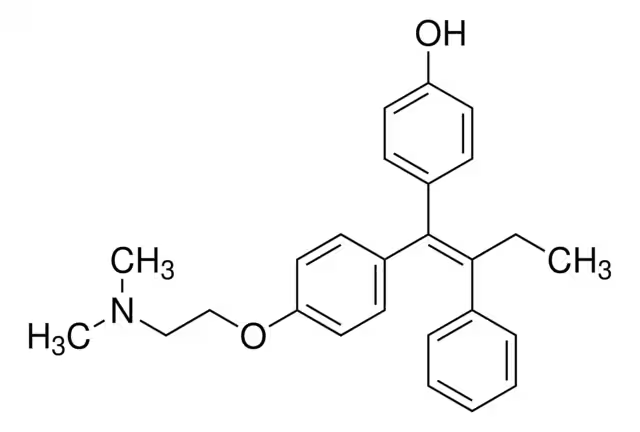
CAS Number68047-06-3
SynonymsMFCD00278780; 4-hydroxytamoxifen; 4-[(1Z)-1-{4-[2-(Dimethylamino)ethoxy]phenyl}-1-phenyl-1-buten-2-yl]phenol; 4-{(1Z)-1-[{4-[2-(dimethylamino)ethoxy]phenyl}(phenyl)methylidene]propyl}phenol; 4-{(1Z)-1-[{4-[2-(dimethylamino)ethoxy]phenyl}(phenyl)methylene]propyl}phenol; 4-hydroxy-tamoxifen
Molecular FormulaC26H29NO2
Molecular Weight387.51
Purity97.00%
Density1.1±0.1 g/cm3
Boiling Point514.4±50.0 °C at 760 mmHg
Melting Point105-107ºC
Appearancesolid
Symbol
Signal WordWarning
| Chemical & Physical Properties | |
|---|---|
| CAS Number | 68047-06-3 |
| Catalog No. | 2A-9046695 |
| Chinese Name | 4-羟基三苯氧胺(Z异构体) |
| Synonyms | MFCD00278780; 4-hydroxytamoxifen; 4-[(1Z)-1-{4-[2-(Dimethylamino)ethoxy]phenyl}-1-phenyl-1-buten-2-yl]phenol; 4-{(1Z)-1-[{4-[2-(dimethylamino)ethoxy]phenyl}(phenyl)methylidene]propyl}phenol; 4-{(1Z)-1-[{4-[2-(dimethylamino)ethoxy]phenyl}(phenyl)methylene]propyl}phenol; 4-hydroxy-tamoxifen |
| Molecular Formula | C26H29NO2 |
| Molecular Weight | 387.51 |
| Purity | 97.00 |
| Density | 1.1±0.1 g/cm3 |
| Boiling Point | 514.4±50.0 °C at 760 mmHg |
| Melting Point | 105-107ºC |
| Appearance | solid |
| Water Solubility | 95% ethanol: 20 mg/mL |
| Storage Condition | 2-8°C |
| Application | 4-Hydroxytamoxifen is a selective estrogen receptor modulator (SERM). |
| PubChem ID | 7494 |
| SMILES | CCC(=C(c1ccc(O)cc1)c1ccc(OCCN(C)C)cc1)c1ccccc1 |
| InChI | InChI=1S/C26H29NO2/c1-4-25(20-10-14-23(28)15-11-20)26(21-8-6-5-7-9-21)22-12-16-24(17-13-22)29-19-18-27(2)3/h5-17,28H,4,18-19H2,1-3H3/b26-25- |
| InChI Key | TXUZVZSFRXZGTL-QPLCGJKRSA-N |
| Hazard Symbols | transportation |
| Bioactivity | 4-Hydroxytamoxifen is a selective estrogen receptor modulator (SERM). Related Catalog Signaling Pathways >> Others >> Estrogen Receptor/ERR Research Areas >> Cancer Target Estrogen receptor:3.3 nM (IC50) CRISPR/Cas9 In Vitro 4-Hydroxytamoxifen (Monohydroxytamoxifen) is a selective oestrogen receptor antagonist, with an IC50 of 3.3 nM for the [3H]oestradiol binding to oestrogen receptor. 4-Hydroxytamoxifen (10, 100 nM) enables to inhibit the binding of [3H]oestradiol to the human 8 S oestrogen receptor[1]. 4-Hydroxytamoxifen activates intein-linked inactive Cas9, reduces off-target CRISPR-mediated gene editing. In human cells, conditionally active Cas9s modify target genomic sites with up to 25-fold higher specificity than wild-type Cas9[2]. In Vivo 4-Hydroxytamoxifen (0.2, 1 and 5 μg/day, p.o.) causes a dose-related decrease in uterine wet weight of immature rats[1]. 4-Hydroxytamoxifen (6 μg/0.1 mL sesame oil/day, s.c.) effectively attenuates methamphetamine-induced nigrostriatal dopamine depletions in bothsexes of intact and gonadectomized C57BL/6 J mice. 4-Hydroxytamoxifen does not alter the dopamine content levels in the striatum[3]. Kinase Assay Cytosol (200 μL) is incubated for 30 min at 4°C with different concentrations of oestradiol, tamoxifen and (4-Hydroxytamoxifen) or dihydroxytamoxifen administered in 10 μL methanol. Control tubes are incubated with 10 μL methanol alone and non-specific binding is determined in a parallel incubation of cytosol (200 μL) with methanol (10 μL) containing DES (5 × 10⁶ M). [2,4,6,7-3H]Oestradiol solution (50 μL) in TED buffer is added to each tube to give a final concentration of 2 × 10⁻⁹ M. Incubation is continued for 4 h (4°C) and then 400 μL of a suspension of dextran-coated charcoal (250 mg % Norit A, 2.5 mg % dextran) in TED buffer are added and allowed to stand for 20 min. Tubes are centrifuged at 800 g for 10 min (4°C) and 400 μL samples of the supernatant are added to 10 mL tritium scintillator (6 g butyl PBD, 135 mL toluene, 720 ml dioxan, 100 g naphthalene, 45 mL absolute methanol). Samples are counted for 10 min in a liquid scintillation spectrometer. Counting efficiency is determined by external standardization (35-36 %). Results are represented as a percentage of the specifically bound radioactivity (c.p.m.) in the control tubes[1]. Animal Admin Mice[3] Animals of each sex are divided into two groups: one group receives 4-Hydroxytamoxifen [6 μg/0.1 mL sesame oil/day, subcutaneously (s.c.) starting at 06.00 h] injections for three consecutive days, while the other group receives an equivalent amount of sesame oil injection for 3 days. Four hours following the third injection, each group is then subdivided into two groups: one receives four cumulative doses of methamphetamine hydrochloride (10 mg/kg, s.c.), and the other receives a comparable volume of saline at 2-h intervals. Bilateral gonadectomy is performed under pentobarbital anesthesia (50 mg/kg, intraperitoneally). Five weeks after surgery,gonadectomized mice of each sex are randomly divided into six groups. Five groups of each sex receive three daily injections ofvarious concentrations of 4-Hydroxytamoxifen (0, 1.5, 3.0, 6.0, and 12.0 μg/0.1 mL sesame oil/day). Four hours following the third injection, mice receive four doses of methamphetamine (MA, 10 mg/kg) at 2-h intervals. The remaining group of each sex receives sesame oil pretreatment for three consecutive days, followed by saline injections, and serves as the control group[3]. References [1]. Jordan VC, et al. A monohydroxylated metabolite of tamoxifen with potent antioestrogenic activity. J Endocrinol. 1977 Nov;75(2):305-16. [2]. Davis KM, et al. Small molecule-triggered Cas9 protein with improved genome-editing specificity. Nat Chem Biol. 2015 May;11(5):316-8. [3]. Kuo YM, et al. 4-Hydroxytamoxifen attenuates methamphetamine-induced nigrostriatal dopaminergic toxicity in intact and gonadetomized mice. J Neurochem. 2003 Dec;87(6):1436-43. Chemical & Physical Properties Density 1.1±0.1 g/cm3 Boiling Point 514.4±50.0 °C at 760 mmHg Melting Point 105-107ºC Molecular Formula C26H29NO2 Molecular Weight 387.514 Flash Point 264.9±30.1 °C Exact Mass 387.219818 PSA 32.70000 LogP 7.34 Vapour Pressure 0.0±1.4 mmHg at 25°C Index of Refraction 1.597 InChIKey TXUZVZSFRXZGTL-QPLCGJKRSA-N SMILES CCC(=C(c1ccc(O)cc1)c1ccc(OCCN(C)C)cc1)c1ccccc1 Storage condition 2-8°C Stability Stable. Store cool. Incompatible with strong oxidizing agents. Water Solubility 95% ethanol: 20 mg/mL |
| Use of | 4-Hydroxytamoxifen is a selective estrogen receptor modulator (SERM). Properties Articles55 Name afimoxifene Synonym More Synonyms 4-hydroxytamoxifen Biological Activity Description 4-Hydroxytamoxifen is a selective estrogen receptor modulator (SERM). Related Catalog Signaling Pathways >> Others >> Estrogen Receptor/ERR Research Areas >> Cancer Estrogen receptor:3.3 nM (IC50) CRISPR/Cas9 In Vitro 4-Hydroxytamoxifen (Monohydroxytamoxifen) is a selective oestrogen receptor antagonist, with an IC50 of 3.3 nM for the [3H]oestradiol binding to oestrogen receptor. 4-Hydroxytamoxifen (10, 100 nM) enables to inhibit the binding of [3H]oestradiol to the human 8 S oestrogen receptor[1]. 4-Hydroxytamoxifen activates intein-linked inactive Cas9, reduces off-target CRISPR-mediated gene editing. In human cells, conditionally active Cas9s modify target genomic sites with up to 25-fold higher specificity than wild-type Cas9[2]. References [1]. Jordan VC, et al. A monohydroxylated metabolite of tamoxifen with potent antioestrogenic activity. J Endocrinol. 1977 Nov;75(2):305-16. [2]. Davis KM, et al. Small molecule-triggered Cas9 protein with improved genome-editing specificity. Nat Chem Biol. 2015 May;11(5):316-8. [3]. Kuo YM, et al. 4-Hydroxytamoxifen attenuates methamphetamine-induced nigrostriatal dopaminergic toxicity in intact and gonadetomized mice. J Neurochem. 2003 Dec;87(6):1436-43. Chemical & Physical Properties Molecular Formula C26H29NO2 Exact Mass 387.219818 PSA 32.70000 Index of Refraction 1.597 InChIKey TXUZVZSFRXZGTL-QPLCGJKRSA-N Stability Stable. Store cool. Incompatible with strong oxidizing agents. |
| Transport Info | Shipping Name: UN |
| MSDS Transport Info | Module 14. Shipping information 14.1 UN dangerous goods number European Land Transport Dangerous Regulations: -International Maritime Dangerous Regulations: -International Air Transport Dangerous Regulations: - 14.2 United Nations shipping name European Land Transport Dangerous Regulations: Non-dangerous goods IMDG Code: Non-dangerous goods International air transport dangerous goods regulations: non-dangerous goods 14.3 Transport hazard categories European Land Transport Dangerous Regulations: -International Maritime Dangerous Regulations: -International Air Transport Dangerous Regulations: - 14.4 Package group European Land Transport Dangerous Regulations: -International Maritime Dangerous Regulations: -International Air Transport Dangerous Regulations: - 14.5 Environmental hazards European Land Transport Danger Regulations: No International Maritime Danger Regulations International Air Transport Danger Regulations: No Marine pollutants (yes/no): No 14.6 Special reminder to users No data available |
| Related Products in API & Advanced Intermediates | ||
|---|---|---|
| Dienogest | 65928-58-7 | 2A-9046353 |
| Noctone; Ranitidine Hydrochloride | 66357-59-3 | 2A-9046422 |
| Bisoprolol | 66722-44-9 | 2A-9046471 |
| Ipratropium bromide monohydrate | 66985-17-9 | 2A-9046497 |
| 3-Hydroxy carbamazepine | 68011-67-6 | 2A-9046686 |
| Aciclovir sodium | 69657-51-8 | 2A-9047053 |
| AlfentanilHcl | 71124-01-1 | 2A-9047143 |
| Ruxolitinib, Phosphate | 1092939-17-7 | 2A-9047174 |
| Kanamycin sulfate | 70560-51-9 | 2A-9047187 |
| Prednisolone valerate acetate | 72064-79-0 | 2A-9047406 |
| Browse all API & Advanced Intermediates products » | ||
Phone:
630-322-8886
630-322-8887
Email:
Office Locations:
Chicago, IL, USA
San Francisco, CA, USA


 EN
EN


 SDS
SDS