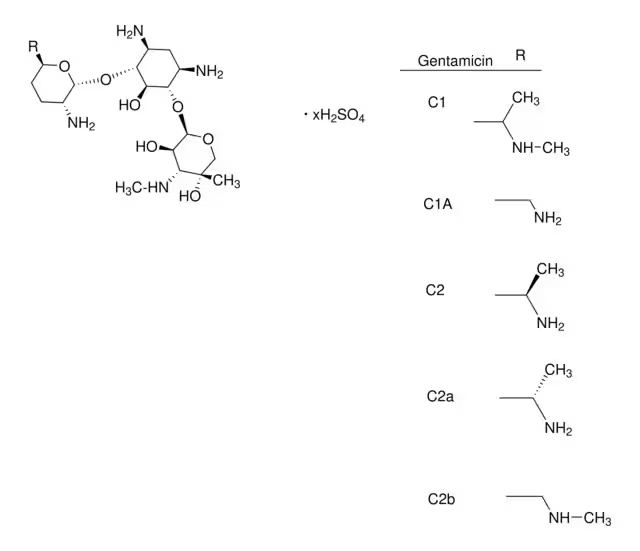
CAS Number1405-41-0
SynonymsGentamicin sulfate; Gentamycin sulfate; MFCD08457668; Gentamicin sulfate salt; EINECS 215-778-9; Gentamicin (sulfate)
Molecular FormulaC(19-21)H(39-43)N5O7·H2SO4
Molecular Weight561.65 (Average)
Purity98.00%
Boiling Point797.6ºC at 760 mmHg
Melting Point218-237°C
AppearanceWhite to light yellow powder odorless
Symbol
Signal WordWarning
| Chemical & Physical Properties | |
|---|---|
| CAS Number | 1405-41-0 |
| Catalog No. | 2A-9026760 |
| Chinese Name | 硫酸庆大霉素 |
| Synonyms | Gentamicin sulfate; Gentamycin sulfate; MFCD08457668; Gentamicin sulfate salt; EINECS 215-778-9; Gentamicin (sulfate) |
| Molecular Formula | C(19-21)H(39-43)N5O7·H2SO4 |
| Molecular Weight | 561.65 (Average) |
| Purity | 98.00 |
| Boiling Point | 797.6ºC at 760 mmHg |
| Melting Point | 218-237°C |
| Appearance | White to light yellow powder odorless |
| Water Solubility | H2O: 50 mg/mL As stock solution, store at −20°C. S |
| Storage Condition | Keep the container sealed and stored in a cool, dr |
| Application | Gentamicin sulfate is an aminoglycoside antibiotic that inhibits the growth of Gram-positive and Gram-negative bacteria and inhibits a variety of mycoplasma strains in tissue culture. The IC50 value f |
| HTC | 2941901000 |
| PubChem ID | 329799845 |
| SMILES | CN[C@H](C)[C@@H]1CC[C@@H](N)[C@H](O1)O[C@@H]2[C@@H](N)C[C@@H](N)[C@H](O[C@H]3OC[C@](C)(O)[C@H](NC)[C@H]3O)[C@H]2O.CN[C@@H]4[C@@H](O)[C@H](OC[C@]4(C)O)O[C@H]5[C@H](N)C[C@H](N)[C@@H](O[C@H]6O[C@H](CN)CC[C@H]6N)[C@@H]5O.CN[C@@H]7[C@@H](O)[C@H](OC[C@]7(C)O)O[C@H]8[C@H](N)C[C@H](N)[C@@H](O[C@H]9O[C@@H](CC[C@H]9N)[C@@H](C)N)[C@@H]8O.O[S](O)(=O)=O |
| InChI | InChI=1S/C21H43N5O7.C20H41N5O7.C19H39N5O7.H2O4S/c1-9(25-3)13-6-5-10(22)19(31-13)32-16-11(23)7-12(24)17(14(16)27)33-20-15(28)18(26-4)21(2,29)8-30-20;1-8(21)12-5-4-9(22)18(30-12)31-15-10(23)6-11(24)16(13(15)26)32-19-14(27)17(25-3)20(2,28)7-29-19;1-19(27)7-28-18(13(26)16(19)24-2)31-15-11(23)5-10(22)14(12(15)25)30-17-9(21)4-3-8(6-20)29-17;1-5(2,3)4/h9-20,25-29H,5-8,22-24H2,1-4H3;8-19,25-28H,4-7,21-24H2,1-3H3;8-18,24-27H,3-7,20-23H2,1-2H3;(H2,1,2,3,4)/t9-,10-,11+,12-,13+,14+,15-,16-,17+,18-,19-,20-,21+;8-,9-,10+,11-,12+,13+,14-,15-,16+,17-,18-,19-,20+;8-,9+,10-,11+,12-,13+,14+,15-,16+,17+,18+,19-;/m110./s1 |
| InChI Key | InChIKey=RDEIXVOBVLKYNT-HDZPSJEVSA-N |
| Hazard Symbols | transportation |
| Bioactivity | Gentamicin sulfate, an aminoglycoside antibiotic, inhibits the growth of both gram-positive and gram-negative bacteria and to inhibit several strains of mycoplasma in tissue culture. It inhibits DNase I with an IC50 of 0.57 mM. Related Catalog Signaling Pathways >> Anti-infection >> Bacterial Research Areas >> Infection Target IC50: 0.57 mM (DNase I)[1] In Vitro Gentamicin is a more effective in vitro bacterial inhibitor than combined penicillin-streptomycin, is nontoxic to tissue culture monolayers, and does not inhibit virus replication. It has been used with success as an additive in commercial mycology media to inhibit growth of bacteria and has been shown to be bactericidal for a wider range of organisms (Pseudomonas aeruginosa, Proteus sp., and Streptococcus faecalis) than penicillin and streptomycin. It does not interfere with the production of cytopathic effect by certain echoviruses and polioviruses in tissue culture, is nontoxic to Rhesus monkey kidney, HeLa, and human amnion cells, and is stable at autoclave temperatures[2]. Gentamicin is produced by various species of the genus Micromonospora. Commercial gentamicin consists mainly of different gentamicin C components. Yoshizawa elucidates the 3D-structure of gentamicin C1a bound to an A-site RNA. Gentamicin C1a binds in the major groove of the A-site of the RNA[3]. In Vivo Gentamicin is currently the first choice aminoglycoside for the treatment of serious infections with alternatives being amikacin, netilmicin, and tobramycin. Gentamicin preparations are commercially available in three forms, namely otic, ophthalmic, and topical based on the respective function to treat infections of ear canal, eye, and skin. Oral and injectable forms of gentamicin are found to exhibit effective antibacterial activity against Yersinia pestis as demonstrated in a mouse infection model[3].Treatment with up to nine doses of methicillin or gentamicin shows a significant reduction of bacteria on the foreign body[4]. Animal Admin Mice: Bacterial challenged mice are treated with methicillin, gentamicin, both methicillin and gentamicin, or no antibiotics. The treatment is given three times a day for up to 3 days. Each dose of methicillin is 75 mg per mouse (3 g/kg of body weight), and the gentamicin dose is 0.75 mg per mouse (0.03 g/kg). The antibiotics are given subcutaneously in 0.1 or 0.5 mL of saline. Mice are sacrificed and serum and aspirate samples are collected[4]. References [1]. Xu W, et al. A rapid and sensitive method for kinetic study and activity assay of DNase I in vitro based on a GO-quenched hairpin probe. Anal Bioanal Chem. 2016 May;408(14):3801-9. [2]. Rudin A, et al. Antibacterial activity of gentamicin sulfate in tissue culture. Appl Microbiol. 1970 Dec;20(6):989-90. [3]. Kumar CG, et al. Microbial biosynthesis and applications of gentamicin: a critical appraisal. [4]. Espersen F, et al. Effect of treatment with methicillin and gentamicin in a new experimental mouse model of foreignbody infection. Antimicrob Agents Chemother. 1994 Sep;38(9):2047-53. Chemical & Physical Properties Boiling Point 797.6ºC at 760 mmHg Melting Point 218-237°C Molecular Formula C(19-21)H(39-43)N5O7·H2SO4 Molecular Weight 561.65 (Average) Flash Point 436.2ºC PSA 719.38000 Storage condition 2-8°C Water Solubility H2O: 50 mg/mL As stock solution, store at −20°C. Stable at 37°C for 5 days. |
| Use of | Properties Articles31 Name Gentamicin Sulfate Synonym More Synonyms Gentamycin Sulfate Biological Activity Related Catalog Signaling Pathways >> Anti-infection >> Bacterial Research Areas >> Infection In Vivo Gentamicin is currently the first choice aminoglycoside for the treatment of serious infections with alternatives being amikacin, netilmicin, and tobramycin. Gentamicin preparations are commercially available in three forms, namely otic, ophthalmic, and topical based on the respective function to treat infections of ear canal, eye, and skin. Oral and injectable forms of gentamicin are found to exhibit effective antibacterial activity against Yersinia pestis as demonstrated in a mouse infection model[3].Treatment with up to nine doses of methicillin or gentamicin shows a significant reduction of bacteria on the foreign body[4]. References [1]. Xu W, et al. A rapid and sensitive method for kinetic study and activity assay of DNase I in vitro based on a GO-quenched hairpin probe. Anal Bioanal Chem. 2016 May;408(14):3801-9. [2]. Rudin A, et al. Antibacterial activity of gentamicin sulfate in tissue culture. Appl Microbiol. 1970 Dec;20(6):989-90. [3]. Kumar CG, et al. Microbial biosynthesis and applications of gentamicin: a critical appraisal. [4]. Espersen F, et al. Effect of treatment with methicillin and gentamicin in a new experimental mouse model of foreignbody infection. Antimicrob Agents Chemother. 1994 Sep;38(9):2047-53. Chemical & Physical Properties Molecular Formula C(19-21)H(39-43)N5O7·H2SO4 PSA 719.38000 |
| Transport Info | Product name: Purity: 0.0% |
| MSDS Transport Info | Module 14. Shipping information 14.1 UN dangerous goods number European Land Transport Dangerous Regulations: -International Maritime Dangerous Regulations: -International Air Transport Dangerous Regulations: - 14.2 Names specified by the United Nations (UN) European Land Transport Dangerous Regulations: Non-dangerous goods IMDG Code: Non-dangerous goods International air transport dangerous goods regulations: non-dangerous goods 14.3 Transport hazard categories European Land Transport Dangerous Regulations: -International Maritime Dangerous Regulations: -International Air Transport Dangerous Regulations: - 14.4 Package group European Land Transport Dangerous Regulations: -International Maritime Dangerous Regulations: -International Air Transport Dangerous Regulations: - 14.5 Environmental hazards European Land Transport Dangerous Regulations: No International Maritime Transport Dangerous Regulations Maritime Pollutants: No International Air Transport Risk Regulations: No 14.6 Special reminder to users No data available |
| Related Products in Specialty Chemicals | ||
|---|---|---|
| Lancovutide | 1391-36-2 | 2A-9026745 |
| Kitasamycin | 1392-21-8 | 2A-9026746 |
| Chitin | 1398-61-4 | 2A-9026749 |
| Orcein | 1400-62-0 | 2A-9026751 |
| Capastat sulfate | 1405-37-4 | 2A-9026759 |
| Tylosin tartrate | 1405-54-5 | 2A-9026762 |
| Bacitracin | 1405-87-4 | 2A-9026765 |
| Zinc bacitracin | 1405-89-6 | 2A-9026766 |
| Angiotensin | 1407-47-2 | 2A-9026768 |
| Nisin | 1414-45-5 | 2A-9026769 |
| Browse all Specialty Chemicals products » | ||
Phone:
630-322-8886
630-322-8887
Email:
Office Locations:
Chicago, IL, USA
San Francisco, CA, USA


 EN
EN


 SDS
SDS