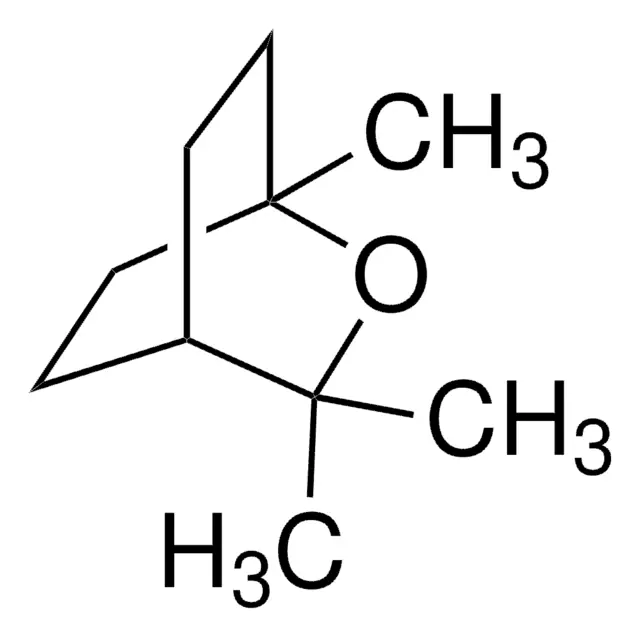
CAS Number470-82-6
Synonyms2-Oxa-1,3,3-trimethylbicyclo(2.2.2)octane; eucalyptol (cineole); Terpan; 2,2,4-trimethyl-3-oxabicyclo[2.2.2]octane; Eucapur; Zineol; Eukalyptol [Czech]; Eucalyptol; Eucalyptole; MFCD00167977; 1,8-Cineol; 1,3,3-Trimethyl-2-oxabicyclo[2.2.2]octane,1,8-Cineole,1,8-Epoxy-p-menthane; EINECS 207-431-5; 1,3,3-Trimethyl-2-oxabicyclo(2.2.2)octane; cineole; Cajeputol; 1,3,3-Trimethyl-2-oxabicyclo[2.2.2]octane; 1,8-cineole; 1,8-Epoxy-p-menthane; limonene oxide; p-Cineole
Molecular FormulaC10H18O
Molecular Weight154.25
Purity99%
Density0.9±0.1 g/cm3
Boiling Point176-177 °C (lit.)
Melting Point1-2 °C (lit.)
Appearanceliquid
EINECS207-431-5
Symbol
Signal WordWarning
| Chemical & Physical Properties | |
|---|---|
| CAS Number | 470-82-6 |
| Catalog No. | 2A-9022085 |
| Chinese Name | 桉叶油醇 |
| Synonyms | 2-Oxa-1,3,3-trimethylbicyclo(2.2.2)octane; eucalyptol (cineole); Terpan; 2,2,4-trimethyl-3-oxabicyclo[2.2.2]octane; Eucapur; Zineol; Eukalyptol [Czech]; Eucalyptol; Eucalyptole; MFCD00167977; 1,8-Cineol; 1,3,3-Trimethyl-2-oxabicyclo[2.2.2]octane,1,8-Cineole,1,8-Epoxy-p-menthane; EINECS 207-431-5; 1,3,3-Trimethyl-2-oxabicyclo(2.2.2)octane; cineole; Cajeputol; 1,3,3-Trimethyl-2-oxabicyclo[2.2.2]octane; 1,8-cineole; 1,8-Epoxy-p-menthane; limonene oxide; p-Cineole |
| Molecular Formula | C10H18O |
| Molecular Weight | 154.25 |
| Purity | 99 |
| Density | 0.9±0.1 g/cm3 |
| Boiling Point | 176-177 °C (lit.) |
| Melting Point | 1-2 °C (lit.) |
| Appearance | liquid |
| Water Solubility | Water solubility: virtually insoluble; water solub |
| Storage Condition | Store sealed at 2-8°C, placed in a ventilated, dry |
| Packaging | III |
| Application | Eucalyptol is an inhibitor of 5-HT3 receptors, potassium channels, TNF-α and IL-1β. |
| EINECS | 207-431-5 |
| PubChem ID | 24893017 |
| MDL Number | MFCD00167977 |
| SMILES | C[C@]12CC[C@H](CC1)C(C)(C)O2 |
| InChI | 1S/C10H18O/c1-9(2)8-4-6-10(3,11-9)7-5-8/h8H,4-7H2,1-3H3/t8-,10+ |
| InChI Key | WEEGYLXZBRQIMU-WAAGHKOSSA-N |
| Beilstein/REAXYS | 105109 |
| NACRES Code | NA.22 |
| UNSPSC | 12352100 |
| Hazard Symbols | 3.0 |
| MSDS | msds/22085_1_470_82_6.pdf |
| Bioactivity | Eucalyptol is an inhibitor of 5-HT3 receptor ,potassium channel, TNF-α and IL-1β. Related Catalog Signaling Pathways >> GPCR/G Protein >> 5-HT Receptor Signaling Pathways >> Neuronal Signaling >> 5-HT Receptor Signaling Pathways >> Immunology/Inflammation >> Interleukin Related Signaling Pathways >> Membrane Transporter/Ion Channel >> Potassium Channel Signaling Pathways >> Apoptosis >> TNF Receptor Research Areas >> Neurological Disease Natural Products >> Terpenoids and Glycosides Target 5-HT3 Receptor IL-1β TNF-α potassium channel In Vitro Eucalyptol inhibits 5-HT-evoked currents in oocytes expressing 5-HT3 receptors with an IC50 of 258 µM[1]. Eucalyptol (Cin) treatment significantly decreases the ROS level in Aβ25-35 treated cells in a dose dependent manner. Eucalyptol treatment significantly decreases the NO level in Aβ25-35 treated cells in a dose dependent manner (p<0.05 and p<0.01). Eucalyptol treatment also significantly decreases IL-1βlevel in Aβ25-35 treated cells in a dose dependent manner (p<0.05 and p<0.01) as compare to Aβ25-35 treated PC12 cells. IL-6 level is also attenuated by Eucalyptol in dose dependent manner (p<0.05 and p<0.01) as compare to Aβ25-35 treated cells[3]. In Vivo Results show that male and female rats treated with Eucalyptol (CIN) at the highest doses, 500 and 1000 mg/kg, have shown lower body weight than control group from the 7th to 50th day of treatment. The administration of Eucalyptol significantly reduces body weight gain of male rats (Eucalyptol 500 and 1000 mg/kg) and female rats (Eucalyptol 1000 mg/kg) in the first week of treatment. However, this reduction is followed by an increase in body weight of rats males and females treated with all doses of the second week until the end of treatment. For male rats, there is a significant increase of 6.93% in mean corpuscular volume (MCV) (Eucalyptol 1000 mg/kg) and of 43.54 and 38.98% in the platelet count (Eucalyptol 500 and 1000 mg/kg, respectively) and a decrease of 6.74 and 6.67% in mean corpuscular hemoglobin concentration (MCHC) (Eucalyptol 500 and 1000 mg/kg) and mean platelet volume (MPV) of 10.40, 10.60 and 15.73% (Eucalyptol 100, 500 and 1000 mg/kg, respectively), when compare to the control group[4]. Cell Assay The protective dose of Eucalyptol (Cineole) is determined by MTT dye-uptake method. In brief, cells (1×10⁴ per well) are seeded in 96-well tissue culture plates and allowed to adhere for 24 h in CO2 incubator at 37°C. Cells are differentiated for the indicated time period. Thereafter, the medium is replaced with the medium containing Eucalyptol (0 to 10 μM) in different experiments for a period up to 24 h. Tetrazolium bromide salt (5 mg/mL of stock in PBS) 10 μL/well is added in 100 mL of cell suspension and plate is incubated for 4 h. At the end of incubation period, the reaction mixture is carefully taken out and 200 μL of DMSO is added to each well by pipetting up and down several times until the content gets homogenized. The plates are kept on rocker shaker for 10 min at room temperature and then read at 550 nm using microplate reader[3]. Animal Admin Swiss mice are used in this experiment. The animals are randomly divided into two groups (n=5) and fasted overnight with free access to water. The group control receives a 1% Tween-80 aqueous solution (0.1 mL/10 g) and the other group is treated with Eucalyptol a single 2000 mg/kg dose by oral route. The animals are observed at 30, 60, 120, 180 and 240 min after oral treatment and daily for 14 days. Behavioral changes, weight, food and water consumption, clinical signs of toxicity or mortality are recorded daily[4]. References [1]. Jarvis GE, et al. Noncompetitive Inhibition of 5-HT3 Receptors by Citral, Linalool, and Eucalyptol Revealed by Nonlinear Mixed-Effects Modeling. J Pharmacol Exp Ther. 2016 Mar;356(3):549-62. [2]. Zeraatpisheh Z, et al. Eucalyptol induces hyperexcitability and epileptiform activity in snail neurons by inhibiting potassium channels. Eur J Pharmacol. 2015 Oct 5;764:70-8. [3]. Khan A, et al. 1,8-cineole (eucalyptol) mitigates inflammation in amyloid Beta toxicated PC12 cells: relevance to Alzheimer's disease. Neurochem Res. 2014 Feb;39(2):344-52.[3] [4]. Caldas GF, et al. Repeated-doses and reproductive toxicity studies of the monoterpene 1,8-cineole (eucalyptol) in Wistar rats. Food Chem Toxicol. 2016 Nov;97:297-306. Chemical & Physical Properties Density 0.9±0.1 g/cm3 Boiling Point 174.0±8.0 °C at 760 mmHg Melting Point 1.5ºC Molecular Formula C10H18O Molecular Weight 154.249 Flash Point 50.9±15.3 °C Exact Mass 154.135757 PSA 9.23000 LogP 2.82 Vapour Pressure 1.6±0.3 mmHg at 25°C Index of Refraction 1.461 InChIKey WEEGYLXZBRQIMU-UHFFFAOYSA-N SMILES CC12CCC(CC1)C(C)(C)O2 Stability Stable. Flammable. Incompatible with acids, bases, strong oxidizing agents. |
| Use of | Eucalyptol is an inhibitor of 5-HT3 receptor ,potassium channel, TNF-α and IL-1β. Properties Articles60 Name 1,8-cineole Synonym More Synonyms Cineole Biological Activity Description Eucalyptol is an inhibitor of 5-HT3 receptor ,potassium channel, TNF-α and IL-1β. Related Catalog Signaling Pathways >> GPCR/G Protein >> 5-HT Receptor Signaling Pathways >> Neuronal Signaling >> 5-HT Receptor Signaling Pathways >> Immunology/Inflammation >> Interleukin Related Signaling Pathways >> Membrane Transporter/Ion Channel >> Potassium Channel Signaling Pathways >> Apoptosis >> TNF Receptor Research Areas >> Neurological Disease Natural Products >> Terpenoids and Glycosides 5-HT3 Receptor potassium channel References [1]. Jarvis GE, et al. Noncompetitive Inhibition of 5-HT3 Receptors by Citral, Linalool, and Eucalyptol Revealed by Nonlinear Mixed-Effects Modeling. J Pharmacol Exp Ther. 2016 Mar;356(3):549-62. [2]. Zeraatpisheh Z, et al. Eucalyptol induces hyperexcitability and epileptiform activity in snail neurons by inhibiting potassium channels. Eur J Pharmacol. 2015 Oct 5;764:70-8. [4]. Caldas GF, et al. Repeated-doses and reproductive toxicity studies of the monoterpene 1,8-cineole (eucalyptol) in Wistar rats. Food Chem Toxicol. 2016 Nov;97:297-306. Chemical & Physical Properties Molecular Formula C10H18O Exact Mass 154.135757 PSA 9.23000 Index of Refraction 1.461 InChIKey WEEGYLXZBRQIMU-UHFFFAOYSA-N Stability Stable. Flammable. Incompatible with acids, bases, strong oxidizing agents. |
| Transport Info | Product name: Chemical name |
| Related Products in Specialty & Botanical Ingredients | ||
|---|---|---|
| alpha-Ionone | 127-41-3 | 2A-9020581 |
| beta-Pinene | 127-91-3 | 2A-9020598 |
| Neryl acetate | 141-12-8 | 2A-9020868 |
| (+)-Borneol | 464-43-7 | 2A-9022062 |
| 1,4-Cineole | 470-67-7 | 2A-9022084 |
| Jasmone | 488-10-8 | 2A-9022207 |
| Borneol | 507-70-0 | 2A-9022386 |
| alpha-Bisabolol | 515-69-5 | 2A-9022428 |
| 6,7-Dihydroxy-4-methylcoumarin | 529-84-0 | 2A-9022551 |
| 7-Methoxycoumarin | 531-59-9 | 2A-9022570 |
| Browse all Specialty & Botanical Ingredients products » | ||
Phone:
630-322-8886
630-322-8887
Email:
Office Locations:
Chicago, IL, USA
San Francisco, CA, USA


 EN
EN


 SDS
SDS