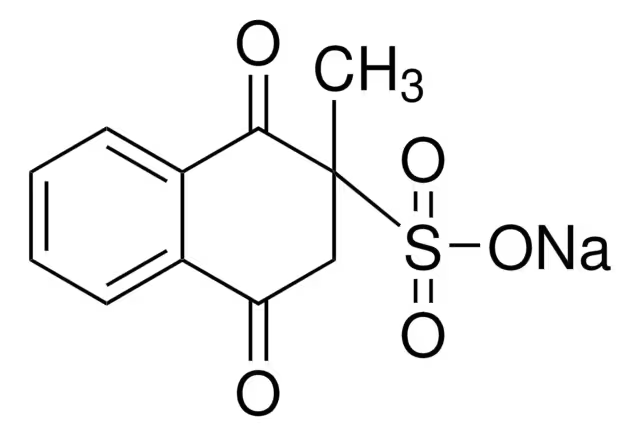
CAS Number130-37-0
Synonymshemodal; menadione sodium bisulfite; sodium 2-methyl-1,2,3,4-tetrahydronaphthalene-1,4-dione-2-sulfonate; kawitan; golagenk; kavitan; UNII:97K34V88SA; msbc; 2-Methyl-1,4-naphthoquinone sodium bisulfite; EINECS 204-987-0; Sodium 1,2,3,4-Tetrahydro-2-methyl-1,4-dioxo-2-naphthalenesulfonate; sodium 2-methyl-1,4-dioxo-1,2,3,4-tetrahydronaphthalene-2-sulfonate; Sodium 2-methyl-1,4-dioxo-1,2,3,4-tetrahydro-2-naphthalenesulfonate; MENADIONE SODIUM SULFONATE; kalzon; ido-k; MFCD00051456; 2-Naphthalenesulfonic acid, 1,2,3,4-tetrahydro-2-methyl-1,4-dioxo-, sodium salt (1:1); bisulfite sodique de menadione; klotogen; hykinone; vikasol; hemoklot; menadioni natrii bisulfis; bisulfito sodico de menadiona
Molecular FormulaC11H9NaO5S
Molecular Weight276.24
Purity≥95 (TLC)%
Melting Point121-124ºC
Appearancepowder
EINECS204-987-0
Symbol
Signal WordWarning
| Chemical & Physical Properties | |
|---|---|
| CAS Number | 130-37-0 |
| Catalog No. | 2A-9020652 |
| Chinese Name | 亚硫酸氢钠甲萘醌 |
| Synonyms | hemodal; menadione sodium bisulfite; sodium 2-methyl-1,2,3,4-tetrahydronaphthalene-1,4-dione-2-sulfonate; kawitan; golagenk; kavitan; UNII:97K34V88SA; msbc; 2-Methyl-1,4-naphthoquinone sodium bisulfite; EINECS 204-987-0; Sodium 1,2,3,4-Tetrahydro-2-methyl-1,4-dioxo-2-naphthalenesulfonate; sodium 2-methyl-1,4-dioxo-1,2,3,4-tetrahydronaphthalene-2-sulfonate; Sodium 2-methyl-1,4-dioxo-1,2,3,4-tetrahydro-2-naphthalenesulfonate; MENADIONE SODIUM SULFONATE; kalzon; ido-k; MFCD00051456; 2-Naphthalenesulfonic acid, 1,2,3,4-tetrahydro-2-methyl-1,4-dioxo-, sodium salt (1:1); bisulfite sodique de menadione; klotogen; hykinone; vikasol; hemoklot; menadioni natrii bisulfis; bisulfito sodico de menadiona |
| Molecular Formula | C11H9NaO5S |
| Molecular Weight | 276.24 |
| Purity | ≥95 (TLC) |
| Melting Point | 121-124ºC |
| Appearance | powder |
| Water Solubility | H2O: ≥50mg/mL, clear, colorless to faintly yellow |
| Storage Condition | −20°C |
| Application | Menadione bisulfite sodium is an agent that induces acute oxidative stress and acts as a plant defense activator against pathogenic bacteria. |
| EINECS | 204-987-0 |
| HTC | 2914700090 |
| PubChem ID | 24897038 |
| MDL Number | MFCD00051456 |
| SMILES | [Na+].CC1(CC(=O)c2ccccc2C1=O)S([O-])(=O)=O |
| InChI | 1S/C11H10O5S.Na/c1-11(17(14,15)16)6-9(12)7-4-2-3-5-8(7)10(11)13;/h2-5H,6H2,1H3,(H,14,15,16);/q;+1/p-1 |
| InChI Key | XDPFHGWVCTXHDX-UHFFFAOYSA-M |
| NACRES Code | NA.77 |
| UNSPSC | 12352200 |
| Hazard Symbols | 9.0 |
| MSDS | msds/20652_1_130_37_0.pdf |
| Bioactivity | Menadione bisulfite (sodium) is used as an agent to induce acute oxidative stress, and to function as a plant-defense activator against several pathogens. Related Catalog Signaling Pathways >> Others >> Others Research Areas >> Infection In Vitro Menadione sodium bisulfite (500 μM) treatment and the concomitant ROS increase have an important impact on the photosynthetic activity of the cells. Global and specific antioxidant defences decrease with Menadione sodium bisulfite (500 μM) treatment[1]. Menadione sodium bisulfite and PABA activate similar defense responses (PR, ROS, and HR). Menadione sodium bisulfite enhances resistance, both locally and systemically, to phoma stem canker disease caused by Leptosphaeria maculans. Menadione sodium bisulfite treatment induces resistance against downy mildew in pearl millet. Menadione sodium bisulfite acts through priming of specific sets of the plant innate-defense repertoire. Menadione sodium bisulfite treatment up-regulates the expression of a gene encoding a GRX480 protein, a member of the glutaredoxin family that regulates protein redox state[1]. Kinase Assay Briefly, cells are lysed by sonication (6 cycles of 10 s separated by 30 s, on ice) in a buffer containing 25 mM Hepes at pH 7.5, 5 mM MgCl2, 5 mM DTT, 2 mM PMSF, 5 mM EDTA, 400 mM sorbitol and 10 μg/mL Protease Inhibitor cocktail. A quantity of 40 μg Symbiodinium protein extract is incubated in the reaction buffer. The mixture consists of 50 μM Ac-DEVD-AFC, 100 mM Hepes at pH 7.5, 10% (v/v) sucrose, 0.1% (v/v) CHAPS, 10 mM DTT and 10 mM PMSF. Samples are then incubated in black 96-well microplates and the fluorescence emitted is measured every 3 min for 90 min at 505 nm, with a 400 nm excitation wavelength provided by a FLX-Xenius spectrofluorometer. Caspase-like activities are then expressed in pmol of AFC cleavage per minute and illustrated as percentage of the controls. References [1]. Roberty S, et al. Differential antioxidant response between two Symbiodinium species from contrasting environments. Plant Cell Environ. 2016 Dec;39(12):2713-2724. Chemical & Physical Properties Melting Point 121-124ºC Molecular Formula C11H9NaO5S Molecular Weight 276.241 Exact Mass 276.006836 PSA 99.72000 LogP 1.84040 InChIKey XDPFHGWVCTXHDX-UHFFFAOYSA-M SMILES CC1(S(=O)(=O)[O-])CC(=O)c2ccccc2C1=O.[Na+] Storage condition −20°C Water Solubility H2O: ≥50mg/mL, clear, colorless to faintly yellow |
| Use of | Menadione bisulfite (sodium) is used as an agent to induce acute oxidative stress, and to function as a plant-defense activator against several pathogens. Properties Articles45 Name menadione sodium sulfonate Synonym More Synonyms Menadione sodiuM bisulfite Biological Activity Description Menadione bisulfite (sodium) is used as an agent to induce acute oxidative stress, and to function as a plant-defense activator against several pathogens. Related Catalog Signaling Pathways >> Others >> Others Research Areas >> Infection In Vitro Menadione sodium bisulfite (500 μM) treatment and the concomitant ROS increase have an important impact on the photosynthetic activity of the cells. Global and specific antioxidant defences decrease with Menadione sodium bisulfite (500 μM) treatment[1]. Menadione sodium bisulfite and PABA activate similar defense responses (PR, ROS, and HR). Menadione sodium bisulfite enhances resistance, both locally and systemically, to phoma stem canker disease caused by Leptosphaeria maculans. Menadione sodium bisulfite treatment induces resistance against downy mildew in pearl millet. Menadione sodium bisulfite acts through priming of specific sets of the plant innate-defense repertoire. Menadione sodium bisulfite treatment up-regulates the expression of a gene encoding a GRX480 protein, a member of the glutaredoxin family that regulates protein redox state[1]. References [1]. Roberty S, et al. Differential antioxidant response between two Symbiodinium species from contrasting environments. Plant Cell Environ. 2016 Dec;39(12):2713-2724. Chemical & Physical Properties Molecular Formula C11H9NaO5S Exact Mass 276.006836 PSA 99.72000 LogP 1.84040 InChIKey XDPFHGWVCTXHDX-UHFFFAOYSA-M |
| Tax Rebate | 13.0% |
| Supervision | None. MFN tariff: 5.5%. Ordinary tariff: 30.0% |
| Transport Info | Shipping Name: UN |
| MSDS Transport Info | Module 14. Shipping information 14.1 UN dangerous goods number European Land Transport Danger Regulations: 3077 International Maritime Transport Danger Regulations: 3077 International Air Transport Danger Regulations: 3077 14.2 United Nations shipping name European land transport hazard regulations: ENVIRONMENTALLY HAZARDOUS SUBSTANCE, SOLID, N.O.S. (Menadione sodium bisulfite) IMDG: ENVIRONMENTALLY HAZARDOUS SUBSTANCE, SOLID, N.O.S. (Menadione sodium bisulfite) International air transport hazard regulations: Environmentally hazardous substance, solid, n.o.s. (Menadione sodium bisulfite) 14.3 Transport hazard categories European land transport Dangerous Regulations: 9 International sea transport Dangerous Regulations: 9 International air transport Dangerous Regulations: 9 14.4 Package group European Land Transport Danger Regulations: III International Maritime Transport Danger Regulations: III International Air Transport Danger Regulations: III 14.5 Environmental hazards European Land Transport Dangerous Regulations: Yes International Maritime Transport Dangerous Regulations International Air Transport Dangerous Regulations: Yes Marine Pollutants (Yes/No): Yes 14.6 Special reminder to users further information Dangerous goods are individually packaged, with liquids exceeding 5 liters or solids exceeding 5 kilograms. The outer packaging of each independent package and the combined independent inner package must have EHS on it. Identification (according to European ADR Regulation 2.2.9.1.10, IMDG Regulation 2.10.3), |
| Related Products in Specialty Chemicals | ||
|---|---|---|
| Sodium 4-amino-1-naphthalenesulfonate | 130-13-2 | 2A-9020643 |
| Sodium 1-naphthalenesulfonate | 130-14-3 | 2A-9020644 |
| Vat Blue 6 | 130-20-1 | 2A-9020648 |
| Alizarin Red S | 130-22-3 | 2A-9020649 |
| 1-Amino-8-naphthol-4,6-disulfonic acid | 130-23-4 | 2A-9020650 |
| Dimethyl diacetoxyfumarate | 130-84-7 | 2A-9020655 |
| Pamoic acid | 130-85-8 | 2A-0202222 |
| (-)-Berbine | 131-10-2 | 2A-9020663 |
| Dimethyl phthalate | 131-11-3 | 2A-9020664 |
| Pimpinellin | 131-12-4 | 2A-9020665 |
| Browse all Specialty Chemicals products » | ||
Phone:
630-322-8886
630-322-8887
Email:
Office Locations:
Chicago, IL, USA
San Francisco, CA, USA


 EN
EN


 SDS
SDS