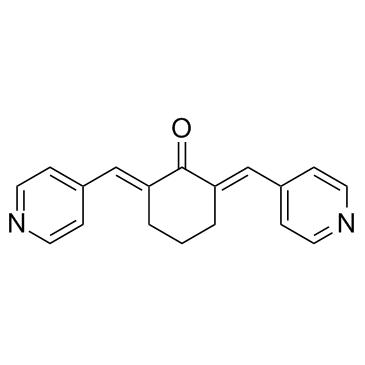
| Chemical & Physical Properties | |
|---|---|
| CAS Number | 871361-88-5 |
| Catalog No. | 2A-1198813 |
| Chinese Name | SC66 |
| Synonyms | (2E,6E)-2,6-Bis(4-pyridinylmethylene)cyclohexanone; SC-66; SC66 |
| Molecular Formula | C18H16N2O |
| Molecular Weight | 276.332 |
| Density | 1.2±0.1 g/cm3 |
| Boiling Point | 514.5±50.0 °C at 760 mmHg |
| Appearance | buffered aqueous glycerol solution |
| Storage Condition | -20℃ |
| Application | SC66 is a novel Akt inhibitor that reduces cell viability in a dose- and time-dependent manner, inhibits colony formation and induces apoptosis in hepatocellular carcinoma (HCC) cells. |
| SMILES | O=C1C(=Cc2ccncc2)CCCC1=Cc1ccncc1 |
| InChI Key | CYVVJSKZRBZHAV-UNZYHPAISA-N |
| NACRES Code | NA.41 |
| UNSPSC | 12352203 |
| Hazard Symbols | transportation |
| MSDS | msds/200755_1_871361_88_5.pdf |
| Bioactivity | SC66 is a novel Akt inhibitor, reduces cell viability in a dose- and time-dependent manner, inhibits colony formation and induces apoptosis in hepatocellular carcinoma (HCC) cells. Related Catalog Research Areas >> Cancer Target Akt In Vitro SC66 inhibits cell viability and colony forming capacity of HCC cells with IC50s of 0.77,0.47,0.92,0.75 and 2.85 μg/mL at 72 hours for HepG2, Hep3B, PLC/PRF/5,HA22T/VGH and Huh7 cells. HepG2, HA22T/VGH and PLC/PRF/5 cells have similar IC50s of approximately 0.85 and 0.75 μg/mL at 48 and 72 hours, respectively. To determine whether the decrease in cell viability is related to apoptosis induction, TUNEL assays are performed in Hep3B and Huh7 cells treated with 1, 2 and 4 μg/mL of SC66 for 24 hours. In Hep3B cells the number of TUNEL-positive cells increased with increasing concentrations of SC66, whereas in Huh7 cells very few light brown-colored cells are observed only after treatment with 4 μg/mL SC66[1]. In Vivo To demonstrate the effectiveness in vivo of SC66 on HCC, a mouse xenograft tumor model of Hep3B cells is used. When tumors became palpable, at a size of about 150 mm3, mice are randomized into three groups of 6 animals each. The treated group receive SC66 at 15 and 25 mg/kg twice a week via i.p. injection, while the untreated group receive the vehicle alone. Treatment with 25 mg/Kg SC66 significantly reduces tumor volume to 37% on day 17 when compared with tumors of the untreated group[1]. Cell Assay Cells (5 ×10³/well) are distributed into each well of 96-well microtiter plates and then incubated overnight. At time 0, the medium is replaced with fresh complete medium and different doses of SC66 are added. Cells are cultured for 24, 48 and 72 hours. At the end of treatment, MTS assays are performed using the CellTiter Aqueous OneSolution kit. Cell viability is expressed as a percentage of the absorbance measured in the control cells. Values are expressed as means±SD of three separate experiments, each performed in triplicate[1]. Animal Admin Mice[1] Male nude athymic mice (Fox1 nu/nu) aged 4 weeks are used. Suspensions of 1×10⁷ Hep3B cells in 0.2 mL of PBS are inoculated into the right flank of the animal. When tumors became palpable (around 150 mm3), the mice are randomly divided into three groups of 6 animals each, with the various tumor volumes equally distributed among the three groups. Two groups of mice are treated twice a week with 15 and 25 mg/kg SC66 suspended in DMSO, further diluted in a solution of 25% ethanol and administered via i.p. injection. The control group receive the vehicle alone. Tumor volumes are determined twice a week using calipers. Primary tumor volumes are calculated. References [1]. Cusimano A, et al. Cytotoxic activity of the novel small molecule AKT inhibitor SC66 in hepatocellular carcinoma cells. Oncotarget. 2015 Jan 30;6(3):1707-22. Chemical & Physical Properties Density 1.2±0.1 g/cm3 Boiling Point 514.5±50.0 °C at 760 mmHg Molecular Formula C18H16N2O Molecular Weight 276.332 Flash Point 260.0±36.5 °C Exact Mass 276.126251 PSA 42.85000 LogP 3.03 Vapour Pressure 0.0±1.3 mmHg at 25°C Index of Refraction 1.683 InChIKey CYVVJSKZRBZHAV-UNZYHPAISA-N SMILES O=C1C(=Cc2ccncc2)CCCC1=Cc1ccncc1 Storage condition -20℃ |
| Use of | SC66 is a novel Akt inhibitor, reduces cell viability in a dose- and time-dependent manner, inhibits colony formation and induces apoptosis in hepatocellular carcinoma (HCC) cells. Properties Name 2,6-bis(pyridin-4-ylmethylidene)cyclohexan-1-one Synonym More Synonyms SC-66 Biological Activity Description SC66 is a novel Akt inhibitor, reduces cell viability in a dose- and time-dependent manner, inhibits colony formation and induces apoptosis in hepatocellular carcinoma (HCC) cells. Related Catalog Research Areas >> Cancer References [1]. Cusimano A, et al. Cytotoxic activity of the novel small molecule AKT inhibitor SC66 in hepatocellular carcinoma cells. Oncotarget. 2015 Jan 30;6(3):1707-22. Chemical & Physical Properties Molecular Formula C18H16N2O Exact Mass 276.126251 PSA 42.85000 Index of Refraction 1.683 InChIKey CYVVJSKZRBZHAV-UNZYHPAISA-N Storage condition -20℃ |
| Transport Info | Product name: Purity: 99.0% |
| MSDS Transport Info | Module 14. Shipping information 14.1 UN dangerous goods number European Land Transport Dangerous Regulations: -International Maritime Dangerous Regulations: -International Air Transport Dangerous Regulations: - 14.2 Names specified by the United Nations (UN) European Land Transport Dangerous Regulations: Non-dangerous goods IMDG Code: Non-dangerous goods International air transport dangerous goods regulations: non-dangerous goods 14.3 Transport hazard categories European Land Transport Dangerous Regulations: -International Maritime Dangerous Regulations: -International Air Transport Dangerous Regulations: - 14.4 Package group European Land Transport Dangerous Regulations: -International Maritime Dangerous Regulations: -International Air Transport Dangerous Regulations: - 14.5 Environmental hazards European Land Transport Dangerous Regulations: No International Maritime Transport Dangerous Regulations Maritime Pollutants: No International Air Transport Risk Regulations: No 14.6 Special reminder to users No data available |
| Related Products in Specialty Chemicals | ||
|---|---|---|
| IC 261 | 186611-52-9 | 2A-1198808 |
| NSC 600157 | 31083-55-3 | 2A-1198809 |
| Dimethylenastron | 863774-58-7 | 2A-1198810 |
| JNJ 63533054 | 1802326-66-4 | 2A-1198811 |
| KENPAULLONE | 142273-20-9 | 2A-1198812 |
| Mirin | 1198097-97-0 | 2A-1198814 |
| KM 11060 | 774549-97-2 | 2A-1198815 |
| Wnt Agonist | 853220-52-7 | 2A-1198816 |
| Propanoic acid, 3-[[[3-[2-(7-chloro-2-quinolinyl)ethenyl]phenyl][[3-(diMethylaMino)-3-oxopropyl]thio]Methyl]thio]-, sodiuM salt, (E)- | 115103-85-0 | 2A-1198817 |
| vericiguat | 1350653-20-1 | 2A-1198825 |
| Browse all Specialty Chemicals products » | ||
Phone:
630-322-8886
630-322-8887
Email:
Office Locations:
Chicago, IL, USA
San Francisco, CA, USA


 EN
EN


 SDS
SDS