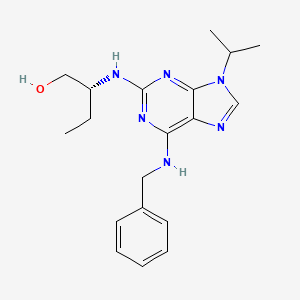
CAS Number186692-46-6
SynonymsCYC 202; (2R)-2-{[6-(Benzylamino)-9-isopropyl-9H-purin-2-yl]amino}butan-1-ol; 6-Benzylamino-2[(R)-(1'-ethyl-2'-hydroxyethylamino)]-9-isopropylpurine Roscovitine; R-roscovitine; (+)-Seliciclib; MFCD02266401; (R)-Roscovitine; (R)-2-((6-(Benzylamino)-9-isopropyl-9H-purin-2-yl)amino)butan-1-ol; (2R)-2-{[6-(benzylamino)-9-(propan-2-yl)-9H-purin-2-yl]amino}butan-1-ol; Seliciclib; Roscovitine; Roscovitin; (2R)-2-{[6-(Benzylamino)-9-isopropyl-9H-purin-2-yl]amino}-1-butanol; CYC202
Molecular FormulaC19H26N6O
Molecular Weight354.449
Density1.3±0.1 g/cm3
Boiling Point577.5±60.0 °C at 760 mmHg
AppearanceWhite to off-white solid
Symbol
Signal WordWarning
| Chemical & Physical Properties | |
|---|---|
| CAS Number | 186692-46-6 |
| Catalog No. | 2A-1170306 |
| Chinese Name | Roscovitine |
| Synonyms | CYC 202; (2R)-2-{[6-(Benzylamino)-9-isopropyl-9H-purin-2-yl]amino}butan-1-ol; 6-Benzylamino-2[(R)-(1'-ethyl-2'-hydroxyethylamino)]-9-isopropylpurine Roscovitine; R-roscovitine; (+)-Seliciclib; MFCD02266401; (R)-Roscovitine; (R)-2-((6-(Benzylamino)-9-isopropyl-9H-purin-2-yl)amino)butan-1-ol; (2R)-2-{[6-(benzylamino)-9-(propan-2-yl)-9H-purin-2-yl]amino}butan-1-ol; Seliciclib; Roscovitine; Roscovitin; (2R)-2-{[6-(Benzylamino)-9-isopropyl-9H-purin-2-yl]amino}-1-butanol; CYC202 |
| Molecular Formula | C19H26N6O |
| Molecular Weight | 354.449 |
| Density | 1.3±0.1 g/cm3 |
| Boiling Point | 577.5±60.0 °C at 760 mmHg |
| Appearance | White to off-white solid |
| Storage Condition | Storage method: -20 °C |
| Application | Roscovitine is a potent and selective inhibitor of CDKs, with IC50s of 0.2 μM, 0.65 μM, and 0.7 μM for CDK5, CDK2, and CDK2 inhibition respectively. |
| HTC | 2933990090 |
| PubChem ID | 527377 |
| SMILES | CCC(CO)Nc1nc(NCc2ccccc2)c2ncn(C(C)C)c2n1 |
| InChI | InChI=1S/C19H26N6O/c1-4-15(11-26)22-19-23-17(20-10-14-8-6-5-7-9-14)16-18(24-19)25(12-21-16)13(2)3/h5-9,12-13,15,26H,4,10-11H2,1-3H3,(H2,20,22,23,24)/t15-/m1/s1 |
| InChI Key | BTIHMVBBUGXLCJ-OAHLLOKOSA-N |
| Hazard Symbols | transportation |
| MSDS | msds/170456_2_186692_46_6.pdf |
| Bioactivity | Roscovitine is a potent and selective CDKs inhibitor with IC50s of 0.2 μM, 0.65 μM, and 0.7 μM for CDK5, Cdc2, and CDK2, respectively. Related Catalog Signaling Pathways >> Cell Cycle/DNA Damage >> CDK Research Areas >> Cancer Target cdc2/cyclin B:0.65 μM (IC50) cdk2/cyclin A:0.7 μM (IC50) Cdk2/cyclin E2:0.7 μM (IC50) CDK5/p35:0.16 μM (IC50) GST-erk1:30 μM (IC50) erk1:34 μM (IC50) erk2:14 μM (IC50) Insulin-receptor tyrosine kinase:70 μM (IC50) In Vitro Roscovitine displays high efficiency and high selectivity towards some cyclin-dependent kinases. The kinase specificity of Roscovitine is investigated with 25 highly purified kinases (including protein kinase A, G and C isoforms, myosin light-chain kinase, casein kinase 2, insulin receptor tyrosine kinase, c-src, v-abl). Most kinases are not significantly inhibited by Roscovitine. Cdc2, Cdk2, and Cdk5 only are substantially inhibited (IC50 values of 0.65, 0.7, and 0.2 μM, respectively). Cdk4k and Cdk6 are very poorly inhibited by Roscovitine (IC50>100 μM). Extracellular regulated kinases erk1 and erk2 are inhibited with an IC50 of 34 μM and 14 μM, respectively. Roscovitine inhibits the proliferation of mammalian cell lines with an average IC50 of 16 μM[1]. Roscovitine decreases the level of CDK5 and p35 with upregulation of E-cadherin, but downregulation of Vimentin and Collagen IV. Moreover, Roscovitine inhibits the ability of high glucose cultured NRK52E cells to migrate and invade[2]. In Vivo Compare with normal controls, Roscovitine downregulates phosphorylated ERK1/2 and PPARγ with concomitant increase in E-cadherin, but decrease in Vimentin and Collagen IV. Correspondingly, Roscovitine decreases renal tubulointerstitial fibrosis of diabetic rats. Roscovitine is effective in decreasing tubulointerstitial fibrosis via the ERK1/2/PPARγ pathway in diabetic rats[2]. Roscovitine (16.5 mg/kg) significantly reduces the rate of tumor growth and increases survival of treated mice. Strikingly, Roscovitine treatment leads to complete tumor disappearance in one mouse (25%); moreover, no tumor regrowth in this mouse is found 5 months after completion of the treatment. Mouse weights do not differ significantly between mice treated with Roscovitine and control mice, and behavioral differences between the two groups are also negligible. These results suggest that Roscovitine can be used effectively as a selective tumor growth inhibitor in HPV+ head and neck cancer[3]. Cell Assay Rat kidney tubular epithelial cells (NRK52E) are used. CDK5 inhibitor Roscovitine (Ros.; 10 μM) and activator p35 (15 μM), PPARγ agonist Rosiglitazone (Rosi.; 50 nM), and ERK1/2 inhibitor U0126 (50 nM) are used to treat NRK52E cells. Cells in each group are treated for 72 hours and then harvested for further analyses[2]. Animal Admin Rats[2] Male Sprague Dawley rats (6-8 weeks of age) are given intraperitoneally a single injection of either Streptozotocin (65 mg/kg) diluted in 0.1 M citrate buffer pH 4.5 (diabetic) or citrate buffer (non-diabetic). Plasma glucose concentrations are determined using the glucose oxidase method on a glucose analyzer three days after the injection. Rats with a glucose level over 16.7 mM are considered diabetic and thus included in the study. Plasma glucose level is measured once every week. To investigate the effect of CDK5 inhibition on renal tubulointerstitial fibrosis, Roscovitine (25 mg/kg) is injected peritoneally to diabetic rats every day till sacrifice. DMSO is included as controls. Mice[3] Exponentially growing UMSCC47 cells are injected subcutaneously into the sacral area of female NUDE mice. Each mouse is inoculated with 2×10⁵ cells in 50% matrigel and 50% PBS at a volume of 100 μL. After tumors reach a measurable size, the mice are given 16.5 mg/kg doses of intraperitoneal Roscovitine or vehicle injections. Body weight, tumor growth, and general behavior are monitored. Tumor volumes are measured every 3 days. Mice are sacrificed when the tumor exceeded a size of 0.5cm3. References [1]. Meijer L, et al. Biochemical and cellular effects of roscovitine, a potent and selective inhibitor of the cyclin-dependent kinases cdc2, cdk2 and cdk5. Eur J Biochem. 1997 Jan 15;243(1-2):527-36. [2]. Bai X, et al. CDK5 promotes renal tubulointerstitial fibrosis in diabetic nephropathy via erk1/2/pparγ pathway. Oncotarget. 2016 Apr 27. [3]. Gary C, et al. Selective antitumor activity of roscovitine in head and neck cancer. Oncotarget. 2016 May 23. Chemical & Physical Properties Density 1.3±0.1 g/cm3 Boiling Point 577.5±60.0 °C at 760 mmHg Molecular Formula C19H26N6O Molecular Weight 354.449 Flash Point 303.1±32.9 °C Exact Mass 354.216797 PSA 87.89000 LogP 1.68 Vapour Pressure 0.0±1.7 mmHg at 25°C Index of Refraction 1.643 InChIKey BTIHMVBBUGXLCJ-OAHLLOKOSA-N SMILES CCC(CO)Nc1nc(NCc2ccccc2)c2ncn(C(C)C)c2n1 Storage condition −20°C |
| Use of | Roscovitine is a potent and selective CDKs inhibitor with IC50s of 0.2 μM, 0.65 μM, and 0.7 μM for CDK5, Cdc2, and CDK2, respectively. Properties Articles40 Name seliciclib Synonym More Synonyms Roscovitine (CYC202) Biological Activity Description Roscovitine is a potent and selective CDKs inhibitor with IC50s of 0.2 μM, 0.65 μM, and 0.7 μM for CDK5, Cdc2, and CDK2, respectively. Related Catalog Signaling Pathways >> Cell Cycle/DNA Damage >> CDK Research Areas >> Cancer GST-erk1:30 μM (IC50) erk1:34 μM (IC50) erk2:14 μM (IC50) Insulin-receptor tyrosine kinase:70 μM (IC50) In Vitro Roscovitine displays high efficiency and high selectivity towards some cyclin-dependent kinases. The kinase specificity of Roscovitine is investigated with 25 highly purified kinases (including protein kinase A, G and C isoforms, myosin light-chain kinase, casein kinase 2, insulin receptor tyrosine kinase, c-src, v-abl). Most kinases are not significantly inhibited by Roscovitine. Cdc2, Cdk2, and Cdk5 only are substantially inhibited (IC50 values of 0.65, 0.7, and 0.2 μM, respectively). Cdk4k and Cdk6 are very poorly inhibited by Roscovitine (IC50>100 μM). Extracellular regulated kinases erk1 and erk2 are inhibited with an IC50 of 34 μM and 14 μM, respectively. Roscovitine inhibits the proliferation of mammalian cell lines with an average IC50 of 16 μM[1]. Roscovitine decreases the level of CDK5 and p35 with upregulation of E-cadherin, but downregulation of Vimentin and Collagen IV. Moreover, Roscovitine inhibits the ability of high glucose cultured NRK52E cells to migrate and invade[2]. References [1]. Meijer L, et al. Biochemical and cellular effects of roscovitine, a potent and selective inhibitor of the cyclin-dependent kinases cdc2, cdk2 and cdk5. Eur J Biochem. 1997 Jan 15;243(1-2):527-36. [3]. Gary C, et al. Selective antitumor activity of roscovitine in head and neck cancer. Oncotarget. 2016 May 23. Chemical & Physical Properties Molecular Formula C19H26N6O Exact Mass 354.216797 PSA 87.89000 Index of Refraction 1.643 InChIKey BTIHMVBBUGXLCJ-OAHLLOKOSA-N |
| Tax Rebate | 13.0% |
| Supervision | None. MFN tariff: 6.5%. Ordinary tariff: 20.0% |
| Transport Info | Product name: Purity: 98.0% |
| MSDS Transport Info | Module 14. Shipping information 14.1 UN dangerous goods number European Land Transport Dangerous Regulations: -International Maritime Dangerous Regulations: -International Air Transport Dangerous Regulations: - 14.2 Names specified by the United Nations (UN) European Land Transport Dangerous Regulations: Non-dangerous goods IMDG Code: Non-dangerous goods International air transport dangerous goods regulations: non-dangerous goods 14.3 Transport hazard categories European Land Transport Dangerous Regulations: -International Maritime Dangerous Regulations: -International Air Transport Dangerous Regulations: - 14.4 Package group European Land Transport Dangerous Regulations: -International Maritime Dangerous Regulations: -International Air Transport Dangerous Regulations: - 14.5 Environmental hazards European Land Transport Dangerous Regulations: No International Maritime Transport Dangerous Regulations Maritime Pollutants: No International Air Transport Risk Regulations: No 14.6 Special reminder to users No data available See reverse side of invoice or packing slip. |
| Related Products in Specialty Chemicals | ||
|---|---|---|
| LY-573636 | 519055-63-1 | 2A-1170300 |
| AZD-8055 | 1009298-09-2 | 2A-1170301 |
| AZD8055 D(-)-Tartaric Acid | 1201799-04-3 | 2A-1170302 |
| AZD8055 FuMaric acid | 1201799-05-4 | 2A-1170303 |
| AST-1306 | 897383-62-9 | 2A-1170304 |
| 3-(2,6-Dichloro-3,5-dimethoxyphenyl)-1-[6-[[4-(4-ethylpiperazin-1-yl)phenyl]amino]pyrimidin-4-yl]-1-methylurea | 872511-34-7 | 2A-1170307 |
| TAS-102 | 733030-01-8 | 2A-1170224 |
| viomycin | 32988-50-4 | 2A-1170308 |
| PRT-060318 | 1194961-19-7 | 2A-1170309 |
| rentiapril | 72679-47-1 | 2A-1170310 |
| Browse all Specialty Chemicals products » | ||
Phone:
630-322-8886
630-322-8887
Email:
Office Locations:
Chicago, IL, USA
San Francisco, CA, USA


 EN
EN


 SDS
SDS