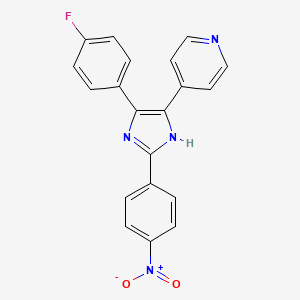
CAS Number152121-53-4
Synonyms4-[4-(4-Fluorophenyl)-2-(4-nitrophenyl)-1H-imidazol-5-yl]pyridine; 4-(4-Fluorophenyl)-2-(4-nitrophenyl)-5-(4-pyridyl)-1H-imidazole; PD169316; PD 169316
Molecular FormulaC20H13FN4O2
Molecular Weight360.341
Density1.4±0.1 g/cm3
Boiling Point583.1±50.0 °C at 760 mmHg
Appearanceyellow solid
Symbol
Signal WordWarning
| Chemical & Physical Properties | |
|---|---|
| CAS Number | 152121-53-4 |
| Catalog No. | 2A-1170185 |
| Chinese Name | PD 169316 |
| Synonyms | 4-[4-(4-Fluorophenyl)-2-(4-nitrophenyl)-1H-imidazol-5-yl]pyridine; 4-(4-Fluorophenyl)-2-(4-nitrophenyl)-5-(4-pyridyl)-1H-imidazole; PD169316; PD 169316 |
| Molecular Formula | C20H13FN4O2 |
| Molecular Weight | 360.341 |
| Density | 1.4±0.1 g/cm3 |
| Boiling Point | 583.1±50.0 °C at 760 mmHg |
| Appearance | yellow solid |
| Storage Condition | -20℃ |
| Application | PD 169316 is a highly potent, cell-permeable, and selective p38 MAP kinase inhibitor with an IC50 value of 89 nM. |
| PubChem ID | 5426806 |
| SMILES | O=[N+]([O-])c1ccc(-c2nc(-c3ccc(F)cc3)c(-c3ccncc3)[nH]2)cc1 |
| InChI | InChI=1S/C20H13FN4O2/c21-16-5-1-13(2-6-16)18-19(14-9-11-22-12-10-14)24-20(23-18)15-3-7-17(8-4-15)25(26)27/h1-12H,(H,23,24) |
| InChI Key | BGIYKDUASORTBB-UHFFFAOYSA-N |
| Hazard Symbols | transportation |
| Bioactivity | PD 169316 is a potent, cell-permeable and selective p38 MAP kinase inhibitor, with IC50 of 89 nM. Related Catalog Signaling Pathways >> Autophagy >> Autophagy Signaling Pathways >> MAPK/ERK Pathway >> p38 MAPK Research Areas >> Cancer Target IC50: 89 nM (p38 MAPK)[5] In Vitro PD169316 (10 μM) inhibits TGFβ and Activin A, but not BMP4 signaling in CaOV3 cells. PD169316 (0.2-20 μM) inhibits TGFβ-induced Smad2 nuclear translocation, Smad7 mRNA induction, and reporter gene activity in CaOV3 cells[1]. PD169316 (10 μM) shows a significantly increased rate of proliferation in Nestin knockdown cells, and can rescue the effect of Nestin knockdown on cell viability in the absence of EGF[2]. PD169316 significantly inhibits p38 MAP kinase activity with no significant change in ERK activity in PC12 cells. PD169316 (10 μM) blocks apoptosis induced by trophic factor withdrawal in differentiated PC12 cells[3]. In Vivo PD169316 (30 ng/5 μL) or in combination with U0126 improves spatial learning in MWM in Aβ-injected rats, 20 days after Aβ-injection. Pretreatment with U0126 and PD169316 decreases the levels of phosphorylated form of ERK and p38 to about 77.7 and 64.2%, respectively, and causes a significant increase in c-fos, p-CREB, NRF-1 and TFAM protein levels, compared to the Aβ-injected group[4]. Kinase Assay Sixteen hours after the removal of serum from Rat-1 fibroblasts or NGF from differentiated PC12 cells, the cells are incubated in the absence or presence of insulin (50 ng/mL) for 15 min at 37°C. After washing with 2 mL of ice-cold PBS, the cells are solubilized in 400 μL of ice-cold immunoprecipitation buffer containing 10 mM Tris, pH 7.4, 1% Triton X-100, 0.5% Nonidet P-40, 150 mM NaCl, 1 mM EDTA, 1 mM EGTA, 0.2 mM sodium orthovanadate, and 0.2 mM phenylmethylsulfonyl fluoride. The cell lysates are centrifuged to remove insoluble material, and 200 μg of the supernatant protein (400 μL, total volume) are incubated with 1 μg of anti-p38 antibodies for 1 h at 4°C followed by incubation with 30 μL of Protein G Plus/Protein A-agarose for an additional hour. The immunocomplexes are pelleted and washed twice in immunoprecipitation buffer and then once in kinase ish buffer (50 mM β-glycerolphosphate, 1 mM EGTA, 20 mM MgCl2, 100 μM sodium orthovanadate). The protein kinase assay is initiated by the addition of 20 μL of 2× reaction buffer (50 mMβ-glycerolphosphate, 1 mM EGTA, 20 mM MgCl2, 100 μM sodium orthovanadate, 0.1 mg/mL ATF-2 (N-terminal half), 50 μg/mL IP20, a peptide inhibitor of c-AMP dependent protein kinase, 200 μM ATP, and 0.9 mCi/mL [32P]ATP) to 20 μL of immune complex. The reaction is allowed to proceed for 10 min at 30°C and then terminated by the addition of 2× LaemmLi sample buffer and analyzed by SDS-polyacrylamide gel electrophoresis using 12% acrylamide gels. After electrophoresis, the gels are dried and subjected to phosphoimaging. Animal Admin Adult male albino Wistar rats weighing 210-280 g are used in these experiments. Animals are divided into six groups: (A) Aβ-injected group, which receives bilateral intra-CA1 injection of Aβ (30 ng/3 μL PBS per side), 4 h after unilateral i.c.v. administration of DMSO (5 μL/rat), without receiving any treatment; (B) vehicle group, which only receives carrier, DMSO in lateral ventricle and PBS (3 μL/side) in both CA1 regions; (C) ERK inhibitor group, which receives i.c.v. infusion of U0126 (30 μg/5 μL 1% DMSO in PBS) with PBS injection (3 μL/side in CA1); (D) p38 inhibitor group, which receives i.c.v. infusion of PD169316 (30 μg/5 μL 1% DMSO in PBS) with PBS injection (3 μL/side in CA1); and (E) treatment group which receives i.c.v. administration of U0126 (30 μg/5 μL 1% DMSO in PBS), 4 h prior to intra-hippocampal A (30 ng/3 μL PBS per side) injection; (F) treatment group which receives i.c.v. administration of PD169316 (30 μg/5 μL 1% DMSO in PBS), 4 h prior to intra-hippocampal A (30 ng/3 μL PBS per side) injection. The aforementioned groups enter two experimental protocols: behavioral experiments and molecular studies. All the groups of animals in molecular study are considered as 7 and 20-day experimental groups. References [1]. Fu Y, et al. The p38 MAPK inhibitor, PD169316, inhibits transforming growth factor beta-induced Smad signaling in human ovarian cancer cells. Biochem Biophys Res Commun. 2003 Oct 17;310(2):391-7. [2]. Hu W, et al. Suppression of Nestin reveals a critical role for p38-EGFR pathway in neural progenitor cell proliferation. Oncotarget. 2016 Dec 27;7(52):87052-87063. [3]. Kummer JL, et al. Apoptosis induced by withdrawal of trophic factors is mediated by p38 mitogen-activated protein kinase. J Biol Chem. 1997 Aug 15;272(33):20490-4. [4]. PD 169316, et al. ERK and p38 inhibitors attenuate memory deficits and increase CREB phosphorylation and PGC-1α levels in Aβ-injected rats. Behav Brain Res. 2012 Jun 15;232(1):165-73. [5]. Ayumi Iwasaki, et al. Molecular Mechanism Responsible for Fibronectin-controlled Alterations in Matrix Stiffness in Advanced Chronic Liver Fibrogenesis. THE JOURNAL OF BIOLOGICAL CHEMISTRY VOL. 291, NO. 1, pp. 72-88, January 1, 2016 [6]. Zhang Z, et al. PD169316, a specific p38 inhibitor, shows antiviral activity against Enterovirus71. Virology. 2017 Aug;508:150-158. Chemical & Physical Properties Density 1.4±0.1 g/cm3 Boiling Point 583.1±50.0 °C at 760 mmHg Molecular Formula C20H13FN4O2 Molecular Weight 360.341 Flash Point 306.4±30.1 °C Exact Mass 360.102264 PSA 87.39000 LogP 5.32 Appearance of Characters yellow solid Vapour Pressure 0.0±1.6 mmHg at 25°C Index of Refraction 1.651 InChIKey BGIYKDUASORTBB-UHFFFAOYSA-N SMILES O=[N+]([O-])c1ccc(-c2nc(-c3ccc(F)cc3)c(-c3ccncc3)[nH]2)cc1 Storage condition -20℃ |
| Use of | PD 169316 is a potent, cell-permeable and selective p38 MAP kinase inhibitor, with IC50 of 89 nM. Properties Name 4-[4-(4-fluorophenyl)-2-(4-nitrophenyl)-1H-imidazol-5-yl]pyridine Synonym More Synonyms PD 169316 Biological Activity Description PD 169316 is a potent, cell-permeable and selective p38 MAP kinase inhibitor, with IC50 of 89 nM. Related Catalog Signaling Pathways >> Autophagy >> Autophagy Signaling Pathways >> MAPK/ERK Pathway >> p38 MAPK Research Areas >> Cancer IC50: 89 nM (p38 MAPK)[5] In Vivo PD169316 (30 ng/5 μL) or in combination with U0126 improves spatial learning in MWM in Aβ-injected rats, 20 days after Aβ-injection. Pretreatment with U0126 and PD169316 decreases the levels of phosphorylated form of ERK and p38 to about 77.7 and 64.2%, respectively, and causes a significant increase in c-fos, p-CREB, NRF-1 and TFAM protein levels, compared to the Aβ-injected group[4]. References [1]. Fu Y, et al. The p38 MAPK inhibitor, PD169316, inhibits transforming growth factor beta-induced Smad signaling in human ovarian cancer cells. Biochem Biophys Res Commun. 2003 Oct 17;310(2):391-7. [2]. Hu W, et al. Suppression of Nestin reveals a critical role for p38-EGFR pathway in neural progenitor cell proliferation. Oncotarget. 2016 Dec 27;7(52):87052-87063. [4]. PD 169316, et al. ERK and p38 inhibitors attenuate memory deficits and increase CREB phosphorylation and PGC-1α levels in Aβ-injected rats. Behav Brain Res. 2012 Jun 15;232(1):165-73. [5]. Ayumi Iwasaki, et al. Molecular Mechanism Responsible for Fibronectin-controlled Alterations in Matrix Stiffness in Advanced Chronic Liver Fibrogenesis. THE JOURNAL OF BIOLOGICAL CHEMISTRY VOL. 291, NO. 1, pp. 72-88, January 1, 2016 [6]. Zhang Z, et al. PD169316, a specific p38 inhibitor, shows antiviral activity against Enterovirus71. Virology. 2017 Aug;508:150-158. Chemical & Physical Properties Molecular Formula C20H13FN4O2 Exact Mass 360.102264 PSA 87.39000 Appearance of Characters yellow solid Index of Refraction 1.651 InChIKey BGIYKDUASORTBB-UHFFFAOYSA-N Storage condition -20℃ |
| Transport Info | Product name: Purity: 97.0% |
| MSDS Transport Info | Module 14. Shipping information 14.1 UN dangerous goods number European Dangerous Regulations for land transport: 2811 International Dangerous Regulations for sea transport: 2811 International Dangerous Regulations for air transport: 2811 14.2 Names specified by the United Nations (UN) European Land Transport Dangerous Regulations: TOXIC SOLID, ORGANIC, N.O.S. (4-(4-Fluorophenyl)-2-(4-nitrophenyl)-5-(4-pyridyl)-1H- imidazole) IMDG: TOXIC SOLID, ORGANIC, N.O.S. (4-(4-Fluorophenyl)-2-(4-nitrophenyl)-5-(4-pyridyl)-1H- imidazole) International air transport hazard regulations: Toxic solid, organic, n.o.s. (4-(4-Fluorophenyl)-2-(4-nitrophenyl)-5-(4-pyridyl)-1H-imidazole) 14.3 Transport hazard categories European Land Transport Danger Regulations: 6.1 International Maritime Transport Danger Regulations: 6.1 International Air Transport Danger Regulations: 6.1 14.4 Package group European Land Transport Danger Regulations: III International Maritime Transport Danger Regulations: III International Air Transport Danger Regulations: III 14.5 Environmental hazards European Land Transport Dangerous Regulations: No International Maritime Transport Dangerous Regulations Maritime Pollutants: No International Air Transport Risk Regulations: No 14.6 Special reminder to users No data available The above information is believed to be correct, but is not all-inclusive and should be used as a guide only. The information in this document is based on our current knowledge and is Correct safety instructions apply to this product. This information does not represent a warranty as to the properties of this product. See reverse side of invoice or packing slip. |
| Related Products in Specialty Chemicals | ||
|---|---|---|
| GSK2838232 | 1443461-21-9 | 2A-1170178 |
| TAK875 | 1000413-72-8 | 2A-1170179 |
| Tarafenacin | 385367-47-5 | 2A-1170180 |
| sp-420 | 1221411-72-8 | 2A-1170181 |
| 2-(4-broMo-2-chlorophenoxy)-N-(4-(N-(4,6-diMethylpyriMidin-2-yl)sulfaMoyl)phenylcarbaMothioyl)acetaMide | 587841-73-4 | 2A-1170182 |
| BIX 02188 | 1094614-84-2 | 2A-1170186 |
| BIX 02189 | 1094614-85-3 | 2A-1170187 |
| CO-1686 | 1374640-70-6 | 2A-1170189 |
| RGFP-966 | 1357389-11-7 | 2A-1170190 |
| AZD 1080 | 612487-72-6 | 2A-1170191 |
| Browse all Specialty Chemicals products » | ||
Phone:
630-322-8886
630-322-8887
Email:
Office Locations:
Chicago, IL, USA
San Francisco, CA, USA


 EN
EN


 SDS
SDS