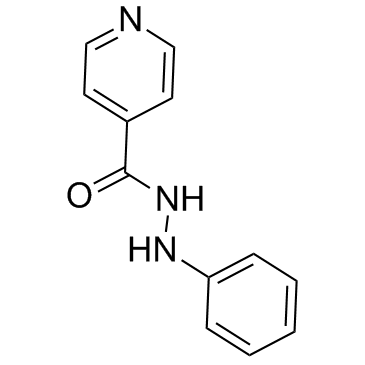
CAS Number91396-88-2
Synonyms1-Isonicotinoyl-2-phenyl-hydrazin; PluriSln 1; N'-Phenylisonicotinohydrazide; Isonicotinsaeure-phenylhydrazid; Isonicotinsaeure-(2-phenyl-hydrazid); 4-Pyridinecarboxylic acid, 2-phenylhydrazide; Isonicotinsaeure-(N'-phenyl-hydrazid); isonicotinic acid N'-phenylhydrazide; NSC 14613
Molecular FormulaC12H11N3O
Molecular Weight213.235
Density1.3±0.1 g/cm3
Boiling Point335.7±15.0 °C at 760 mmHg
Melting Point177-178℃
Appearancewhite to beige
Symbol
Signal WordWarning
| Chemical & Physical Properties | |
|---|---|
| CAS Number | 91396-88-2 |
| Catalog No. | 2A-1170167 |
| Chinese Name | 异烟酸2-苯肼 |
| Synonyms | 1-Isonicotinoyl-2-phenyl-hydrazin; PluriSln 1; N'-Phenylisonicotinohydrazide; Isonicotinsaeure-phenylhydrazid; Isonicotinsaeure-(2-phenyl-hydrazid); 4-Pyridinecarboxylic acid, 2-phenylhydrazide; Isonicotinsaeure-(N'-phenyl-hydrazid); isonicotinic acid N'-phenylhydrazide; NSC 14613 |
| Molecular Formula | C12H11N3O |
| Molecular Weight | 213.235 |
| Density | 1.3±0.1 g/cm3 |
| Boiling Point | 335.7±15.0 °C at 760 mmHg |
| Melting Point | 177-178℃ |
| Appearance | white to beige |
| Water Solubility | DMSO: soluble15mg/mL, clear |
| Storage Condition | ?20°C |
| Application | PluriSln 1 is an acyl-CoA desaturase (SCD) inhibitor and is a pluripotent cell-specific inhibitor. |
| SMILES | O=C(NNc1ccccc1)c1ccncc1 |
| InChI | InChI=1S/C12H11N3O/c16-12(10-6-8-13-9-7-10)15-14-11-4-2-1-3-5-11/h1-9,14H,(H,15,16) |
| InChI Key | HUDWXDLBWRHCKO-UHFFFAOYSA-N |
| Hazard Symbols | transportation |
| MSDS | msds/170306_2_91396_88_2.pdf |
| Bioactivity | PluriSln 1 is an inhibitor of stearoyl-coA desaturase (SCD), and is a pluripotent cell-specific inhibitor. Related Catalog Signaling Pathways >> Metabolic Enzyme/Protease >> Stearoyl-CoA Desaturase (SCD) Research Areas >> Cancer Target SCD[1] In Vitro PluriSln 1, a small-molecule inhibitor of stearoyl-coA desaturase (SCD), on induced pluripotent stem cells (iPS)-derived cardiomyocytes (CM). PluriSln 1 treatment significantly decreases the mRNA and protein level of Nanog, a marker for both cell pluripotency and tumor progression; importantly, we provide evidence that PluriSln 1 treatment at 20 µM for 1 day significantly induces the apoptosis of Nanog-positive iPS derivates (iPSD). In addition, PluriSln 1 treatment at 20 µM for 4 days diminished Nanog-positive stem cells in cultured iPSD while not increasing apoptosis of iPS-derived CM. To investigate whether PluriSln 1 treatment prevents tumorigenicity of iPSD after cell transplantation, we intramyocardially injected PluriSln 1- or DMSO-treated iPSD in a mouse model of myocardial infarction (MI). DMSO-treated iPSD readily formed Nanog-expressing tumors 2 weeks after injection, which is prevented by treatment with PluriSln 1. Moreover, treatment with PluriSln 1 does not change the expression of cTnI, α-MHC, or MLC-2v, markers of cardiac differentiation (P>0.05, n=4). Importantly, PluriSln 1-treated iPS-derived CM exhibits the ability to engraft and survive in the infarcted myocardium[1]. Cell Assay The differentiation of iPS cells to cardiomyocytes (CM) is induced by embryoid body (EB) formation. When iPS cells reached 70% confluency in 10-cm dishes, cells are digested using 0.25% trypsin/EDTA. Cell pellets are re-suspended in differentiation medium (DMEM with 20% FBS and 10 ng/mL BMP4) to a final concentration of 200,000 cells/mL. Cell suspensions are added to 6-well plates with Ulta-Low Attachment surfaces for 4 d to initiate EB formation. On day 5, EBs are cultured on 0.1% gelatin-coated dishes for 14 d using CF culture medium for the outgrowth of cardiac structures. At this stage, iPS cells undergoing EB formation are termed iPS derivates (iPSD)[1]. References [1]. Zhang L, et al. Inhibition of stearoyl-coA desaturase selectively eliminates tumorigenic Nanog-positive cells: improving the safety of iPS cell transplantation to myocardium. Cell Cycle. 2014;13(5):762-71. Chemical & Physical Properties Density 1.3±0.1 g/cm3 Boiling Point 335.7±15.0 °C at 760 mmHg Melting Point 177-178℃ Molecular Formula C12H11N3O Molecular Weight 213.235 Flash Point 156.9±20.4 °C Exact Mass 213.090210 PSA 54.02000 LogP 1.34 Appearance of Characters white to beige Vapour Pressure 0.0±0.7 mmHg at 25°C Index of Refraction 1.655 InChIKey HUDWXDLBWRHCKO-UHFFFAOYSA-N SMILES O=C(NNc1ccccc1)c1ccncc1 Storage condition ?20°C Water Solubility DMSO: soluble15mg/mL, clear |
| Use of | PluriSln 1 is an inhibitor of stearoyl-coA desaturase (SCD), and is a pluripotent cell-specific inhibitor. Properties Name N'-phenylpyridine-4-carbohydrazide Synonym More Synonyms PluriSln 1 Biological Activity Description PluriSln 1 is an inhibitor of stearoyl-coA desaturase (SCD), and is a pluripotent cell-specific inhibitor. Related Catalog Signaling Pathways >> Metabolic Enzyme/Protease >> Stearoyl-CoA Desaturase (SCD) Research Areas >> Cancer In Vitro PluriSln 1, a small-molecule inhibitor of stearoyl-coA desaturase (SCD), on induced pluripotent stem cells (iPS)-derived cardiomyocytes (CM). PluriSln 1 treatment significantly decreases the mRNA and protein level of Nanog, a marker for both cell pluripotency and tumor progression; importantly, we provide evidence that PluriSln 1 treatment at 20 µM for 1 day significantly induces the apoptosis of Nanog-positive iPS derivates (iPSD). In addition, PluriSln 1 treatment at 20 µM for 4 days diminished Nanog-positive stem cells in cultured iPSD while not increasing apoptosis of iPS-derived CM. To investigate whether PluriSln 1 treatment prevents tumorigenicity of iPSD after cell transplantation, we intramyocardially injected PluriSln 1- or DMSO-treated iPSD in a mouse model of myocardial infarction (MI). DMSO-treated iPSD readily formed Nanog-expressing tumors 2 weeks after injection, which is prevented by treatment with PluriSln 1. Moreover, treatment with PluriSln 1 does not change the expression of cTnI, α-MHC, or MLC-2v, markers of cardiac differentiation (P>0.05, n=4). Importantly, PluriSln 1-treated iPS-derived CM exhibits the ability to engraft and survive in the infarcted myocardium[1]. References [1]. Zhang L, et al. Inhibition of stearoyl-coA desaturase selectively eliminates tumorigenic Nanog-positive cells: improving the safety of iPS cell transplantation to myocardium. Cell Cycle. 2014;13(5):762-71. Chemical & Physical Properties Molecular Formula C12H11N3O Exact Mass 213.090210 PSA 54.02000 Appearance of Characters white to beige Index of Refraction 1.655 InChIKey HUDWXDLBWRHCKO-UHFFFAOYSA-N |
| Transport Info | Shipping Name: UN |
| MSDS Transport Info | Module 14. Shipping information 14.1 UN dangerous goods number European Land Transport Dangerous Regulations: -International Maritime Dangerous Regulations: -International Air Transport Dangerous Regulations: - 14.2 United Nations shipping name European Land Transport Dangerous Regulations: Non-dangerous goods IMDG Code: Non-dangerous goods International air transport dangerous goods regulations: non-dangerous goods 14.3 Transport hazard categories European Land Transport Dangerous Regulations: -International Maritime Dangerous Regulations: -International Air Transport Dangerous Regulations: - 14.4 Package group European Land Transport Dangerous Regulations: -International Maritime Dangerous Regulations: -International Air Transport Dangerous Regulations: - 14.5 Environmental hazards European Land Transport Danger Regulations: No International Maritime Danger Regulations International Air Transport Danger Regulations: No Marine pollutants (yes/no): No 14.6 Special reminder to users No data available |
| Related Products in Functional Building Blocks | ||
|---|---|---|
| [1R-(1alpha,2beta,5alpha)]-2-(isopropyl)-5-methylcyclohexanecarboxylic acid | 16052-40-7 | 2A-1170090 |
| 2,3,4,9-TETRAHYDRO-1H-BETA-CARBOLINE-3-CARBOXYLIC ACID | 6052-68-2 | 2A-1170117 |
| 1 3-DI-Z-2-(TRIFLUOROMETHYLSULFONYL)- | 207857-19-0 | 2A-1170135 |
| (1,10-Phenanthroline)(trifluoroMethyl)copper(I) | 1300746-79-5 | 2A-1170155 |
| 9-(DichloroMethylene)-1,2,3,4-tetrahydro-1,4-Methanonaphthalen-5-aMine | 935772-63-7 | 2A-1170159 |
| (2-Iodo-5-methoxyphenyl)boronic acid | 89694-50-8 | 2A-1170209 |
| 1-BROMO-4-NAPHTHALDEHYDE | 50672-84-9 | 2A-1170212 |
| 2-amino-4-methoxy-benzaldehyde | 59236-36-1 | 2A-1170231 |
| (R)-1-(2-(2,5-dichlorobenzamido)acetamido)-3-methylbutylboronic acid | 1072833-77-2 | 2A-1170245 |
| 4-Oxoadamantane-1-carboxylic acid methyl ester | 56674-88-5 | 2A-1170285 |
| Browse all Functional Building Blocks products » | ||
Phone:
630-322-8886
630-322-8887
Email:
Office Locations:
Chicago, IL, USA
San Francisco, CA, USA


 EN
EN


 SDS
SDS