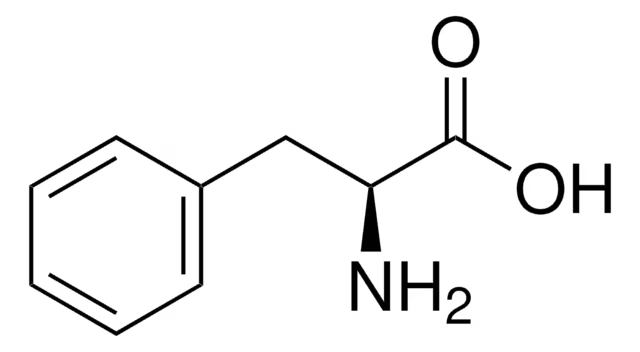
CAS Number63-91-2
SynonymsBenzenepropanethioic acid,S-phenyl ester; (S)-phenylalanine; L-Phenylalanine; EINECS 200-568-1; (2S)-2-amino-3-phenylpropanoic acid; L-PHENYLALININE; H-Phe-OH; L-phenylalanine zwitterion; S-phenylalanine; (S)-(-)-Phenylalanine; Thiohydrozimtsaeurephenylester; (S)-a-Amino-b-phenylpropionic Acid; L-2-Amino-3-phenylpropionic acid; (S)-2-Amino-3-phenylpropionic acid; (S)-2-Amino-3-phenylpropanoic acid; (S)-a-Aminohydrocinnamic Acid; Phenylalanine; (L)-Phenylalanine; Phenylalanine (VAN); l-Phe; PhE; phenyl 4-phenylthiobutanoate; S-Phenyl-3-phenylpropanthioat; β-phenyl-L-alanine; (-)-Phenylalanine; (S)-α-Aminobenzenepropanoic acid; MFCD00064227; 3-Phenylpropionyl-phenyl-thioether; α-Amino-β-phenylpropionic acid; 3-Phenylthiopropionic acid,S-phenyl ester
Molecular FormulaC6H5CH2CH(NH2)CO2H
Molecular Weight165.19
Purity98.5-101.0%
Density1.2±0.1 g/cm3
Boiling Point307.5±30.0 °C at 760 mmHg
Melting Point270-275 °C (dec.) (lit.)
Appearancepowder
EINECS200-568-1
Symbol
Signal WordWarning
| Chemical & Physical Properties | |
|---|---|
| CAS Number | 63-91-2 |
| Catalog No. | 2A-9016893 |
| Chinese Name | L-苯丙氨酸 |
| Synonyms | Benzenepropanethioic acid,S-phenyl ester; (S)-phenylalanine; L-Phenylalanine; EINECS 200-568-1; (2S)-2-amino-3-phenylpropanoic acid; L-PHENYLALININE; H-Phe-OH; L-phenylalanine zwitterion; S-phenylalanine; (S)-(-)-Phenylalanine; Thiohydrozimtsaeurephenylester; (S)-a-Amino-b-phenylpropionic Acid; L-2-Amino-3-phenylpropionic acid; (S)-2-Amino-3-phenylpropionic acid; (S)-2-Amino-3-phenylpropanoic acid; (S)-a-Aminohydrocinnamic Acid; Phenylalanine; (L)-Phenylalanine; Phenylalanine (VAN); l-Phe; PhE; phenyl 4-phenylthiobutanoate; S-Phenyl-3-phenylpropanthioat; β-phenyl-L-alanine; (-)-Phenylalanine; (S)-α-Aminobenzenepropanoic acid; MFCD00064227; 3-Phenylpropionyl-phenyl-thioether; α-Amino-β-phenylpropionic acid; 3-Phenylthiopropionic acid,S-phenyl ester |
| Molecular Formula | C6H5CH2CH(NH2)CO2H |
| Molecular Weight | 165.19 |
| Purity | 98.5-101.0 |
| Density | 1.2±0.1 g/cm3 |
| Boiling Point | 307.5±30.0 °C at 760 mmHg |
| Melting Point | 270-275 °C (dec.) (lit.) |
| Appearance | powder |
| Storage Condition | 1. This product should be sealed and stored in a c |
| Application | L-Phenylalanine is an alpha_2_delta_ calcium channel antagonist with a Ki of 980 nM. |
| EINECS | 200-568-1 |
| HTC | 29224995 |
| PubChem ID | 24898657 |
| MDL Number | MFCD00064227 |
| SMILES | N[C@@H](Cc1ccccc1)C(O)=O |
| InChI | 1S/C9H11NO2/c10-8(9(11)12)6-7-4-2-1-3-5-7/h1-5,8H,6,10H2,(H,11,12)/t8-/m0/s1 |
| InChI Key | COLNVLDHVKWLRT-QMMMGPOBSA-N |
| Beilstein/REAXYS | 1910408 |
| NACRES Code | NA.26 |
| eCl@ss | 32160406 |
| UNSPSC | 12352209 |
| Hazard Symbols | Transport |
| MSDS | msds/16893_1_63_91_2.pdf |
| Bioactivity | L-Phenylalanine is an antagonist at α2δ calcium channels with a Ki of 980 nM. IC50 Value: 980 nM [1]Target: Calcium ChannelL-Phenylalanine (LPA) is an electrically neutral amino acid, one of the twenty common amino acids used to biochemically form proteins. In the brain, L-phenylalanine is a competitive antagonist at the glycine binding site of NMDA receptor and at the glutamate binding site of AMPA receptor [2, 3]. At the glycine binding site of NMDA receptor L-phenylalanine has an apparent equilibrium dissociation constant (KB) of 573 ?M estimated by Schild regression [4] which is considerably lower than brain L-phenylalanine concentration observed in untreated human phenylketonuria [5]. L-Phenylalanine also inhibits neurotransmitter release at glutamatergic synapses in hippocampus and cortex with IC50 of 980 nM, a brain concentration seen in classical phenylketonuria, whereas D-phenylalanine has a significantly smaller effect [3]. Related Catalog Signaling Pathways >> Membrane Transporter/Ion Channel >> Calcium Channel Research Areas >> Metabolic Disease Natural Products >> Phenylpropanoids References [1]. Mortell, K.H., et al., Structure-activity relationships of alpha-amino acid ligands for the alpha2delta subunit of voltage-gated calcium channels. Bioorg Med Chem Lett, 2006. 16(5): p. 1138-41. [2]. Glushakov, A.V., et al., Specific inhibition of N-methyl-D-aspartate receptor function in rat hippocampal neurons by L-phenylalanine at concentrations observed during phenylketonuria. Mol Psychiatry, 2002. 7(4): p. 359-67. [3]. Glushakov, A.V., et al., L-phenylalanine selectively depresses currents at glutamatergic excitatory synapses. J Neurosci Res, 2003. 72(1): p. 116-24. [4]. Glushakov, A.V., et al., Long-term changes in glutamatergic synaptic transmission in phenylketonuria. Brain, 2005. 128(Pt 2): p. 300-7. [5]. Moller, H.E., et al., Brain imaging and proton magnetic resonance spectroscopy in patients with phenylketonuria. Pediatrics, 2003. 112(6 Pt 2): p. 1580-3. Chemical & Physical Properties Density 1.2±0.1 g/cm3 Boiling Point 307.5±30.0 °C at 760 mmHg Melting Point 270-275ºC (dec.)(lit.) Molecular Formula C9H11NO2 Molecular Weight 165.189 Flash Point 139.8±24.6 °C Exact Mass 165.078979 PSA 63.32000 LogP 1.11 Vapour Pressure 0.0±0.7 mmHg at 25°C Index of Refraction 1.576 InChIKey COLNVLDHVKWLRT-QMMMGPOBSA-N SMILES NC(Cc1ccccc1)C(=O)O |
| Use of | L-Phenylalanine is an antagonist at α2δ calcium channels with a Ki of 980 nM. IC50 Value: 980 nM [1]Target: Calcium ChannelL-Phenylalanine (LPA) is an electrically neutral amino acid, one of the twenty common amino acids used to biochemically form proteins. In the brain, L-phenylalanine is a competitive antagonist at the glycine binding site of NMDA receptor and at the glutamate binding site of AMPA receptor [2, 3]. At the glycine binding site of NMDA receptor L-phenylalanine has an apparent equilibrium dissociation constant (KB) of 573 ?M estimated by Schild regression [4] which is considerably lower than brain L-phenylalanine concentration observed in untreated human phenylketonuria [5]. L-Phenylalanine also inhibits neurotransmitter release at glutamatergic synapses in hippocampus and cortex with IC50 of 980 nM, a brain concentration seen in classical phenylketonuria, whereas D-phenylalanine has a significantly smaller effect [3]. Properties Articles233 Name L-phenylalanine Synonym More Synonyms L-Phenylalanine Biological Activity Description L-Phenylalanine is an antagonist at α2δ calcium channels with a Ki of 980 nM. IC50 Value: 980 nM [1]Target: Calcium ChannelL-Phenylalanine (LPA) is an electrically neutral amino acid, one of the twenty common amino acids used to biochemically form proteins. In the brain, L-phenylalanine is a competitive antagonist at the glycine binding site of NMDA receptor and at the glutamate binding site of AMPA receptor [2, 3]. At the glycine binding site of NMDA receptor L-phenylalanine has an apparent equilibrium dissociation constant (KB) of 573 ?M estimated by Schild regression [4] which is considerably lower than brain L-phenylalanine concentration observed in untreated human phenylketonuria [5]. L-Phenylalanine also inhibits neurotransmitter release at glutamatergic synapses in hippocampus and cortex with IC50 of 980 nM, a brain concentration seen in classical phenylketonuria, whereas D-phenylalanine has a significantly smaller effect [3]. Related Catalog Signaling Pathways >> Membrane Transporter/Ion Channel >> Calcium Channel Research Areas >> Metabolic Disease Natural Products >> Phenylpropanoids References [1]. Mortell, K.H., et al., Structure-activity relationships of alpha-amino acid ligands for the alpha2delta subunit of voltage-gated calcium channels. Bioorg Med Chem Lett, 2006. 16(5): p. 1138-41. [2]. Glushakov, A.V., et al., Specific inhibition of N-methyl-D-aspartate receptor function in rat hippocampal neurons by L-phenylalanine at concentrations observed during phenylketonuria. Mol Psychiatry, 2002. 7(4): p. 359-67. [3]. Glushakov, A.V., et al., L-phenylalanine selectively depresses currents at glutamatergic excitatory synapses. J Neurosci Res, 2003. 72(1): p. 116-24. [4]. Glushakov, A.V., et al., Long-term changes in glutamatergic synaptic transmission in phenylketonuria. Brain, 2005. 128(Pt 2): p. 300-7. [5]. Moller, H.E., et al., Brain imaging and proton magnetic resonance spectroscopy in patients with phenylketonuria. Pediatrics, 2003. 112(6 Pt 2): p. 1580-3. Chemical & Physical Properties Molecular Formula C9H11NO2 Exact Mass 165.078979 PSA 63.32000 Index of Refraction 1.576 InChIKey COLNVLDHVKWLRT-QMMMGPOBSA-N |
| Transport Info | Shipping Name: UN |
| MSDS Transport Info | Module 14. Shipping information 14.1 UN dangerous goods number European Land Transport Dangerous Regulations: -International Maritime Dangerous Regulations: -International Air Transport Dangerous Regulations: - 14.2 United Nations shipping name European Land Transport Dangerous Regulations: Non-dangerous goods IMDG Code: Non-dangerous goods International air transport dangerous goods regulations: non-dangerous goods 14.3 Transport hazard categories European Land Transport Dangerous Regulations: -International Maritime Dangerous Regulations: -International Air Transport Dangerous Regulations: - 14.4 Package group European Land Transport Dangerous Regulations: -International Maritime Dangerous Regulations: -International Air Transport Dangerous Regulations: - 14.5 Environmental hazards European Land Transport Danger Regulations: No International Maritime Danger Regulations International Air Transport Danger Regulations: No Marine pollutants (yes/no): No 14.6 Special reminder to users No data available |
| Related Products in Nutritional Ingredients | ||
|---|---|---|
| Pyridoxine hydrochloride | 58-56-0 | 2A-9016784 |
| Vitamin E; D-alpha-tocopherol | 59-02-9 | 2A-9016801 |
| Folic acid | 59-30-3 | 2A-9016806 |
| L-Tyrosine | 60-18-4 | 2A-9016833 |
| Acetylcholine chloride | 60-31-1 | 2A-9016839 |
| Pyridoxine; Vitamin B6 | 65-23-6 | 2A-9016915 |
| 3,5-Diiodo-DL-tyrosine | 66-02-4 | 2A-9016927 |
| Pyridoxal | 66-72-8 | 2A-9016933 |
| Thiamine hydrochloride; Vitamin B1 | 67-03-8 | 2A-9016941 |
| Thiamine disulfide | 67-16-3 | 2A-9016944 |
| Browse all Nutritional Ingredients products » | ||
Phone:
630-322-8886
630-322-8887
Email:
Office Locations:
Chicago, IL, USA
San Francisco, CA, USA


 EN
EN


 SDS
SDS