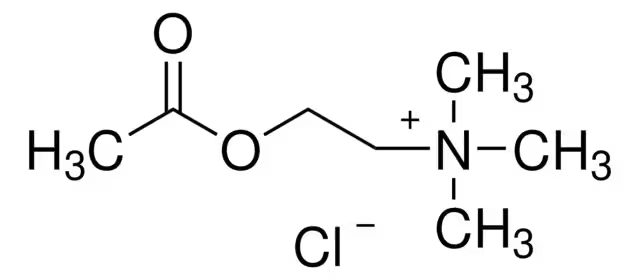
CAS Number60-31-1
SynonymsAcetylcholine chloride; 2-Acetoxy-N,N,N-trimethylethanaminium chloride; ethanaminium, 2-(acetyloxy)-N,N,N-trimethyl-, chloride; chlorure de 2-(acétyloxy)-N,N,N-triméthyléthanaminium; Ovisot; Acecoline; EINECS 200-468-8; MFCD00011698; Ethanaminium, 2-(acetyloxy)-N,N,N-trimethyl-, chloride (1:1); Arterocoline; 2-(acetyloxy)-N,N,N-trimethylethanaminium chloride; Acetylcholine chloride,2-(Acetyloxy)-N,N,N-trimethylethanaminiumchloride; 2-(Acetyloxy)-N,N,N-trimethylethanaminiumchlorid; Acetylcholinium chloride; Acetylcholine (chloride)
Molecular Formula(CH3)3N+CH2CH2OCOCH3Cl-
Molecular Weight181.66
Purity≥99 (TLC)%
Melting Point146-150 °C (lit.)
AppearanceWhite crystalline powder
EINECS200-468-8
Symbol
Signal WordWarning
| Chemical & Physical Properties | |
|---|---|
| CAS Number | 60-31-1 |
| Catalog No. | 2A-9016839 |
| Chinese Name | 氯化乙酰胆碱; 乙酰氯化胆碱 |
| Synonyms | Acetylcholine chloride; 2-Acetoxy-N,N,N-trimethylethanaminium chloride; ethanaminium, 2-(acetyloxy)-N,N,N-trimethyl-, chloride; chlorure de 2-(acétyloxy)-N,N,N-triméthyléthanaminium; Ovisot; Acecoline; EINECS 200-468-8; MFCD00011698; Ethanaminium, 2-(acetyloxy)-N,N,N-trimethyl-, chloride (1:1); Arterocoline; 2-(acetyloxy)-N,N,N-trimethylethanaminium chloride; Acetylcholine chloride,2-(Acetyloxy)-N,N,N-trimethylethanaminiumchloride; 2-(Acetyloxy)-N,N,N-trimethylethanaminiumchlorid; Acetylcholinium chloride; Acetylcholine (chloride) |
| Molecular Formula | (CH3)3N+CH2CH2OCOCH3Cl- |
| Molecular Weight | 181.66 |
| Purity | ≥99 (TLC) |
| Melting Point | 146-150 °C (lit.) |
| Appearance | White crystalline powder |
| Water Solubility | Soluble IN COLD WATER |
| Storage Condition | Warehouse Ventilation Low Temperature Drying |
| Application | Acetylcholine is a neurotransmitter that induces the opening of calcium ion channels. |
| EINECS | 200-468-8 |
| HTC | 29379000 |
| PubChem ID | 57653875 |
| MDL Number | MFCD00011698 |
| SMILES | [Cl-].CC(=O)OCC[N+](C)(C)C |
| InChI | 1S/C7H16NO2.ClH/c1-7(9)10-6-5-8(2,3)4;/h5-6H2,1-4H3;1H/q+1;/p-1 |
| InChI Key | JUGOREOARAHOCO-UHFFFAOYSA-M |
| Beilstein/REAXYS | 3571875 |
| NACRES Code | NA.25 |
| UNSPSC | 51151535 |
| Hazard Symbols | Transport |
| MSDS | msds/16839_1_60_31_1.pdf |
| Bioactivity | Acetylcholine is a neurotransmitter that can induce the opening of calcium channels. Target: Calcium Channel; nAChR; mAChRAcetylcholine in vertebrates is the major transmitter at neuromuscular junctions, autonomic ganglia, parasympathetic effector junctions, a subset of sympathetic effector junctions, and at many sites in the central nervous system. It is generally not used as an administered drug because it is broken down very rapidly by cholinesterases, but it is useful in some ophthalmological applications.Acetylcholine chloride, more commonly referred to as just acetylcholine, is a cholinergic neurotransmitter that can induce the opening of calcium channels, as well as act on nicotinic and muscarinic acetylcholine receptors. Acetylcholine plays an important role at many sites in the central nervous system. The compound has been shown to have ophthalmological uses and can be broken down quickly by choliesterases. Studies show that non-neuronal acetylcholine influences many basic cells functions, such as mitosis, cells differentiation, cytoskeletal organization, and cell to cell contact, among other functions [1-3]. Related Catalog Signaling Pathways >> Autophagy >> Autophagy Signaling Pathways >> Membrane Transporter/Ion Channel >> Calcium Channel Natural Products >> Alkaloid Research Areas >> Neurological Disease References [1]. Pepeu, G. and P. Blandina, The acetylcholine, GABA, glutamate triangle in the rat forebrain. J Physiol Paris, 1998. 92(5-6): p. 351-5. [2]. Israel, M. and Y. Dunant, Acetylcholine release and the cholinergic genomic locus. Mol Neurobiol, 1998. 16(1): p. 1-20. [3]. Lei, X., et al., Effects of acetylcholine chloride on intracellular calcium concentration of cultured sweat gland epithelial cells. Arch Dermatol Res, 2008. 300(7): p. 335-41. Chemical & Physical Properties Melting Point 146-150 °C(lit.) Molecular Formula C7H16ClNO2 Molecular Weight 181.660 Exact Mass 181.086960 PSA 26.30000 InChIKey JUGOREOARAHOCO-UHFFFAOYSA-M SMILES CC(=O)OCC[N+](C)(C)C.[Cl-] Stability Stable. Substances to be avoided include strong oxidizing agents. Protect from moisture - very hygroscopic. |
| Use of | Acetylcholine is a neurotransmitter that can induce the opening of calcium channels. Target: Calcium Channel; nAChR; mAChRAcetylcholine in vertebrates is the major transmitter at neuromuscular junctions, autonomic ganglia, parasympathetic effector junctions, a subset of sympathetic effector junctions, and at many sites in the central nervous system. It is generally not used as an administered drug because it is broken down very rapidly by cholinesterases, but it is useful in some ophthalmological applications.Acetylcholine chloride, more commonly referred to as just acetylcholine, is a cholinergic neurotransmitter that can induce the opening of calcium channels, as well as act on nicotinic and muscarinic acetylcholine receptors. Acetylcholine plays an important role at many sites in the central nervous system. The compound has been shown to have ophthalmological uses and can be broken down quickly by choliesterases. Studies show that non-neuronal acetylcholine influences many basic cells functions, such as mitosis, cells differentiation, cytoskeletal organization, and cell to cell contact, among other functions [1-3]. Properties Articles150 Name acetylcholine chloride Synonym More Synonyms Acetylcholine chloride Biological Activity Description Acetylcholine is a neurotransmitter that can induce the opening of calcium channels. Target: Calcium Channel; nAChR; mAChRAcetylcholine in vertebrates is the major transmitter at neuromuscular junctions, autonomic ganglia, parasympathetic effector junctions, a subset of sympathetic effector junctions, and at many sites in the central nervous system. It is generally not used as an administered drug because it is broken down very rapidly by cholinesterases, but it is useful in some ophthalmological applications.Acetylcholine chloride, more commonly referred to as just acetylcholine, is a cholinergic neurotransmitter that can induce the opening of calcium channels, as well as act on nicotinic and muscarinic acetylcholine receptors. Acetylcholine plays an important role at many sites in the central nervous system. The compound has been shown to have ophthalmological uses and can be broken down quickly by choliesterases. Studies show that non-neuronal acetylcholine influences many basic cells functions, such as mitosis, cells differentiation, cytoskeletal organization, and cell to cell contact, among other functions [1-3]. Related Catalog Signaling Pathways >> Autophagy >> Autophagy Signaling Pathways >> Membrane Transporter/Ion Channel >> Calcium Channel Natural Products >> Alkaloid Research Areas >> Neurological Disease References [1]. Pepeu, G. and P. Blandina, The acetylcholine, GABA, glutamate triangle in the rat forebrain. J Physiol Paris, 1998. 92(5-6): p. 351-5. [2]. Israel, M. and Y. Dunant, Acetylcholine release and the cholinergic genomic locus. Mol Neurobiol, 1998. 16(1): p. 1-20. [3]. Lei, X., et al., Effects of acetylcholine chloride on intracellular calcium concentration of cultured sweat gland epithelial cells. Arch Dermatol Res, 2008. 300(7): p. 335-41. Chemical & Physical Properties Exact Mass 181.086960 PSA 26.30000 InChIKey JUGOREOARAHOCO-UHFFFAOYSA-M SMILES CC(=O)OCC[N+](C)(C)C.[Cl-] Stability Stable. Substances to be avoided include strong oxidizing agents. Protect from moisture - very hygroscopic. |
| Tax Rebate | 9.0% |
| Supervision | none |
| Transport Info | Shipping Name: UN |
| MSDS Transport Info | Module 14. Shipping information 14.1 UN dangerous goods number European Land Transport Dangerous Regulations: -International Maritime Dangerous Regulations: -International Air Transport Dangerous Regulations: - 14.2 United Nations shipping name European Land Transport Dangerous Regulations: Non-dangerous goods IMDG Code: Non-dangerous goods International air transport dangerous goods regulations: non-dangerous goods 14.3 Transport hazard categories European Land Transport Dangerous Regulations: -International Maritime Dangerous Regulations: -International Air Transport Dangerous Regulations: - 14.4 Package group European Land Transport Dangerous Regulations: -International Maritime Dangerous Regulations: -International Air Transport Dangerous Regulations: - 14.5 Environmental hazards European Land Transport Danger Regulations: No International Maritime Danger Regulations International Air Transport Danger Regulations: No Marine pollutants (yes/no): No 14.6 Special reminder to users No data available |
| Related Products in Nutritional Ingredients | ||
|---|---|---|
| Ergosterol | 57-87-4 | 2A-9016758 |
| Pyridoxine hydrochloride | 58-56-0 | 2A-9016784 |
| Vitamin E; D-alpha-tocopherol | 59-02-9 | 2A-9016801 |
| Folic acid | 59-30-3 | 2A-9016806 |
| L-Tyrosine | 60-18-4 | 2A-9016833 |
| L-Phenylalanine | 63-91-2 | 2A-9016893 |
| Pyridoxine; Vitamin B6 | 65-23-6 | 2A-9016915 |
| 3,5-Diiodo-DL-tyrosine | 66-02-4 | 2A-9016927 |
| Pyridoxal | 66-72-8 | 2A-9016933 |
| Thiamine hydrochloride; Vitamin B1 | 67-03-8 | 2A-9016941 |
| Browse all Nutritional Ingredients products » | ||
Phone:
630-322-8886
630-322-8887
Email:
Office Locations:
Chicago, IL, USA
San Francisco, CA, USA


 EN
EN


 SDS
SDS