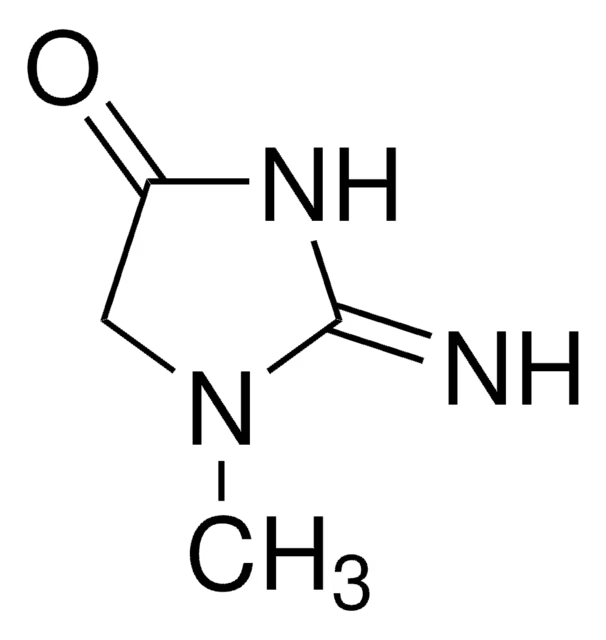
CAS Number60-27-5
SynonymsCreatinine,heated; Creatinine; 1-Methylglycocyamidine; 4H-Imidazol-4-one,2-amino-1,5-dihydro-1-methyl; 2-amino-1,5-dihydro-1-methyl-4H-imidazol-4-one; [3H]-Creatinine; 2-amino-1-methylimidazolin-4-one; 2-amino-3-methyl-4H-imidazol-5-one; 2-Amino-1-methyl-1,5-dihydroimidazol-4-one; 1-methyl-2-amino-1,5-dihydroimidazol-4-one; EINECS 200-466-7; MFCD00059730; 1-Methylhydantoin-2-imide; 2-Amino-1-methyl-1,5-dihydro-4H-imidazol-4-one; 2-imino-1-methylimidazolidin-4-one; 2-Imino-N-methylhydantoin
Molecular FormulaC4H7N3O
Molecular Weight113.12
Purity≥98%
Density1.5±0.1 g/cm3
Boiling Point184.3±23.0 °C at 760 mmHg
Melting Point295 °C (dec.) (lit.)
Appearancepowder
EINECS200-466-7
| Chemical & Physical Properties | |
|---|---|
| CAS Number | 60-27-5 |
| Catalog No. | 2A-9016837 |
| Chinese Name | 肌酐 |
| Synonyms | Creatinine,heated; Creatinine; 1-Methylglycocyamidine; 4H-Imidazol-4-one,2-amino-1,5-dihydro-1-methyl; 2-amino-1,5-dihydro-1-methyl-4H-imidazol-4-one; [3H]-Creatinine; 2-amino-1-methylimidazolin-4-one; 2-amino-3-methyl-4H-imidazol-5-one; 2-Amino-1-methyl-1,5-dihydroimidazol-4-one; 1-methyl-2-amino-1,5-dihydroimidazol-4-one; EINECS 200-466-7; MFCD00059730; 1-Methylhydantoin-2-imide; 2-Amino-1-methyl-1,5-dihydro-4H-imidazol-4-one; 2-imino-1-methylimidazolidin-4-one; 2-Imino-N-methylhydantoin |
| Molecular Formula | C4H7N3O |
| Molecular Weight | 113.12 |
| Purity | ≥98 |
| Density | 1.5±0.1 g/cm3 |
| Boiling Point | 184.3±23.0 °C at 760 mmHg |
| Melting Point | 295 °C (dec.) (lit.) |
| Appearance | powder |
| Water Solubility | SOLUBLE |
| Storage Condition | This product should be sealed and stored in a dry |
| Application | Creatinine (NSC13123) is a breakdown product of creatine phosphate in muscles. |
| EINECS | 200-466-7 |
| HTC | 2933290090 |
| PubChem ID | 24892677 |
| MDL Number | MFCD00059730 |
| SMILES | CN1CC(=O)N=C1N |
| InChI | 1S/C4H7N3O/c1-7-2-3(8)6-4(7)5/h2H2,1H3,(H2,5,6,8) |
| InChI Key | DDRJAANPRJIHGJ-UHFFFAOYSA-N |
| Beilstein/REAXYS | 112061 |
| NACRES Code | NA.22 |
| UNSPSC | 12352100 |
| MSDS | msds/16837_1_60_27_5.pdf |
| Bioactivity | Creatinine(NSC13123) is a break-down product of creatine phosphate in muscle, and is usually produced at a fairly constant rate by the body.Target: OthersCreatinine is a breakdown product of creatine phosphate in muscle, and is usually produced at a fairly constant rate by the body (depending on muscle mass). Creatine is synthesized primarily in the liver from the methylation of glycocyamine (guanidino acetate, synthesized in the kidney from the amino acids arginine and glycine) by S-adenosyl methionine. It is then transported through blood to the other organs, muscle, and brain, where, through phosphorylation, it becomes the high-energy compound phosphocreatine. During the reaction, creatine and phosphocreatine are catalyzed by creatine kinase, and a spontaneous conversion to creatinine may occur [1]. Creatinine levels in blood and urine may be used to calculate the creatinine clearance (CrCl), which reflects the glomerular filtration rate (GFR), an important clinical index of renal function [2]. Related Catalog Research Areas >> Metabolic Disease Natural Products >> Alkaloid Target Human Endogenous Metabolite References [1]. Allen, P.J., Creatine metabolism and psychiatric disorders: Does creatine supplementation have therapeutic value. Neurosci Biobehav Rev, 2012. 36(5): p. 1442-62. [2]. Levey, A.S., et al., Using standardized serum creatinine values in the modification of diet in renal disease study equation for estimating glomerular filtration rate. Ann Intern Med, 2006. 145(4): p. 247-54. Chemical & Physical Properties Density 1.5±0.1 g/cm3 Boiling Point 184.3±23.0 °C at 760 mmHg Melting Point 295 °C (dec.)(lit.) Molecular Formula C4H7N3O Molecular Weight 113.118 Flash Point 65.3±22.6 °C Exact Mass 113.058914 PSA 58.69000 LogP -1.68 Vapour Pressure 0.2±0.8 mmHg at 25°C Index of Refraction 1.651 InChIKey DDRJAANPRJIHGJ-UHFFFAOYSA-N SMILES CN1CC(=O)N=C1N Storage condition 2-8°C Stability Stable. Incompatible with strong oxidizing agents. Water Solubility SOLUBLE |
| Use of | Creatinine(NSC13123) is a break-down product of creatine phosphate in muscle, and is usually produced at a fairly constant rate by the body.Target: OthersCreatinine is a breakdown product of creatine phosphate in muscle, and is usually produced at a fairly constant rate by the body (depending on muscle mass). Creatine is synthesized primarily in the liver from the methylation of glycocyamine (guanidino acetate, synthesized in the kidney from the amino acids arginine and glycine) by S-adenosyl methionine. It is then transported through blood to the other organs, muscle, and brain, where, through phosphorylation, it becomes the high-energy compound phosphocreatine. During the reaction, creatine and phosphocreatine are catalyzed by creatine kinase, and a spontaneous conversion to creatinine may occur [1]. Creatinine levels in blood and urine may be used to calculate the creatinine clearance (CrCl), which reflects the glomerular filtration rate (GFR), an important clinical index of renal function [2]. Properties Articles1683 Name creatinine Synonym More Synonyms Creatinine Biological Activity Description Creatinine(NSC13123) is a break-down product of creatine phosphate in muscle, and is usually produced at a fairly constant rate by the body.Target: OthersCreatinine is a breakdown product of creatine phosphate in muscle, and is usually produced at a fairly constant rate by the body (depending on muscle mass). Creatine is synthesized primarily in the liver from the methylation of glycocyamine (guanidino acetate, synthesized in the kidney from the amino acids arginine and glycine) by S-adenosyl methionine. It is then transported through blood to the other organs, muscle, and brain, where, through phosphorylation, it becomes the high-energy compound phosphocreatine. During the reaction, creatine and phosphocreatine are catalyzed by creatine kinase, and a spontaneous conversion to creatinine may occur [1]. Creatinine levels in blood and urine may be used to calculate the creatinine clearance (CrCl), which reflects the glomerular filtration rate (GFR), an important clinical index of renal function [2]. Related Catalog Research Areas >> Metabolic Disease Natural Products >> Alkaloid Human Endogenous Metabolite References [1]. Allen, P.J., Creatine metabolism and psychiatric disorders: Does creatine supplementation have therapeutic value. Neurosci Biobehav Rev, 2012. 36(5): p. 1442-62. [2]. Levey, A.S., et al., Using standardized serum creatinine values in the modification of diet in renal disease study equation for estimating glomerular filtration rate. Ann Intern Med, 2006. 145(4): p. 247-54. Chemical & Physical Properties Molecular Formula C4H7N3O Exact Mass 113.058914 PSA 58.69000 LogP -1.68 Index of Refraction 1.651 InChIKey DDRJAANPRJIHGJ-UHFFFAOYSA-N Stability Stable. Incompatible with strong oxidizing agents. Water Solubility SOLUBLE |
| Tax Rebate | 13.0% |
| Supervision | None. MFN tariff: 6.5%. Ordinary tariff: 20.0% |
| Transport Info | Product name: Purity: 98.0% |
| MSDS Transport Info | Module 14. Shipping information United Nations classification: inconsistent with United Nations classification standards UN number: not specified |
| Related Products in Specialty Chemicals | ||
|---|---|---|
| Prosultiamine | 59-58-5 | 2A-9016820 |
| Furacilin; Nitrofurazone | 59-87-0 | 2A-9016823 |
| Tolazoline hydrochloride | 59-97-2 | 2A-9016826 |
| Dithizone | 60-10-6 | 2A-9016830 |
| 2-Aminoethanethiol | 60-23-1 | 2A-9016835 |
| Diethyl ether | 60-29-7 | 2A-0201714 |
| 6-Aminocaproic acid | 60-32-2 | 2A-9016840 |
| Antipyrine | 60-80-0 | 2A-9016847 |
| Cyclic AMP | 60-92-4 | 2A-9016850 |
| Sodium naphthalene-1-acetate | 61-31-4 | 2A-9016855 |
| Browse all Specialty Chemicals products » | ||
Phone:
630-322-8886
630-322-8887
Email:
Office Locations:
Chicago, IL, USA
San Francisco, CA, USA


 EN
EN


 SDS
SDS