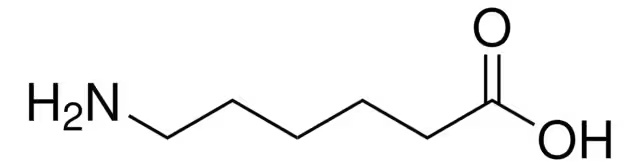
CAS Number60-32-2
Synonymsε-aminocaproic acid; N-Cbz-ε-aminocaproic Acid; 6-Aminocaproic acid; 6-amino hexanoic acid; HEXANOIC ACID,6-AMINO; w-Aminocaproic acid; Aminohexanoic acid; Acidum Aminocaproicum; Aminocaproic acid; 6-(((Benzyloxy)carbonyl)amino)hexanoic acid; 6-[N-(Benzyloxycarbonyl)amino]hexanoic acid; 6-amino-n-hexanoic acid; H-6-Aca-OH; ε-Amino-n-caproic acid; 6-amino-hexanoic acid; N-Cbz-6-aminocaproic acid; N-benzyloxycarbonyl-6-aminohexanoic acid; N-Carbobenzoxy-ε-aminocaproic Acid; acido aminocaproico; H-ε-Acp-OH; ε-aminohexanoic acid; H-EAhx-OH; 6-{[(Benzyloxy)carbonyl]amino}hexanoic acid; N-Carbobenzoxy-6-aminohexanoic Acid; 6-amino-n-caproic acid; 4-aminobutyltrimethoxysilane; N-(Benzyloxycarbonyl)-6-aminohexanoic acid; MFCD00008238; H-6-Ahx-OH; 6-[(phenylmethoxy)carbonylamino]hexanoic acid
Molecular FormulaH2N(CH2)5CO2H
Molecular Weight131.17
Purity≥99 (titration)%
Density1.0±0.1 g/cm3
Boiling Point255.6±23.0 °C at 760 mmHg
Melting Point207-209 °C (dec.) (lit.)
Appearancepowder
EINECS200-469-3
Symbol
Signal WordWarning


Please Login or Create an Account to: See VlP prices and availability
US Stock: ship in 0-1 business day
Global Stock: ship in 5-7 days
| Chemical & Physical Properties | |
|---|---|
| CAS Number | 60-32-2 |
| Catalog No. | 2A-9016840 |
| Chinese Name | 6-氨基己酸 |
| Synonyms | ε-aminocaproic acid; N-Cbz-ε-aminocaproic Acid; 6-Aminocaproic acid; 6-amino hexanoic acid; HEXANOIC ACID,6-AMINO; w-Aminocaproic acid; Aminohexanoic acid; Acidum Aminocaproicum; Aminocaproic acid; 6-(((Benzyloxy)carbonyl)amino)hexanoic acid; 6-[N-(Benzyloxycarbonyl)amino]hexanoic acid; 6-amino-n-hexanoic acid; H-6-Aca-OH; ε-Amino-n-caproic acid; 6-amino-hexanoic acid; N-Cbz-6-aminocaproic acid; N-benzyloxycarbonyl-6-aminohexanoic acid; N-Carbobenzoxy-ε-aminocaproic Acid; acido aminocaproico; H-ε-Acp-OH; ε-aminohexanoic acid; H-EAhx-OH; 6-{[(Benzyloxy)carbonyl]amino}hexanoic acid; N-Carbobenzoxy-6-aminohexanoic Acid; 6-amino-n-caproic acid; 4-aminobutyltrimethoxysilane; N-(Benzyloxycarbonyl)-6-aminohexanoic acid; MFCD00008238; H-6-Ahx-OH; 6-[(phenylmethoxy)carbonylamino]hexanoic acid |
| Molecular Formula | H2N(CH2)5CO2H |
| Molecular Weight | 131.17 |
| Purity | ≥99 (titration) |
| Density | 1.0±0.1 g/cm3 |
| Boiling Point | 255.6±23.0 °C at 760 mmHg |
| Melting Point | 207-209 °C (dec.) (lit.) |
| Appearance | powder |
| Water Solubility | SOLUBLE |
| Storage Condition | Store sealed and away from light. |
| Application | 6-Aminocaproic acid is an antifibrinolytic agent that inhibits plasminogen activator. |
| EINECS | 200-469-3 |
| HTC | 29224995 |
| PubChem ID | 24890662 |
| MDL Number | MFCD00008238 |
| SMILES | NCCCCCC(O)=O |
| InChI | 1S/C6H13NO2/c7-5-3-1-2-4-6(8)9/h1-5,7H2,(H,8,9) |
| InChI Key | SLXKOJJOQWFEFD-UHFFFAOYSA-N |
| Beilstein/REAXYS | 906872 |
| NACRES Code | NA.77 |
| UNSPSC | 12352202 |
| Hazard Symbols | Transport |
| MSDS | msds/16840_1_60_32_2.pdf |
| Bioactivity | 6-Aminocaproic acid is an antifibrinolytic agent that acts by inhibiting plasminogen activators which have fibrinolytic properties.Target: Others6-aminohexanoic acid is a derivative and analogue of the amino acid lysine, which makes it an effective inhibitor for enzymes that bind that particular residue. Such enzymes include proteolytic enzymes like plasmin, the enzyme responsible for fibrinolysis. Aminocaproic acid is also an intermediate in the polymerization of Nylon-6, where it is formed by ring-opening hydrolysis of caprolactam.Aminocaproic acid is used to treat excessive postoperative bleeding, especially after procedures in which a great amount of bleeding is expected, such as cardiac surgery. Aminocaproic acid can also be used to treat the overdose and/or toxic effects of the thrombolytic pharmacologic agents tissue plasminogen activator and streptokinase [1, 2]. Related Catalog Signaling Pathways >> Others >> Others Research Areas >> Metabolic Disease Natural Products >> Others References [1]. Gardner, F.H. and R.E. Helmer, 3rd, Aminocaproic acid. Use in control of hemorrhage in patients with amegakaryocytic thrombocytopenia. JAMA, 1980. 243(1): p. 35-7. [2]. Schwartz, B.S., et al., Epsilon-aminocaproic acid in the treatment of patients with acute promyelocytic leukemia and acquired alpha-2-plasmin inhibitor deficiency. Ann Intern Med, 1986. 105(6): p. 873-7. Chemical & Physical Properties Density 1.0±0.1 g/cm3 Boiling Point 255.6±23.0 °C at 760 mmHg Melting Point 207-209 °C (dec.)(lit.) Molecular Formula C6H13NO2 Molecular Weight 131.173 Flash Point 108.4±22.6 °C Exact Mass 131.094635 PSA 63.32000 LogP -0.11 Vapour Pressure 0.0±1.1 mmHg at 25°C Index of Refraction 1.467 InChIKey SLXKOJJOQWFEFD-UHFFFAOYSA-N SMILES NCCCCCC(=O)O Water Solubility SOLUBLE |
| Use of | 6-Aminocaproic acid is an antifibrinolytic agent that acts by inhibiting plasminogen activators which have fibrinolytic properties.Target: Others6-aminohexanoic acid is a derivative and analogue of the amino acid lysine, which makes it an effective inhibitor for enzymes that bind that particular residue. Such enzymes include proteolytic enzymes like plasmin, the enzyme responsible for fibrinolysis. Aminocaproic acid is also an intermediate in the polymerization of Nylon-6, where it is formed by ring-opening hydrolysis of caprolactam.Aminocaproic acid is used to treat excessive postoperative bleeding, especially after procedures in which a great amount of bleeding is expected, such as cardiac surgery. Aminocaproic acid can also be used to treat the overdose and/or toxic effects of the thrombolytic pharmacologic agents tissue plasminogen activator and streptokinase [1, 2]. Properties Articles86 Name 6-aminohexanoate Synonym More Synonyms 6-Aminocaproic acid Biological Activity Description 6-Aminocaproic acid is an antifibrinolytic agent that acts by inhibiting plasminogen activators which have fibrinolytic properties.Target: Others6-aminohexanoic acid is a derivative and analogue of the amino acid lysine, which makes it an effective inhibitor for enzymes that bind that particular residue. Such enzymes include proteolytic enzymes like plasmin, the enzyme responsible for fibrinolysis. Aminocaproic acid is also an intermediate in the polymerization of Nylon-6, where it is formed by ring-opening hydrolysis of caprolactam.Aminocaproic acid is used to treat excessive postoperative bleeding, especially after procedures in which a great amount of bleeding is expected, such as cardiac surgery. Aminocaproic acid can also be used to treat the overdose and/or toxic effects of the thrombolytic pharmacologic agents tissue plasminogen activator and streptokinase [1, 2]. Related Catalog Signaling Pathways >> Others >> Others Research Areas >> Metabolic Disease Natural Products >> Others References [1]. Gardner, F.H. and R.E. Helmer, 3rd, Aminocaproic acid. Use in control of hemorrhage in patients with amegakaryocytic thrombocytopenia. JAMA, 1980. 243(1): p. 35-7. [2]. Schwartz, B.S., et al., Epsilon-aminocaproic acid in the treatment of patients with acute promyelocytic leukemia and acquired alpha-2-plasmin inhibitor deficiency. Ann Intern Med, 1986. 105(6): p. 873-7. Chemical & Physical Properties Molecular Formula C6H13NO2 Exact Mass 131.094635 PSA 63.32000 LogP -0.11 Index of Refraction 1.467 InChIKey SLXKOJJOQWFEFD-UHFFFAOYSA-N SMILES NCCCCCC(=O)O Water Solubility SOLUBLE |
| Tax Rebate | 9.0% |
| Supervision | A. Customs clearance form for inbound goods B. Customs clearance form for outbound goods |
| Inspection | P. Quarantine of entry animals, plants, and animal and plant products Q. Quarantine of exit animals, plants, and animal and plant products R. Hygiene supervision and inspection of imported food S. Hyg |
| Transport Info | Shipping Name: UN |
| MSDS Transport Info | Module 14. Shipping information 14.1 United Nations number European Land Transport Dangerous Regulations: -International Maritime Dangerous Regulations: -International Air Transport Dangerous Regulations: - 14.2 United Nations shipping name European Land Transport Dangerous Regulations: Non-dangerous goods IMDG Code: Non-dangerous goods International air transport dangerous goods regulations: non-dangerous goods 14.3 Transport hazard categories European Land Transport Dangerous Regulations: -International Maritime Dangerous Regulations: -International Air Transport Dangerous Regulations: - 14.4 Package group European Land Transport Dangerous Regulations: -International Maritime Dangerous Regulations: -International Air Transport Dangerous Regulations: - 14.5 Environmental hazards European Land Transport Danger Regulations: No International Maritime Danger Regulations International Air Transport Danger Regulations: No Marine pollutants (yes/no): No 14.6 Special precautions No data available |
| Related Products in Specialty Chemicals | ||
|---|---|---|
| Tolazoline hydrochloride | 59-97-2 | 2A-9016826 |
| Dithizone | 60-10-6 | 2A-9016830 |
| 2-Aminoethanethiol | 60-23-1 | 2A-9016835 |
| Creatinine | 60-27-5 | 2A-9016837 |
| Diethyl ether | 60-29-7 | 2A-0201714 |
| Antipyrine | 60-80-0 | 2A-9016847 |
| Cyclic AMP | 60-92-4 | 2A-9016850 |
| Sodium naphthalene-1-acetate | 61-31-4 | 2A-9016855 |
| N,N-Dimethyltryptamine | 61-50-7 | 2A-9016857 |
| N,N-Dipropyltryptamine | 61-52-9 | 2A-9016858 |
| Browse all Specialty Chemicals products » | ||
Phone:
630-322-8886
630-322-8887
Email:
Office Locations:
Chicago, IL, USA
San Francisco, CA, USA


 EN
EN

 SDS
SDS