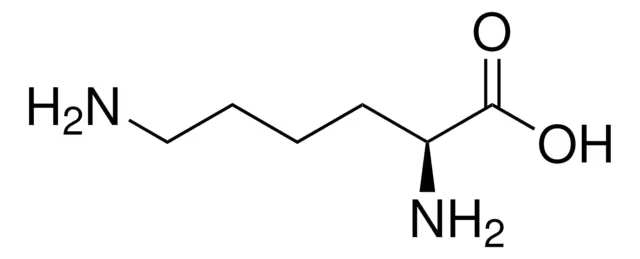
CAS Number56-87-1
SynonymsL-lys; Lisina [Spanish]; 6-Amino-L-norleucine; (+)-S-Lysine; Lys; (l)-lysine; (S)-(+)-Lysine; Aminutrin; Lysine acid; (S)-a,e-Diaminocaproic Acid; Lysinum [Latin]; (S)-lysine; Lysine; FEMA 3847; (S)-2,6-diamino-Hexanoic acid; L-Lysine; MFCD00064433; EINECS 200-294-2; H-Lys-OH; L-lysine zwitterion
Molecular FormulaH2N(CH2)4CH(NH2)CO2H
Molecular Weight146.19
Purity≥98 (TLC)%
Density1.1±0.1 g/cm3
Boiling Point311.5±32.0 °C at 760 mmHg
Melting Point215 °C (dec.) (lit.)
Appearancepowder
EINECS200-294-2
Symbol
Signal WordWarning
| Chemical & Physical Properties | |
|---|---|
| CAS Number | 56-87-1 |
| Catalog No. | 2A-9016718 |
| Chinese Name | L-赖氨酸 |
| Synonyms | L-lys; Lisina [Spanish]; 6-Amino-L-norleucine; (+)-S-Lysine; Lys; (l)-lysine; (S)-(+)-Lysine; Aminutrin; Lysine acid; (S)-a,e-Diaminocaproic Acid; Lysinum [Latin]; (S)-lysine; Lysine; FEMA 3847; (S)-2,6-diamino-Hexanoic acid; L-Lysine; MFCD00064433; EINECS 200-294-2; H-Lys-OH; L-lysine zwitterion |
| Molecular Formula | H2N(CH2)4CH(NH2)CO2H |
| Molecular Weight | 146.19 |
| Purity | ≥98 (TLC) |
| Density | 1.1±0.1 g/cm3 |
| Boiling Point | 311.5±32.0 °C at 760 mmHg |
| Melting Point | 215 °C (dec.) (lit.) |
| Appearance | powder |
| Water Solubility | H2O: 0.1 g/mL, clear, colorless |
| Storage Condition | This product should be sealed and stored dry and b |
| Application | L-lysine is an essential amino acid. It plays an important role in connective tissue and carnitine synthesis, energy production, children's growth and maintenance of immune function [2]. |
| EINECS | 200-294-2 |
| HTC | 2922411000 |
| PubChem ID | 24896404 |
| MDL Number | MFCD00064433 |
| SMILES | NCCCC[C@H](N)C(O)=O |
| InChI | 1S/C6H14N2O2/c7-4-2-1-3-5(8)6(9)10/h5H,1-4,7-8H2,(H,9,10)/t5-/m0/s1 |
| InChI Key | KDXKERNSBIXSRK-YFKPBYRVSA-N |
| Beilstein/REAXYS | 1722531 |
| NACRES Code | NA.26 |
| eCl@ss | 32160406 |
| UNSPSC | 12352209 |
| Hazard Symbols | Transport |
| MSDS | msds/16718_1_56_87_1.pdf |
| Bioactivity | L-lysine is an essential amino acid[1][2] with important roles in connective tissues and carnitine synthesis, energy production, growth in children, and maintenance of immune functions[2]. Related Catalog Signaling Pathways >> Others >> Others Research Areas >> Inflammation/Immunology Target L-lysine (150 mg/kg) promotes, but not initiates, bladder cancer. The administration of L-lysine to rats submitted to colovesical cystoplasty accelerates the development of transitional metaplasia of the intestinal epithelium[1]. L-lysine (10 mg/kg) treatment attenuates pancreatic tissue injury induced by L-arginine by inhibiting the release of the inflammatory cytokine IL-6 and enhance antioxidant activity[2]. References [1]. Santos AMD, et al. Transitional metaplasia in intestinal epithelium of rats submitted to intestinal cystoplasty and treatment with L -lysine. Acta Cir Bras. 2017 Apr;32(4):297-306. [2]. Al-Malki AL. Suppression of acute pancreatitis by L-lysine in mice. BMC Complement Altern Med. 2015 Jun 23;15:193. Chemical & Physical Properties Density 1.1±0.1 g/cm3 Boiling Point 311.5±32.0 °C at 760 mmHg Melting Point 215 °C (dec.)(lit.) Molecular Formula C6H14N2O2 Molecular Weight 146.188 Flash Point 142.2±25.1 °C Exact Mass 146.105530 PSA 89.34000 LogP -1.04 Vapour Pressure 0.0±1.4 mmHg at 25°C Index of Refraction 1.503 InChIKey KDXKERNSBIXSRK-YFKPBYRVSA-N SMILES NCCCCC(N)C(=O)O Storage condition Store at RT. Stability Stable. Incompatible with strong oxidizing agents. Water Solubility H2O: 0.1 g/mL, clear, colorless |
| Use of | L-lysine is an essential amino acid[1][2] with important roles in connective tissues and carnitine synthesis, energy production, growth in children, and maintenance of immune functions[2]. Properties Articles351 Name L-lysine Synonym More Synonyms L-Lysine Biological Activity Description L-lysine is an essential amino acid[1][2] with important roles in connective tissues and carnitine synthesis, energy production, growth in children, and maintenance of immune functions[2]. Related Catalog Signaling Pathways >> Others >> Others Research Areas >> Inflammation/Immunology References [1]. Santos AMD, et al. Transitional metaplasia in intestinal epithelium of rats submitted to intestinal cystoplasty and treatment with L -lysine. Acta Cir Bras. 2017 Apr;32(4):297-306. [2]. Al-Malki AL. Suppression of acute pancreatitis by L-lysine in mice. BMC Complement Altern Med. 2015 Jun 23;15:193. Chemical & Physical Properties Molecular Formula C6H14N2O2 Exact Mass 146.105530 PSA 89.34000 LogP -1.04 Index of Refraction 1.503 InChIKey KDXKERNSBIXSRK-YFKPBYRVSA-N SMILES NCCCCC(N)C(=O)O Storage condition Store at RT. Stability Stable. Incompatible with strong oxidizing agents. |
| Tax Rebate | 9.0% |
| Supervision | A. Customs clearance form for inbound goods B. Customs clearance form for outbound goods |
| Inspection | P. Quarantine of entry animals, plants, and animal and plant products Q. Quarantine of exit animals, plants, and animal and plant products M. Inspection of imported commodities |
| Transport Info | Product name: Purity: 0.0% |
| MSDS Transport Info | Module 14. Shipping information 14.1 UN dangerous goods number European Land Transport Dangerous Regulations: -International Maritime Dangerous Regulations: -International Air Transport Dangerous Regulations: - 14.2 Names specified by the United Nations (UN) European Land Transport Dangerous Regulations: Non-dangerous goods IMDG Code: Non-dangerous goods International air transport dangerous goods regulations: non-dangerous goods 14.3 Transport hazard categories European Land Transport Dangerous Regulations: -International Maritime Dangerous Regulations: -International Air Transport Dangerous Regulations: - 14.4 Package group European Land Transport Dangerous Regulations: -International Maritime Dangerous Regulations: -International Air Transport Dangerous Regulations: - 14.5 Environmental hazards European Land Transport Dangerous Regulations: No International Maritime Transport Dangerous Regulations Maritime Pollutants: No International Air Transport Risk Regulations: No 14.6 Special reminder to users No data available |
| Related Products in Specialty Chemicals | ||
|---|---|---|
| Tetraethyl ammonium chloride | 56-34-8 | 2A-9016699 |
| Benzyltriethylammonium chloride | 56-37-1 | 2A-9016701 |
| L-Serine | 56-45-1 | 2A-9016705 |
| 5-Hydroxytryptophan | 56-69-9 | 2A-9016711 |
| L-Aspartic acid | 56-84-8 | 2A-9016715 |
| L-Cystine | 56-89-3 | 2A-9016719 |
| Histamine dihydrochloride | 56-92-8 | 2A-9016721 |
| 6-Acetamidohexanoic acid | 57-08-9 | 2A-9016728 |
| Hexadecyl trimethyl ammonium bromide | 57-09-0 | 2A-9016729 |
| Palmitic acid | 57-10-3 | 2A-9016730 |
| Browse all Specialty Chemicals products » | ||
Phone:
630-322-8886
630-322-8887
Email:
Office Locations:
Chicago, IL, USA
San Francisco, CA, USA


 EN
EN


 SDS
SDS