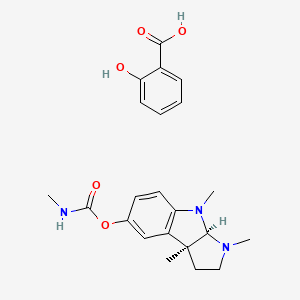
| Chemical & Physical Properties | |
|---|---|
| CAS Number | 57-64-7 |
| Catalog No. | 2A-1166692 |
| Chinese Name | 水杨酸毒扁豆碱 |
| Synonyms | EINECS 200-343-8; MFCD00135659; Physostigmine Salicylate |
| Molecular Formula | C22H27N3O5 |
| Molecular Weight | 413.46700 |
| Purity | 96 |
| Boiling Point | 393.5ºC at 760 mmHg |
| Melting Point | 181-183 °C |
| Appearance | Colorless crystal, odorless |
| Storage Condition | 2-8°C |
| Packaging | II |
| Application | Physostigmine salicylate (Eserine salicylate) is a reversible inhibitor of acetylcholinesterase (AChE). Physostigmine salicylate crosses the blood-brain barrier and stimulates central cholinergic neur |
| HTC | 2933990090 |
| PubChem ID | 855875 |
| SMILES | CNC(=O)Oc1ccc2c(c1)C1(C)CCN(C)C1N2C.O=C(O)c1ccccc1O |
| InChI | InChI=1S/C15H21N3O2.C7H6O3/c1-15-7-8-17(3)13(15)18(4)12-6-5-10(9-11(12)15)20-14(19)16-2;8-6-4-2-1-3-5(6)7(9)10/h5-6,9,13H,7-8H2,1-4H3,(H,16,19);1-4,8H,(H,9,10)/t13-,15+;/m1./s1 |
| InChI Key | HZOTZTANVBDFOF-PBCQUBLHSA-N |
| Hazard Symbols | 6.1(a) |
| Bioactivity | Physostigmine salicylate (Eserine salicylate) is a reversible acetylcholinesterase (AChE) inhibitor. Physostigmine salicylate crosses the blood-brain barrier and stimulates central cholinergic neurotransmission. Physostigmine salicylate can reverse memory deficits in transgenic mice with Alzheimer's disease. Physostigmine salicylate is also an antidote for anticholinergic poisoning[1][2][3][4]. Related Catalog Research Areas >> Neurological Disease Signaling Pathways >> Neuronal Signaling >> AChE In Vivo Physostigmine salicylate (Eserine salicylate; 0.03-0.3 mg/kg; s.c.; daily for 6 weeks) improves deficits in contextual and cued memory in Tg(+) mice[2]. Physostigmine salicylate (IV; 0.1, 0.2 mg/kg) delays time to emergence from isoflurane anesthesia at doses ≥0.2 mg/kg in male Sprague-Dawley rats[4]. Animal Model: Heterozygous transgenic mice (Tg(+) mice)[2] Dosage: 0.03, 0.1, and 0.3 mg/kg Administration: SC; daily for 6 weeks Result: Tended to normalize the contextual memory deficit in Tg(+) animals so that they became more similar to Tg(-) animals. References [1]. Haase U, et al. Pharmakotherapie--physostigmin post OP [Pharmacotherapy--physostigmine administered post-operatively]. Anasthesiol Intensivmed Notfallmed Schmerzther. 2007;42(3):188‐189. [2]. Dong H, et al, Bertchume A, Vallera D, Csernansky JG. Acetylcholinesterase inhibitors ameliorate behavioral deficits in the Tg2576 mouse model of Alzheimer's disease. Psychopharmacology (Berl). 2005;181(1):145‐152. [3]. Frascogna N. Physostigmine: is there a role for this antidote in pediatric poisonings?. Curr Opin Pediatr. 2007;19(2):201‐205. [4]. Jonathan D Kenny, et al. Physostigmine and Methylphenidate Induce Distinct Arousal States During Isoflurane General Anesthesia in Rats. Anesth Analg. 2016 Nov;123(5):1210-1219. Chemical & Physical Properties Boiling Point 393.5ºC at 760 mmHg Melting Point 181-183 °C Molecular Formula C22H27N3O5 Molecular Weight 413.46700 Flash Point 191.8ºC Exact Mass 413.19500 PSA 102.34000 LogP 3.25810 InChIKey HZOTZTANVBDFOF-PBCQUBLHSA-N SMILES CNC(=O)Oc1ccc2c(c1)C1(C)CCN(C)C1N2C.O=C(O)c1ccccc1O Storage condition 2-8°C |
| Use of | Physostigmine salicylate (Eserine salicylate) is a reversible acetylcholinesterase (AChE) inhibitor. Physostigmine salicylate crosses the blood-brain barrier and stimulates central cholinergic neurotransmission. Physostigmine salicylate can reverse memory deficits in transgenic mice with Alzheimer's disease. Physostigmine salicylate is also an antidote for anticholinergic poisoning[1][2][3][4]. Properties Articles25 Name Eserine Salicylate Synonym More Synonyms Physostigmine salicylate Biological Activity Description Physostigmine salicylate (Eserine salicylate) is a reversible acetylcholinesterase (AChE) inhibitor. Physostigmine salicylate crosses the blood-brain barrier and stimulates central cholinergic neurotransmission. Physostigmine salicylate can reverse memory deficits in transgenic mice with Alzheimer's disease. Physostigmine salicylate is also an antidote for anticholinergic poisoning[1][2][3][4]. Related Catalog Research Areas >> Neurological Disease Signaling Pathways >> Neuronal Signaling >> AChE References [1]. Haase U, et al. Pharmakotherapie--physostigmin post OP [Pharmacotherapy--physostigmine administered post-operatively]. Anasthesiol Intensivmed Notfallmed Schmerzther. 2007;42(3):188‐189. [3]. Frascogna N. Physostigmine: is there a role for this antidote in pediatric poisonings?. Curr Opin Pediatr. 2007;19(2):201‐205. [4]. Jonathan D Kenny, et al. Physostigmine and Methylphenidate Induce Distinct Arousal States During Isoflurane General Anesthesia in Rats. Anesth Analg. 2016 Nov;123(5):1210-1219. Chemical & Physical Properties Molecular Formula C22H27N3O5 Exact Mass 413.19500 PSA 102.34000 LogP 3.25810 InChIKey HZOTZTANVBDFOF-PBCQUBLHSA-N |
| Tax Rebate | 13.0% |
| Supervision | None. MFN tariff: 6.5%. Ordinary tariff: 20.0% |
| Transport Info | Product name: Purity: 98.0% |
| MSDS Transport Info | Module 14. Shipping information United Nations classification: Item 1 Poisons. UN number: 1544 Formal shipping name: Alkaloid salt, solid, not otherwise specified Packing grade: I |
| Related Products in Alkaloids | ||
|---|---|---|
| Nicotine ditartrate | 65-31- 6 | 2A-9092677 |
| CATHARANTHINE SULFATE | 70674-90-7 | 2A-9093216 |
| MONOCROTALINE | 315-22-0 | 2A-9093323 |
| 3-Chloromethcathinone Hydrochloride | 1607439-32-6 | 2A-9093527 |
| 9S-AMINO-9-DEOXYQUININE | 168960-95-0 | 2A-0150615 |
| (+/-)-NICOTINE | 22083-74-5 | 2A-1166751 |
| TETRAHYDROPIPERINE | 23434-88-0 | 2A-1166760 |
| 2-Oxaindolizidine | 6833-37-0 | 2A-1167609 |
| LAPPACONITINE HYDROBROMIDE | 97792-45-5 | 2A-1168627 |
| N-DESMETHYLGALANTHAMINE | 41303-74-6 | 2A-1170025 |
| Browse all Alkaloids products » | ||
Phone:
630-322-8886
630-322-8887
Email:
Office Locations:
Chicago, IL, USA
San Francisco, CA, USA


 EN
EN


 SDS
SDS