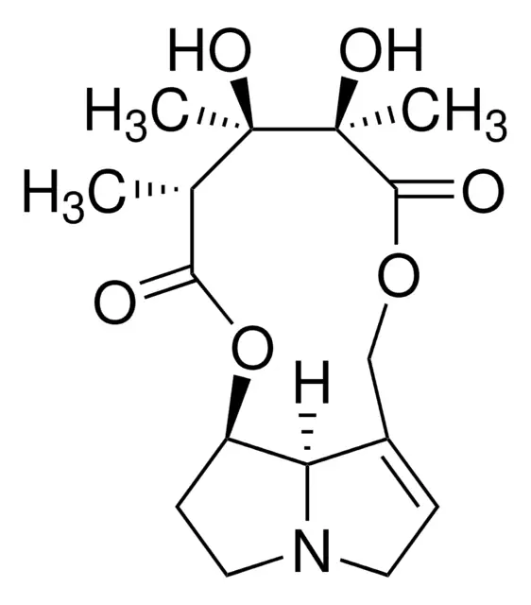
CAS Number315-22-0
SynonymsMonocrotaline/crotaline; Monccrotalire; Bulbus Lilii; CROTALINE; (13a,14a)-14,19-Dihydro-12,13-dihydroxy-20-norcrotolanan-11,15-dione; Monocrotaline; MONOCRATALINE; MFCD00084656; A 6080; MONOCROTALIN; CROTALIN; Crotaline,Monocrotaline
Molecular FormulaC16H23NO6
Molecular Weight325.36
Density1.4±0.1 g/cm3
Boiling Point537.3±50.0 °C at 760 mmHg
Melting Point204 °C (dec.) (lit.)
Appearancepowder
Symbol
Signal WordWarning
| Chemical & Physical Properties | |
|---|---|
| CAS Number | 315-22-0 |
| Catalog No. | 2A-9093323 |
| Chinese Name | 单响尾蛇毒蛋白 |
| Synonyms | Monocrotaline/crotaline; Monccrotalire; Bulbus Lilii; CROTALINE; (13a,14a)-14,19-Dihydro-12,13-dihydroxy-20-norcrotolanan-11,15-dione; Monocrotaline; MONOCRATALINE; MFCD00084656; A 6080; MONOCROTALIN; CROTALIN; Crotaline,Monocrotaline |
| Molecular Formula | C16H23NO6 |
| Molecular Weight | 325.36 |
| Density | 1.4±0.1 g/cm3 |
| Boiling Point | 537.3±50.0 °C at 760 mmHg |
| Melting Point | 204 °C (dec.) (lit.) |
| Appearance | powder |
| Storage Condition | This product should be sealed and stored dry at 4° |
| Packaging | III |
| Application | Monocrotaline is a pyrrolizidine alkaloid extracted from the seeds of the Monocrotaline plant and is used to induce pulmonary hypertension in rodents. |
| HTC | 29399990 |
| PubChem ID | 24892326 |
| MDL Number | MFCD00084656 |
| SMILES | [H][C@@]12[C@H]3CCN1CC=C2COC(=O)[C@](C)(O)[C@](C)(O)[C@@H](C)C(=O)O3 |
| InChI | 1S/C16H23NO6/c1-9-13(18)23-11-5-7-17-6-4-10(12(11)17)8-22-14(19)16(3,21)15(9,2)20/h4,9,11-12,20-21H,5-8H2,1-3H3/t9-,11+,12+,15+,16-/m0/s1 |
| InChI Key | QVCMHGGNRFRMAD-XFGHUUIASA-N |
| Beilstein/REAXYS | 48732 |
| NACRES Code | NA.77 |
| UNSPSC | 12352200 |
| Hazard Symbols | 6.1(b) |
| MSDS | msds/93323_1_315_22_0.pdf |
| Bioactivity | Monocrotaline is an pyrrolizidine alkaloid extracted from the seeds of the Crotalaria spectabilis plant to induce pulmonary hypertension in rodents. Related Catalog Signaling Pathways >> Others >> Others Natural Products >> Others Research Areas >> Metabolic Disease In Vitro Monocrotaline (MCT) is an 11-membered macrocyclic pyrrolizidine alkaloid (PA) derived from the seeds of the Crotalaria spectabilis plant[1]. Monocrotaline a natural ligand exhibits dose-dependent cytotoxicity with potent antineoplastic activity. The in vitro cytotoxicity of monocrotaline is proved at IC50 24.966 µg/mL and genotoxicity at 2 X IC50 against HepG2 cells[2]. In Vivo MCT causes a pulmonary vascular syndrome in rats characterized by proliferative pulmonary vasculitis, pulmonary hypertension (PH), and cor pulmonale[3]. Among preclinical models of pulmonary arterial hypertension (PAH), monocrotaline animal model offers the advantage of mimic several key aspects of human PAH, including vascular remodeling, proliferation of smooth muscle cells, endothelial dysfunction, upregulation of inflammatory cytokines, and right ventricle failure, requiring a single drug injection[4]. Changes in multiple pathways associated with the development of PH, including activated glycolysis, increased markers of proliferation, disruptions in carnitine homeostasis, increased inflammatory and fibrosis biomarkers, and a reduction in glutathione biosynthesis are observed with the injection of monocrotaline[5]. Animal Admin Rats: A total of 20 male Sprague Dawley rats (SD; 220-270g) are used in this study (n=10 per group). Control group received vehicle for monocrotaline (MCT). Pre-pulmonary hypertension (PH) group received a single injection of MCT (60 mg/kg i.p.) to induce and are sacrificed after 14 days[5]. References [1]. Gomez-Arroyo JG, et al. The monocrotaline model of pulmonary hypertension in perspective. Am J Physiol Lung Cell Mol Physiol. 2012 Feb 15;302(4):L363-9. [2]. Kusuma SS, et al. Antineoplastic activity of monocrotaline against hepatocellular carcinoma. Anticancer Agents Med Chem. 2014;14(9):1237-48. [3]. Wilson DW, et, al. Mechanisms and pathology of monocrotaline pulmonary toxicity. Crit Rev Toxicol. 1992;22(5-6):307-25. [4]. Nogueira-Ferreira R, et al. Exploring the monocrotaline animal model for the study of pulmonary arterial hypertension: A network approach. Pulm Pharmacol Ther. 2015 Dec;35:8-16. [5]. Rafikova O,et al. Metabolic Changes Precede the Development of Pulmonary Hypertension in the Monocrotaline Exposed RatLung. PLoS One. 2016 Mar 3;11(3):e0150480. Chemical & Physical Properties Density 1.4±0.1 g/cm3 Boiling Point 537.3±50.0 °C at 760 mmHg Melting Point 204ºC (dec.)(lit.) Molecular Formula C16H23NO6 Molecular Weight 325.357 Flash Point 278.7±30.1 °C Exact Mass 325.152527 PSA 96.30000 LogP -0.37 Vapour Pressure 0.0±3.2 mmHg at 25°C Index of Refraction 1.586 InChIKey QVCMHGGNRFRMAD-XFGHUUIASA-N SMILES CC1C(=O)OC2CCN3CC=C(COC(=O)C(C)(O)C1(C)O)C23 Storage condition 2~8°C |
| Use of | Monocrotaline is an pyrrolizidine alkaloid extracted from the seeds of the Crotalaria spectabilis plant to induce pulmonary hypertension in rodents. Properties Articles72 Name monocrotaline Synonym More Synonyms Crotaline Biological Activity Description Monocrotaline is an pyrrolizidine alkaloid extracted from the seeds of the Crotalaria spectabilis plant to induce pulmonary hypertension in rodents. Related Catalog Signaling Pathways >> Others >> Others Natural Products >> Others Research Areas >> Metabolic Disease In Vivo MCT causes a pulmonary vascular syndrome in rats characterized by proliferative pulmonary vasculitis, pulmonary hypertension (PH), and cor pulmonale[3]. Among preclinical models of pulmonary arterial hypertension (PAH), monocrotaline animal model offers the advantage of mimic several key aspects of human PAH, including vascular remodeling, proliferation of smooth muscle cells, endothelial dysfunction, upregulation of inflammatory cytokines, and right ventricle failure, requiring a single drug injection[4]. Changes in multiple pathways associated with the development of PH, including activated glycolysis, increased markers of proliferation, disruptions in carnitine homeostasis, increased inflammatory and fibrosis biomarkers, and a reduction in glutathione biosynthesis are observed with the injection of monocrotaline[5]. References [1]. Gomez-Arroyo JG, et al. The monocrotaline model of pulmonary hypertension in perspective. Am J Physiol Lung Cell Mol Physiol. 2012 Feb 15;302(4):L363-9. [2]. Kusuma SS, et al. Antineoplastic activity of monocrotaline against hepatocellular carcinoma. Anticancer Agents Med Chem. 2014;14(9):1237-48. [3]. Wilson DW, et, al. Mechanisms and pathology of monocrotaline pulmonary toxicity. Crit Rev Toxicol. 1992;22(5-6):307-25. [4]. Nogueira-Ferreira R, et al. Exploring the monocrotaline animal model for the study of pulmonary arterial hypertension: A network approach. Pulm Pharmacol Ther. 2015 Dec;35:8-16. [5]. Rafikova O,et al. Metabolic Changes Precede the Development of Pulmonary Hypertension in the Monocrotaline Exposed RatLung. PLoS One. 2016 Mar 3;11(3):e0150480. Chemical & Physical Properties Molecular Formula C16H23NO6 Exact Mass 325.152527 PSA 96.30000 LogP -0.37 Index of Refraction 1.586 InChIKey QVCMHGGNRFRMAD-XFGHUUIASA-N |
| Transport Info | Shipping Name: UN |
| MSDS Transport Info | Module 14. Shipping information 14.1 UN dangerous goods number European Land Transport Danger Regulations: 1544 International Maritime Transport Danger Regulations: 1544 International Air Transport Danger Regulations: 1544 14.2 United Nations shipping name European Land Transport Dangerous Regulations: ALKALOIDS, SOLID, N.O.S. (Monocrotaline) IMDG Code: ALKALOIDS, SOLID, N.O.S. (Monocrotaline) IMDG: Alkaloids, solid, n.o.s. (Monocrotaline) 14.3 Transport hazard categories European Land Transport Danger Regulations: 6.1 International Maritime Transport Danger Regulations: 6.1 International Air Transport Danger Regulations: 6.1 14.4 Package group European Land Transport Danger Regulations: III International Maritime Transport Danger Regulations: III International Air Transport Danger Regulations: III 14.5 Environmental hazards European Land Transport Danger Regulations: No International Maritime Danger Regulations International Air Transport Danger Regulations: No Marine pollutants (yes/no): No 14.6 Special reminder to users No data available |
| Related Products in Alkaloids | ||
|---|---|---|
| 8'-hydroxydihydroergotamine | 90650-44-5 | 2A-9091635 |
| solanine | 20562-02-1 | 2A-9091771 |
| NICOTINE DITARTRATE DIHYDRATE | 6019-06-3 | 2A-9092676 |
| Nicotine ditartrate | 65-31- 6 | 2A-9092677 |
| CATHARANTHINE SULFATE | 70674-90-7 | 2A-9093216 |
| 3-Chloromethcathinone Hydrochloride | 1607439-32-6 | 2A-9093527 |
| 9S-AMINO-9-DEOXYQUININE | 168960-95-0 | 2A-0150615 |
| PHYSOSTIGMINE SALICYLATE | 57-64-7 | 2A-1166692 |
| (+/-)-NICOTINE | 22083-74-5 | 2A-1166751 |
| TETRAHYDROPIPERINE | 23434-88-0 | 2A-1166760 |
| Browse all Alkaloids products » | ||
Phone:
630-322-8886
630-322-8887
Email:
Office Locations:
Chicago, IL, USA
San Francisco, CA, USA


 EN
EN


 SDS
SDS