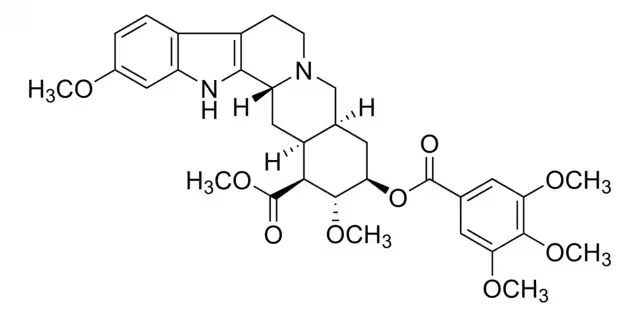
CAS Number50-55-5
SynonymsMFCD00005091; Hiserpia; Methyl 18b-Hydroxy-11,17a-dimethoxy-3b,20a-yohimban-16b-carboxylate 3,4,5-Trimethoxybenzoate (Ester); Serpipur; EINECS 200-047-9; Raunervil; Serpanray; Methyl (3β,16β,17α,18β,20α)-11,17-dimethoxy-18-[(3,4,5-trimethoxybenzoyl)oxy]yohimban-16-carboxylate; methyl reserpate 3,4,5-trimethoxybenzoic acid ester; Raupasil; SERPASIL; Rausedil; rivasin; reserpine; [3H]-Reserpine; Serpivite; (-)-reserpine; Reserpine Base; serpentina; Serp-AFD; Serpalan; Apoplon
Molecular FormulaC33H40N2O9
Molecular Weight608.68
Purity98.00%
Density1.3±0.1 g/cm3
Boiling Point700.1±60.0 °C at 760 mmHg
Melting Point~265 °C (dec.)
AppearanceLight yellow powder
EINECS200-047-9
Symbol
Signal WordWarning
| Chemical & Physical Properties | |
|---|---|
| CAS Number | 50-55-5 |
| Catalog No. | 2A-9016563 |
| Chinese Name | 利血平 |
| Synonyms | MFCD00005091; Hiserpia; Methyl 18b-Hydroxy-11,17a-dimethoxy-3b,20a-yohimban-16b-carboxylate 3,4,5-Trimethoxybenzoate (Ester); Serpipur; EINECS 200-047-9; Raunervil; Serpanray; Methyl (3β,16β,17α,18β,20α)-11,17-dimethoxy-18-[(3,4,5-trimethoxybenzoyl)oxy]yohimban-16-carboxylate; methyl reserpate 3,4,5-trimethoxybenzoic acid ester; Raupasil; SERPASIL; Rausedil; rivasin; reserpine; [3H]-Reserpine; Serpivite; (-)-reserpine; Reserpine Base; serpentina; Serp-AFD; Serpalan; Apoplon |
| Molecular Formula | C33H40N2O9 |
| Molecular Weight | 608.68 |
| Purity | 98.00 |
| Density | 1.3±0.1 g/cm3 |
| Boiling Point | 700.1±60.0 °C at 760 mmHg |
| Melting Point | ~265 °C (dec.) |
| Appearance | Light yellow powder |
| Storage Condition | This product is sealed and stored in a dry place a |
| Packaging | II |
| Application | Reserpine is an inhibitor of vesicular monoamine transporter 2 (VMAT2). |
| EINECS | 200-047-9 |
| HTC | 3003909090 |
| UN(IATA) | UN 1219 |
| PubChem ID | 24278208 |
| MDL Number | MFCD00005091 |
| SMILES | CO[C@H]1[C@@H](C[C@@H]2CN3CCc4c([nH]c5cc(OC)ccc45)[C@H]3C[C@@H]2[C@@H]1C(=O)OC)OC(=O)c6cc(OC)c(OC)c(OC)c6 |
| InChI | 1S/C33H40N2O9/c1-38-19-7-8-20-21-9-10-35-16-18-13-27(44-32(36)17-11-25(39-2)30(41-4)26(12-17)40-3)31(42-5)28(33(37)43-6)22(18)15-24(35)29(21)34-23(20)14-19/h7-8,11-12,14,18,22,24,27-28,31,34H,9-10,13,15-16H2,1-6H3/t18-,22+,24-,27-,28+,31+/m1/s1 |
| InChI Key | QEVHRUUCFGRFIF-MDEJGZGSSA-N |
| Beilstein/REAXYS | 102014 |
| NACRES Code | NA.77 |
| UNSPSC | 12352200 |
| Hazard Symbols | 6.1 |
| Risk Codes | R10;R36;R67 |
| Safety Description | S26 |
| MSDS | msds/16563_1_50_55_5.pdf |
| Bioactivity | Reserpine is an inhibitor of the vesicular monoamine transporter 2 (VMAT2). Related Catalog Signaling Pathways >> Membrane Transporter/Ion Channel >> Monoamine Transporter Natural Products >> Alkaloid Research Areas >> Neurological Disease Target VMAT2[1] In Vitro Reserpine is an inhibitor of the vesicular monoamine transporter 2 (VMAT2). Reserpine displays a significant effect on the density of dopamine D1 receptors (F2,12=8.81, p<0.01) in the rat striatum. The affinity (Kd) for the dopamine D1 and D2 receptors during withdrawal from acute and chronic administration of reserpine is not change[1]. IC50 values of 43.9 and 54.9 μM are obtained after 1 day of treatment with Reserpine in JB6 P+ and HepG2-C8 cells, respectively. Reserpine induces luciferase activity in a dose-dependent manner at concentrations ranging from 5 to 50 μM, and no significant induction is observed at concentrations lower than 5 μM. Results demonstrate that Reserpine (2.5 to 10 μM) also increases the protein expression of Nrf2, HO-1, and NQO1. Reserpine at concentrations of 2.5 to 10 μM decreases the mRNA expression of DNMT1, DNMT3a, and DNMT3b in a concentration-dependent manner in JB6 P+ cells after 7 days of treatment. Reserpine at 10 μM generates a significant difference for DNMT3a expression (p<0.05)[2]. In Vivo Withdrawal (48 h) from chronic (14-day) but not acute Reserpine administration in a dose of 0.2 mg/kg i.p. produces a significant reduction of the immobility time (F2,18=3.68, p<0.05), but increases the climbing time (F2,18=4.48, p<0.02), and does not change the swimming time (F2,18=1.78; NS) in the forced swim test (FST) in rats[1]. Reserpine at a dose of 5 mg/kg body weight produces significant increase in the urinary excretion profile of vanillylmandelic acid (VMA) compare to control animals. The amount of 5-hydroxyindoleacetic acid (5-HIAA) excreted in animals treated with Reserpine is found to be more than in the control. Dose dependent hypotension is observed with Reserpine. Reserpine at doses of 0.5, 1, 5, 10 and 15 μg/kg produce significant (p<0.01) reduction in blood pressure compare to control[3]. Kinase Assay After incubation for 24 h, JB6 P+ cells (1×10⁵ cells/10-cm dish) are treated with various concentrations of Reserpine. Whole cell lysates are prepared from the treated cells using radioimmunoprecipitation assay buffer supplemented with a protease inhibitor cocktail, and a BCA kit is used to determine protein concentrations[2]. Cell Assay JB6 P+ cells are seeded in 96-well plates containing Minimum essential media (MEM) at a density of 1×10⁴ cells/mL (100 μL/well) for 1, 3, and 5 days, and HepG2-C8 cells are seeded in plates containing DMEM. After incubation for 24 h, the cells are treated with either DMSO or various concentrations of Reserpine. For JB6 P+ cells, the medium is changed every 2 days for the 3-day and 5-day treatments. Cell viability is assessed using a MTS assay kit according to the manufacturer's instructions. The absorbance of the formazan product is read at 490 nm, and the cell viability is calculated and compared with the DMSO control group[2]. Animal Admin Albino rats of either sex weighing between 100 to 150 g are used in the study. They are acclimatized to the laboratory conditions for at least 10 days prior to the experiment and provided with standard diet and water ad libitum with 12 h light and dark cycle. Animals are divided into different groups of six each and are housed individually in metabolic cages. Group 1: Control animals treated with DMSO intraperitoneally at a dose of 0.1 mL/100 g body weight. Group 2: Animals administered intraperitoneally with Reserpine at a dose of 5 mg/kg body weight. The 24 h urine samples from the point of drug administration are collected for each animal[3]. References [1]. Antkiewicz-Michaluk L, et al. Withdrawal from repeated administration of a low dose of reserpine induced opposing adaptive changes in the noradrenaline and serotonin system function: a behavioral and neurochemical ex vivo and in vivo studies in the rat. Prog Neuropsychopharmacol Biol Psychiatry. 2015 Mar 3;57:146-54. [2]. Hong B, et al. Reserpine Inhibit the JB6 P+ Cell Transformation Through Epigenetic Reactivation of Nrf2-Mediated Anti-oxidative Stress Pathway. AAPS J. 2016 May;18(3):659-69. [3]. Sreemantula S, et al. Reserpine methonitrate, a novel quaternary analogue of reserpine augments urinary excretion of VMA and 5-HIAA without affecting HVA in rats. BMC Pharmacol. 2004 Nov 16;4:30. Chemical & Physical Properties Density 1.3±0.1 g/cm3 Boiling Point 700.1±60.0 °C at 760 mmHg Melting Point 265ºC (dec.) Molecular Formula C33H40N2O9 Molecular Weight 608.679 Flash Point 377.2±32.9 °C Exact Mass 608.273376 PSA 117.78000 LogP 4.05 Vapour Pressure 0.0±2.2 mmHg at 25°C Index of Refraction 1.620 InChIKey QEVHRUUCFGRFIF-MDEJGZGSSA-N SMILES COC(=O)C1C2CC3c4[nH]c5cc(OC)ccc5c4CCN3CC2CC(OC(=O)c2cc(OC)c(OC)c(OC)c2)C1OC |
| Use of | Reserpine is an inhibitor of the vesicular monoamine transporter 2 (VMAT2). Properties Articles141 Name reserpine Synonym More Synonyms Reserpine Biological Activity Description Reserpine is an inhibitor of the vesicular monoamine transporter 2 (VMAT2). Related Catalog Signaling Pathways >> Membrane Transporter/Ion Channel >> Monoamine Transporter Natural Products >> Alkaloid Research Areas >> Neurological Disease References [1]. Antkiewicz-Michaluk L, et al. Withdrawal from repeated administration of a low dose of reserpine induced opposing adaptive changes in the noradrenaline and serotonin system function: a behavioral and neurochemical ex vivo and in vivo studies in the rat. Prog Neuropsychopharmacol Biol Psychiatry. 2015 Mar 3;57:146-54. [2]. Hong B, et al. Reserpine Inhibit the JB6 P+ Cell Transformation Through Epigenetic Reactivation of Nrf2-Mediated Anti-oxidative Stress Pathway. AAPS J. 2016 May;18(3):659-69. [3]. Sreemantula S, et al. Reserpine methonitrate, a novel quaternary analogue of reserpine augments urinary excretion of VMA and 5-HIAA without affecting HVA in rats. BMC Pharmacol. 2004 Nov 16;4:30. Chemical & Physical Properties Molecular Formula C33H40N2O9 Exact Mass 608.273376 PSA 117.78000 Index of Refraction 1.620 InChIKey QEVHRUUCFGRFIF-MDEJGZGSSA-N |
| Transport Info | Shipping Name: UN |
| MSDS Transport Info | Module 14. Shipping information 14.1 UN dangerous goods number European Land Transport Dangerous Regulations: -International Maritime Dangerous Regulations: -International Air Transport Dangerous Regulations: - 14.2 United Nations shipping name European Land Transport Dangerous Regulations: Non-dangerous goods IMDG Code: Non-dangerous goods International air transport dangerous goods regulations: non-dangerous goods 14.3 Transport hazard categories European Land Transport Dangerous Regulations: -International Maritime Dangerous Regulations: -International Air Transport Dangerous Regulations: - 14.4 Package group European Land Transport Dangerous Regulations: -International Maritime Dangerous Regulations: -International Air Transport Dangerous Regulations: - 14.5 Environmental hazards European Land Transport Danger Regulations: No International Maritime Danger Regulations International Air Transport Danger Regulations: No Marine pollutants (yes/no): No 14.6 Special reminder to users No data available The above information is believed to be correct, but is not all-inclusive and should be used as a guide only. The information in this document is based on our current knowledge and is Correct safety instructions apply to this product. This information does not represent a warranty as to the properties of this product. See reverse side of invoice or packing slip. |
| Related Products in Alkaloids | ||
|---|---|---|
| Sanguinarine chloride | 5578-73-4 | 2A-9012387 |
| Sanguinarine HCl dihydrate | 2A-303472 | 2A-9012388 |
| Swainsonine | 72741-87-8 | 2A-9012557 |
| Theobromine | 83-67-0 | 2A-9012675 |
| Pseudoephedrine sulphate | 7460-12-0 | 2A-9015492 |
| (+)-Pilocarpine hydrochloride | 54-71-7 | 2A-9016668 |
| Strychnine | 57-24-9 | 2A-9016736 |
| Papaverine | 58-74-2 | 2A-9016791 |
| Quinine dihydrochloride | 60-93-5 | 2A-9016851 |
| Papaverine hydrochloride | 61-25-6 | 2A-9016854 |
| Browse all Alkaloids products » | ||
Phone:
630-322-8886
630-322-8887
Email:
Office Locations:
Chicago, IL, USA
San Francisco, CA, USA


 EN
EN


 SDS
SDS