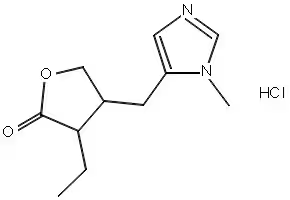
CAS Number54-71-7
Synonyms(3S,4R); pilocel; Akarpine; Pilocarpine HCl; Salagen; Pilocarpine; (3S,4R)-3-ethyl-4-[(1-methyl-1H-imidazol-5-yl)-methyl]dihydrofuran-2(3H)one hydrochloride; pilovisc; EINECS 200-212-5; Sanpilo; Pilocarpine (Hydrochloride); (3S,4R)-3-Ethyl-4-[(1-methyl-1H-imidazol-5-yl)methyl]dihydro-2(3H)-furanone; MFCD00012722; pilocar; ami-pilo; (+)-pilocarpine; (3S,4R)-3-Ethyl-4-[(1-methyl-1H-imidazol-5-yl)methyl]dihydrofuran-2(3H)-one; amisturap
Molecular FormulaC11H17ClN2O2
Molecular Weight244.72
Purity98.00%
Density1.2±0.1 g/cm3
Boiling Point431.8±18.0 °C at 760 mmHg
Melting Point202-205 °C(lit.)
Appearancewhite powder
EINECS200-212-5
Symbol
Signal WordWarning
| Chemical & Physical Properties | |
|---|---|
| CAS Number | 54-71-7 |
| Catalog No. | 2A-9016668 |
| Chinese Name | 盐酸毛果芸香碱 |
| Synonyms | (3S,4R); pilocel; Akarpine; Pilocarpine HCl; Salagen; Pilocarpine; (3S,4R)-3-ethyl-4-[(1-methyl-1H-imidazol-5-yl)-methyl]dihydrofuran-2(3H)one hydrochloride; pilovisc; EINECS 200-212-5; Sanpilo; Pilocarpine (Hydrochloride); (3S,4R)-3-Ethyl-4-[(1-methyl-1H-imidazol-5-yl)methyl]dihydro-2(3H)-furanone; MFCD00012722; pilocar; ami-pilo; (+)-pilocarpine; (3S,4R)-3-Ethyl-4-[(1-methyl-1H-imidazol-5-yl)methyl]dihydrofuran-2(3H)-one; amisturap |
| Molecular Formula | C11H17ClN2O2 |
| Molecular Weight | 244.72 |
| Purity | 98.00 |
| Density | 1.2±0.1 g/cm3 |
| Boiling Point | 431.8±18.0 °C at 760 mmHg |
| Melting Point | 202-205 °C(lit.) |
| Appearance | white powder |
| Water Solubility | soluble |
| Storage Condition | This product should be sealed and stored in a cool |
| Packaging | III |
| Application | Pilocarpine Hydrochloride is a selective M3 muscarinic acetylcholine receptor agonist. |
| EINECS | 200-212-5 |
| HTC | 2934999090 |
| UN(IATA) | UN 1544 |
| MDL Number | C11H16N2O2·HCl |
| SMILES | CCC1C(=O)OCC1Cc1cncn1C.Cl |
| InChI | InChI=1S/C11H16N2O2.ClH/c1-3-10-8(6-15-11(10)14)4-9-5-12-7-13(9)2;/h5,7-8,10H,3-4,6H2,1-2H3;1H/t8-,10-;/m0./s1 |
| InChI Key | RNAICSBVACLLGM-GNAZCLTHSA-N |
| Hazard Symbols | 6.1 |
| Risk Codes | R26/28 |
| Safety Description | S25;S45 |
| MSDS | msds/16668_1_54_71_7.pdf |
| Bioactivity | Pilocarpine Hydrochloride is a selective M3-type muscarinic acetylcholine receptor (M3 muscarinic receptor) agonist. Related Catalog Signaling Pathways >> GPCR/G Protein >> mAChR Signaling Pathways >> Neuronal Signaling >> mAChR Research Areas >> Neurological Disease Target M3 muscarinic receptor[1] In Vitro To evaluate the cytotoxicity of Pilocarpine, the morphology and viability of human corneal stromal (HCS) cells are examined by light microscopy and MTT assay, respectively. Morphological observations show that HCS cells exposed to Pilocarpine at a concentration from 0.625 to 20 g/L exhibit dose- and time-dependent proliferation retardation and morphological abnormality such as cellular shrinkage, cytoplasmic vacuolation, detachment from culture matrix, and eventually death, while no obvious difference is observed between those exposed to Pilocarpine below the concentration of 0.625 g/L and controls. Results of MTT assay reveal that the cell viability of HCS cells decrease with time and concentration after exposing to Pilocarpine above the concentration of 0.625 g/L (P<0.01 or 0.05), while that of HCS cells treated with Pilocarpine below the concentration of 0.625 g/L show no significant difference to controls[2]. The partial muscarinic agonist, Pilocarpine, evokes concentration-dependent relaxation with an EC50 of 2.4 mM in isolated segments of rat tail artery that were constricted with Penylephrine (10 to 200 nM)[3]. In Vivo The Pilocarpine-induced saliva secretion of the control rats (CN) and exercised (EX) rats is examined. A significantly greater amount of saliva is induced by Pilocarpine in the EX rats than in the CN rats (P<0.01). Conversely, the Na+ concentration in the saliva of the EX rats is significantly lower than that of the CN rats (P<0.05)[1]. Cell Assay Cell viability is determined by MTT assay. Briefly, HCS cells are inoculated into a 96-well culture plate (Nunc) at a density of 1×10⁴ cells/100 µL/well, and are cultured and treated. At a 4h interval, the Pilocarpine (0.625 to 20 g/L)-containing medium is replaced entirely with 100 µL serum-free DMEM/F12 medium containing 1.0 g/L MTT, and the cells are incubated at 37°C in the dark for 4h. After the MTT-containing medium is discarded with caution, 150 µL DMSO is added to dissolve the produced formazan crystals at 37°C in the dark for 15 min, and the absorbance at 490 nm is measured with a Multiskan GO microplate reader[2]. Animal Admin Rats[1] Male, 10-week-old Wistar rats are assigned to one of two groups, exercise (EX, n=6) and control (CN, n=6). The EX rats are kept for 40 days in cages with a running wheel (SN-451), allowing them to undertake voluntary exercise, while the CN rats are kept in cages with the running wheel locked. On the 40th day, Pilocarpine-induced saliva is measured as follows. Briefly, the rats are anesthetized, preweighed cotton was placed in their mouths sublingually, and Pilocarpine (0.5 mg/kg) is intraperitoneally injected to induce saliva secretion. Each cotton ball is then changed every 10 min for 1 h. The collected cotton balls are weighed again, and the mass of saliva secreted is calculated by subtracting the initial from the final weight. References [1]. Matsuzaki K, et al. Daily voluntary exercise enhances pilocarpine-induced saliva secretion and aquaporin 1 expression in rat submandibular glands. FEBS Open Bio. 2017 Dec 7;8(1):85-93. [2]. Yuan XL, et al. Cytotoxicity of pilocarpine to human corneal stromal cells and its underlying cytotoxic mechanisms. Int J Ophthalmol. 2016 Apr 18;9(4):505-11. [3]. Tonta MA, et al. Pilocarpine-induced relaxation of rat tail artery by a non-cholinergic mechanism and in the absence of an intact endothelium. Br J Pharmacol. 1994 Jun;112(2):525-32. [4]. Wang RF, et al. Post-treatment with the GLP-1 analogue liraglutide alleviate chronic inflammation and mitochondrial stress induced by Status epilepticus. Epilepsy Res. 2018 Mar 9;142:45-52. Chemical & Physical Properties Density 1.2±0.1 g/cm3 Boiling Point 431.8±18.0 °C at 760 mmHg Melting Point 202-205 °C(lit.) Molecular Formula C11H17ClN2O2 Molecular Weight 208.257 Flash Point 215.0±21.2 °C Exact Mass 208.121185 PSA 44.12000 LogP -0.09 Vapour Pressure 0.0±1.0 mmHg at 25°C Index of Refraction 1.585 InChIKey RNAICSBVACLLGM-GNAZCLTHSA-N SMILES CCC1C(=O)OCC1Cc1cncn1C.Cl Water Solubility soluble |
| Use of | Properties Articles84 Name (+)-Pilocarpine hydrochloride Synonym More Synonyms Pilocarpine Hydrochloride Biological Activity Related Catalog Signaling Pathways >> GPCR/G Protein >> mAChR Signaling Pathways >> Neuronal Signaling >> mAChR Research Areas >> Neurological Disease In Vivo The Pilocarpine-induced saliva secretion of the control rats (CN) and exercised (EX) rats is examined. A significantly greater amount of saliva is induced by Pilocarpine in the EX rats than in the CN rats (P<0.01). Conversely, the Na+ concentration in the saliva of the EX rats is significantly lower than that of the CN rats (P<0.05)[1]. References [1]. Matsuzaki K, et al. Daily voluntary exercise enhances pilocarpine-induced saliva secretion and aquaporin 1 expression in rat submandibular glands. FEBS Open Bio. 2017 Dec 7;8(1):85-93. [2]. Yuan XL, et al. Cytotoxicity of pilocarpine to human corneal stromal cells and its underlying cytotoxic mechanisms. Int J Ophthalmol. 2016 Apr 18;9(4):505-11. [3]. Tonta MA, et al. Pilocarpine-induced relaxation of rat tail artery by a non-cholinergic mechanism and in the absence of an intact endothelium. Br J Pharmacol. 1994 Jun;112(2):525-32. [4]. Wang RF, et al. Post-treatment with the GLP-1 analogue liraglutide alleviate chronic inflammation and mitochondrial stress induced by Status epilepticus. Epilepsy Res. 2018 Mar 9;142:45-52. Chemical & Physical Properties Exact Mass 208.121185 PSA 44.12000 LogP -0.09 Index of Refraction 1.585 InChIKey RNAICSBVACLLGM-GNAZCLTHSA-N Water Solubility soluble |
| Tax Rebate | 13.0% |
| Supervision | None. MFN tariff: 6.5%. Ordinary tariff: 20.0% |
| Transport Info | Product name: Summary 2934999090. other heterocyclic compounds. VAT:17.0%. Tax rebate rate:13.0%. . MFN tariff:6.5%. General tariff:20.0% |
| Related Products in Alkaloids | ||
|---|---|---|
| Sanguinarine HCl dihydrate | 2A-303472 | 2A-9012388 |
| Swainsonine | 72741-87-8 | 2A-9012557 |
| Theobromine | 83-67-0 | 2A-9012675 |
| Pseudoephedrine sulphate | 7460-12-0 | 2A-9015492 |
| Reserpine | 50-55-5 | 2A-9016563 |
| Strychnine | 57-24-9 | 2A-9016736 |
| Papaverine | 58-74-2 | 2A-9016791 |
| Quinine dihydrochloride | 60-93-5 | 2A-9016851 |
| Papaverine hydrochloride | 61-25-6 | 2A-9016854 |
| Nicotine ditartrate | 65-31-6 | 2A-9016918 |
| Browse all Alkaloids products » | ||
Phone:
630-322-8886
630-322-8887
Email:
Office Locations:
Chicago, IL, USA
San Francisco, CA, USA


 EN
EN


 SDS
SDS