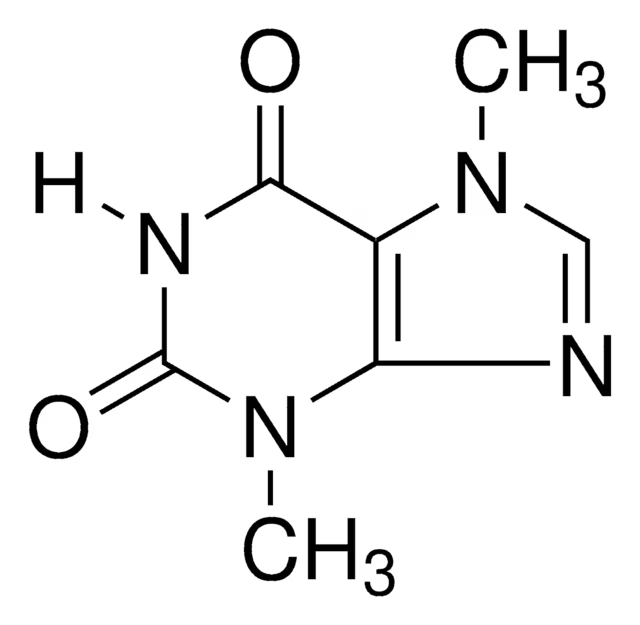
CAS Number83-67-0
Synonyms3,7-Dimethyl-xanthine; Diurobromine; EINECS 201-494-2; Teobromin; Theostene; 2,6-Dihydroxy-3,7-dimethyl-purine; Theobromine; Diuretin; Thesal; 3,7-Dimethyl-3,7-dihydro-1H-purine-2,6-dione; 3,7-dimethylpurine-2,6-dione; Theosalvose; Theobromin; 3,7-dimethyl xanthine; Thesodate; 5-26-13-00553 (Beilstein Handbook Reference); Santheose; 3,7-dihydro-3,7-dimethyl-1H-purine-2,6-dione; MFCD00022830
Molecular FormulaC7H8N4O2
Molecular Weight180.16
Purity≥98.0%
Density1.6±0.1 g/cm3
Boiling Point495.5±37.0 °C at 760 mmHg
Melting Point345-350 °C
AppearanceWhite to yellow crystalline powder
EINECS201-494-2
Symbol
Signal WordWarning
| Chemical & Physical Properties | |
|---|---|
| CAS Number | 83-67-0 |
| Catalog No. | 2A-9012675 |
| Chinese Name | 可可碱 |
| Synonyms | 3,7-Dimethyl-xanthine; Diurobromine; EINECS 201-494-2; Teobromin; Theostene; 2,6-Dihydroxy-3,7-dimethyl-purine; Theobromine; Diuretin; Thesal; 3,7-Dimethyl-3,7-dihydro-1H-purine-2,6-dione; 3,7-dimethylpurine-2,6-dione; Theosalvose; Theobromin; 3,7-dimethyl xanthine; Thesodate; 5-26-13-00553 (Beilstein Handbook Reference); Santheose; 3,7-dihydro-3,7-dimethyl-1H-purine-2,6-dione; MFCD00022830 |
| Molecular Formula | C7H8N4O2 |
| Molecular Weight | 180.16 |
| Purity | ≥98.0 |
| Density | 1.6±0.1 g/cm3 |
| Boiling Point | 495.5±37.0 °C at 760 mmHg |
| Melting Point | 345-350 °C |
| Appearance | White to yellow crystalline powder |
| Water Solubility | slightly soluble, |
| Storage Condition | Sealed packaging in non-toxic plastic bags or glas |
| Application | Theobromine is a methylxanthine found in cocoa beans that inhibits adenosine receptor A1 (AR1) signaling. |
| EINECS | 201-494-2 |
| HTC | 2933990090 |
| PubChem ID | 24277679 |
| MDL Number | MFCD00022830 |
| SMILES | [H]N1C(N(C)C2=C(N(C)C=N2)C1=O)=O |
| InChI | 1S/C7H8N4O2/c1-10-3-8-5-4(10)6(12)9-7(13)11(5)2/h3H,1-2H3,(H,9,12,13) |
| InChI Key | YAPQBXQYLJRXSA-UHFFFAOYSA-N |
| Beilstein/REAXYS | 16464 |
| NACRES Code | NA.77 |
| UNSPSC | 41106305 |
| Hazard Symbols | 6.1 |
| MSDS | msds/12675_1_83_67_0.pdf |
| Bioactivity | Theobromine is a methylxanthine found in cacao beans which can inhibit adenosine receptor A1 (AR1) signaling. Related Catalog Signaling Pathways >> GPCR/G Protein >> Adenosine Receptor Natural Products >> Alkaloid Research Areas >> Neurological Disease Target Human Endogenous Metabolite In Vitro Theobromine, at concentrations above 25 μM, decreases lipid accumulation in these cells. Cell viability is not affected by Theobromine. Theobromine, at concentrations above 25 μM, suppresses protein expression of PPARγ, C/EBPα and adipogenic genes. The mRNA levels of these genes are also decreased by Theobromine[1]. In Vivo Body weights are lower in the Theobromine group than in the vehicle group. In addition, Theobromine suppresses gains in weight of epididymal and perirenal adipose tissues. The mean adipocyte area is smaller in the Theobromine group than in the vehicle group[1]. Theobromine group shows lower counts than the other groups when considering the number of bacteria per fecal weight (p=0.021 and p=0.055 compare to the reference (RF) and the cocoa (CC) groups, respectively). The Theobromine diet leads to higher pH values than those found after the RF and CC diets. Fecal concentrations of lactic acid are not significantly affected by the experimental diets (4.26±1.54 mM in RF group; 1.96±0.41 mM in CC group; 2.69±0.73 mM in Theobromine group)[2]. Kinase Assay 3T3-L1 preadipocytes are pre-incubated with MG132 (10 μM) for 30 min, followed by incubation with IBMX in the presence or absence of Theobromine (25 μM) for 8 h. The cells are lysed in denaturing cell extraction buffer (50 mM Tris-HCl, pH 7.5, containing 70 mM β-mercaptoethanol and 2% SDS) at 95°C for 10 min. The cell lysates are diluted 20 fold with dilution buffer (20 mM Tris-HCl, pH 7.5, containing 150 mM NaCl, 1 mM EDTA, 1mM EGTA, 1% TritonX-100, 2.5 mM sodium pyrophosphate and protease inhibitor cocktail) and centrifuged at 20,000 g for 30 s. The supernatant is incubated with rabbit polyclonal anti-C/EBPβ IgG, anti-FLAG IgG or control IgG at 4°C overnight, followed by incubation with 30 μL protein G-Sepharose resin at 4°C for 1 h. The resin is washed with lysis buffer three times and proteins bound to the resin are separated by SDS-PAGE and analyzed by western blotting[1]. Animal Admin Lewis rats (3 week old) are used in this study. The rats are randomly distributed into three dietary groups (n=7 per group): the reference (RF) group ingested standard diet AIN-93M, the cocoa (CC) group ingested a standard diet with 10% of natural Forastero cocoa containing 0.25% Theobromine, and the Theobromine (TB) group ingested a standard diet including 0.25% of Theobromine, i.e. the content of Theobromine presents in the CC diet[2]. References [1]. Mitani T, et al. Theobromine suppresses adipogenesis through enhancement of CCAAT-enhancer-binding protein β degradation by adenosine receptor A1. [2]. Martín-Peláez S, et al. Effect of cocoa's theobromine on intestinal microbiota of rats. Mol Nutr Food Res. 2017 Oct;61(10). Chemical & Physical Properties Density 1.6±0.1 g/cm3 Boiling Point 495.5±37.0 °C at 760 mmHg Melting Point 345-350 °C Molecular Formula C7H8N4O2 Molecular Weight 180.164 Flash Point 253.5±26.5 °C Exact Mass 180.064728 PSA 72.68000 LogP -2.08 Vapour Pressure 0.0±1.3 mmHg at 25°C Index of Refraction 1.737 InChIKey YAPQBXQYLJRXSA-UHFFFAOYSA-N SMILES Cn1cnc2c1c(=O)[nH]c(=O)n2C Storage condition Refrigerator Water Solubility slightly soluble, |
| Use of | Theobromine is a methylxanthine found in cacao beans which can inhibit adenosine receptor A1 (AR1) signaling. Properties Articles62 Name theobromine Synonym More Synonyms Theobromine Biological Activity Description Theobromine is a methylxanthine found in cacao beans which can inhibit adenosine receptor A1 (AR1) signaling. Related Catalog Signaling Pathways >> GPCR/G Protein >> Adenosine Receptor Natural Products >> Alkaloid Research Areas >> Neurological Disease Human Endogenous Metabolite In Vitro Theobromine, at concentrations above 25 μM, decreases lipid accumulation in these cells. Cell viability is not affected by Theobromine. Theobromine, at concentrations above 25 μM, suppresses protein expression of PPARγ, C/EBPα and adipogenic genes. The mRNA levels of these genes are also decreased by Theobromine[1]. Animal Admin Lewis rats (3 week old) are used in this study. The rats are randomly distributed into three dietary groups (n=7 per group): the reference (RF) group ingested standard diet AIN-93M, the cocoa (CC) group ingested a standard diet with 10% of natural Forastero cocoa containing 0.25% Theobromine, and the Theobromine (TB) group ingested a standard diet including 0.25% of Theobromine, i.e. the content of Theobromine presents in the CC diet[2]. References [1]. Mitani T, et al. Theobromine suppresses adipogenesis through enhancement of CCAAT-enhancer-binding protein β degradation by adenosine receptor A1. [2]. Martín-Peláez S, et al. Effect of cocoa's theobromine on intestinal microbiota of rats. Mol Nutr Food Res. 2017 Oct;61(10). Chemical & Physical Properties Molecular Formula C7H8N4O2 Exact Mass 180.064728 PSA 72.68000 LogP -2.08 Index of Refraction 1.737 InChIKey YAPQBXQYLJRXSA-UHFFFAOYSA-N Storage condition Refrigerator Water Solubility slightly soluble, |
| Tax Rebate | 13.0% |
| Supervision | None. MFN tariff: 6.5%. Ordinary tariff: 20.0% |
| Transport Info | Product name: Purity: 98.0% |
| MSDS Transport Info | Module 14. Shipping information 14.1 UN dangerous goods number European Land Transport Dangerous Regulations: -International Maritime Dangerous Regulations: -International Air Transport Dangerous Regulations: - 14.2 Names specified by the United Nations (UN) European Land Transport Dangerous Regulations: Non-dangerous goods IMDG Code: Non-dangerous goods International air transport dangerous goods regulations: non-dangerous goods 14.3 Transport hazard categories European Land Transport Dangerous Regulations: -International Maritime Dangerous Regulations: -International Air Transport Dangerous Regulations: - 14.4 Package group European Land Transport Dangerous Regulations: -International Maritime Dangerous Regulations: -International Air Transport Dangerous Regulations: - 14.5 Environmental hazards European Land Transport Dangerous Regulations: No International Maritime Transport Dangerous Regulations Maritime Pollutants: No International Air Transport Risk Regulations: No 14.6 Special reminder to users No data available |
| Related Products in Alkaloids | ||
|---|---|---|
| Quinine sulfate | 804-63-7 | 2A-9012239 |
| Rescinnamine | 24815-24-5 | 2A-9012288 |
| Sanguinarine chloride | 5578-73-4 | 2A-9012387 |
| Sanguinarine HCl dihydrate | 2A-303472 | 2A-9012388 |
| Swainsonine | 72741-87-8 | 2A-9012557 |
| Pseudoephedrine sulphate | 7460-12-0 | 2A-9015492 |
| Reserpine | 50-55-5 | 2A-9016563 |
| (+)-Pilocarpine hydrochloride | 54-71-7 | 2A-9016668 |
| Strychnine | 57-24-9 | 2A-9016736 |
| Papaverine | 58-74-2 | 2A-9016791 |
| Browse all Alkaloids products » | ||
Phone:
630-322-8886
630-322-8887
Email:
Office Locations:
Chicago, IL, USA
San Francisco, CA, USA


 EN
EN


 SDS
SDS