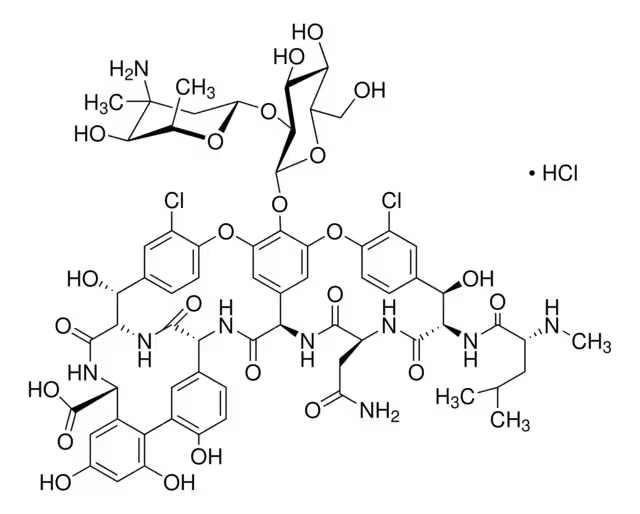
CAS Number1404-93-9
SynonymsVancocin; Vancomycin HCL; Lyphocin (LyphoMed); VANCOR; Vancomycin hydrochloride; Vancomycin (hydrochloride); EINECS 604-193-8
Molecular FormulaC66H76Cl3N9O24
Molecular Weight1485.71
Purity98.00%
Density1.7±0.1 g/cm3
Melting Point>190°C (dec.)
Appearancepowder
Symbol
Signal WordWarning
| Chemical & Physical Properties | |
|---|---|
| CAS Number | 1404-93-9 |
| Catalog No. | 2A-9012914 |
| Chinese Name | 盐酸万古霉素 |
| Synonyms | Vancocin; Vancomycin HCL; Lyphocin (LyphoMed); VANCOR; Vancomycin hydrochloride; Vancomycin (hydrochloride); EINECS 604-193-8 |
| Molecular Formula | C66H76Cl3N9O24 |
| Molecular Weight | 1485.71 |
| Purity | 98.00 |
| Density | 1.7±0.1 g/cm3 |
| Melting Point | >190°C (dec.) |
| Appearance | powder |
| Water Solubility | H2O: 50 mg/mL, clear, yellow | Soluble in water. S |
| Storage Condition | Keep the receptacle sealed, stored in a cool, dry |
| Application | Vancomycin hydrochloride is an antibiotic used to treat bacterial infections. It works by inhibiting the second phase of cell wall synthesis in susceptible bacteria. Vancomycin also changes the permea |
| HTC | 2941909000 |
| PubChem ID | 24900723 |
| SMILES | Cl[H].CO[C@@H]1O[C@H](CO)[C@@H](O)[C@H](O)[C@@H]1O[C@H]2C[C@](C)(N)[C@@H](O)[C@@H](C)O2.CN[C@H](CC(C)C)C(=O)NC3[C@H](O)c4ccc(Oc5cc6Oc7ccc(cc7Cl)[C@@H](O)[C@H]8NC(=O)[C@H](NC(=O)[C@H](NC(=O)[C@H](CC(N)=O)NC3=O)c(c5)c6)c9ccc(O)c(c9)-c%10c(O)cc(O)cc%10[C@@H](NC8=O)C(O)=O)c(Cl)c4 |
| InChI | 1S/C66H75Cl2N9O24.ClH/c1-23(2)12-34(71-5)58(88)76-49-51(83)26-7-10-38(32(67)14-26)97-40-16-28-17-41(55(40)101-65-56(54(86)53(85)42(22-78)99-65)100-44-21-66(4,70)57(87)24(3)96-44)98-39-11-8-27(15-33(39)68)52(84)50-63(93)75-48(64(94)95)31-18-29(79)19-37(81)45(31)30-13-25(6-9-36(30)80)46(60(90)77-50)74-61(91)47(28)73-59(89)35(20-43(69)82)72-62(49)92;/h6-11,13-19,23-24,34-35,42,44,46-54,56-57,65,71,78-81,83-87H,12,20-22,70H2,1-5H3,(H2,69,82)(H,72,92)(H,73,89)(H,74,91)(H,75,93)(H,76,88)(H,77,90)(H,94,95);1H/t24-,34+,35-,42+,44-,46+,47+,48-,49+,50-,51+,52+,53+,54-,56+,57+,65-,66-;/m0./s1 |
| InChI Key | LCTORFDMHNKUSG-XTTLPDOESA-N |
| Beilstein/REAXYS | 3704657 |
| NACRES Code | NA.85 |
| UNSPSC | 51282703 |
| Hazard Symbols | Transport |
| MSDS | msds/12914_1_1404_93_9.pdf |
| Bioactivity | Vancomycin hydrochloride is an antibiotic for the treatment of bacterial infections. It acts by inhibiting the second stage of cell wall synthesis of susceptible bacteria. Vancomycin also alters the permeability of the cell membrane and selectively inhibits ribonucleic acid synthesis. Related Catalog Signaling Pathways >> Autophagy >> Autophagy Signaling Pathways >> Anti-infection >> Bacterial Research Areas >> Infection Target Bacterial[1] In Vitro Vancomycin is a large glycopeptide compound with a molecular weight of 1450 Da[1]. Vancomycin is a unique glycopeptide structurally unrelated to any currently available antibiotic. It also has a unique mode of action inhibiting the second stage of cell wall synthesis of susceptible bacteria. Vancomycin is active against a large number of species of Gram-positive bacteria, such as Staphylococcus aureus, Staph. epidermidis, Str. agalactiae, Str. bovis, Str. mutans, viridans streptococci, enterococci[2]. In Vivo Vancomycin is administered intravenously, with a standard infusion time of at least 1 h, to minimize infusion-related adverse effects. Subjects with normal creatinine clearance, vancomycin has an α-distribution phase of 30 min to 1 h and a β-elimination half-life of 6-12 h. The volume of distribution is 0.4-1 L/kg. The binding of vancomycin to protein ranges from 10% to 50%. Factors that affect the overall activity of vancomycin include its tissue distribution, inoculum size, and protein-binding effects[1]. Vancomycin treatment of infected mice is associated with improved clinical, diarrhea, and histopathology scores and survival during treatment[3]. Animal Admin Mice: One set of experiments is performed in which infected mice are treated with vancomycin (50 mg/kg) daily for 1, 2, 3, or 5 days and are observed for 21 days postinfection or with vancomycin (20 mg/kg) daily for either 5 or 10 days and monitoring for 15 days postinfection[3]. References [1]. Rybak MJ, et al. The pharmacokinetic and pharmacodynamic properties of vancomycin. Clin Infect Dis. 2006 Jan 1;42 Suppl 1:S35-9. [2]. Watanakunakorn C, et al. Mode of action and in-vitro activity of vancomycin. J Antimicrob Chemother. 1984 Dec;14 Suppl D:7-18. [3]. Warren CA, et al. Vancomycin treatment's association with delayed intestinal tissue injury, clostridial overgrowth, and recurrence of Clostridium difficile infection in mice. Antimicrob Agents Chemother. 2013 Feb;57(2):689-96. Chemical & Physical Properties Density 1.7±0.1 g/cm3 Melting Point >190°C (dec.) Molecular Formula C66H76Cl3N9O24 Molecular Weight 1485.714 Flash Point 87℃ Exact Mass 1483.406860 PSA 530.49000 LogP -1.44 Index of Refraction 1.735 InChIKey LCTORFDMHNKUSG-CLCHFBCUSA-N SMILES CNC(CC(C)C)C(=O)NC1C(=O)NC(CC(N)=O)C(=O)NC2C(=O)NC3C(=O)NC(C(=O)NC(C(=O)O)c4cc(O)cc(O)c4-c4cc3ccc4O)C(O)c3ccc(c(Cl)c3)Oc3cc2cc(c3OC2OC(CO)C(O)C(O)C2OC2CC(C)(N)C(O)C(C)O2)Oc2ccc(cc2Cl)C1O.Cl Storage condition 2-8°C Water Solubility H2O: 50 mg/mL, clear, yellow | Soluble in water. Slightly soluble in methanol, ethanol and dimethylsulfoxide. |
| Use of | Vancomycin hydrochloride is an antibiotic for the treatment of bacterial infections. It acts by inhibiting the second stage of cell wall synthesis of susceptible bacteria. Vancomycin also alters the permeability of the cell membrane and selectively inhibits ribonucleic acid synthesis. Properties Articles111 Name Vancomycin Hydrochloride Synonym More Synonyms Vancomycin Hydrochloride Biological Activity Description Vancomycin hydrochloride is an antibiotic for the treatment of bacterial infections. It acts by inhibiting the second stage of cell wall synthesis of susceptible bacteria. Vancomycin also alters the permeability of the cell membrane and selectively inhibits ribonucleic acid synthesis. Related Catalog Signaling Pathways >> Autophagy >> Autophagy Signaling Pathways >> Anti-infection >> Bacterial Research Areas >> Infection Bacterial[1] In Vitro Vancomycin is a large glycopeptide compound with a molecular weight of 1450 Da[1]. Vancomycin is a unique glycopeptide structurally unrelated to any currently available antibiotic. It also has a unique mode of action inhibiting the second stage of cell wall synthesis of susceptible bacteria. Vancomycin is active against a large number of species of Gram-positive bacteria, such as Staphylococcus aureus, Staph. epidermidis, Str. agalactiae, Str. bovis, Str. mutans, viridans streptococci, enterococci[2]. References [1]. Rybak MJ, et al. The pharmacokinetic and pharmacodynamic properties of vancomycin. Clin Infect Dis. 2006 Jan 1;42 Suppl 1:S35-9. [2]. Watanakunakorn C, et al. Mode of action and in-vitro activity of vancomycin. J Antimicrob Chemother. 1984 Dec;14 Suppl D:7-18. [3]. Warren CA, et al. Vancomycin treatment's association with delayed intestinal tissue injury, clostridial overgrowth, and recurrence of Clostridium difficile infection in mice. Antimicrob Agents Chemother. 2013 Feb;57(2):689-96. Chemical & Physical Properties Exact Mass 1483.406860 PSA 530.49000 LogP -1.44 Index of Refraction 1.735 InChIKey LCTORFDMHNKUSG-CLCHFBCUSA-N |
| Transport Info | Product name: Purity: 98.0% |
| MSDS Transport Info | Module 14. Shipping information 14.1 UN dangerous goods number European Land Transport Dangerous Regulations: -International Maritime Dangerous Regulations: -International Air Transport Dangerous Regulations: - 14.2 Names specified by the United Nations (UN) European Land Transport Dangerous Regulations: Non-dangerous goods IMDG Code: Non-dangerous goods International air transport dangerous goods regulations: non-dangerous goods 14.3 Transport hazard categories European Land Transport Dangerous Regulations: -International Maritime Dangerous Regulations: -International Air Transport Dangerous Regulations: - 14.4 Package group European Land Transport Dangerous Regulations: -International Maritime Dangerous Regulations: -International Air Transport Dangerous Regulations: - 14.5 Environmental hazards European Land Transport Dangerous Regulations: No International Maritime Transport Dangerous Regulations Maritime Pollutants: No International Air Transport Risk Regulations: No 14.6 Special reminder to users No data available |
| Related Products in API & Advanced Intermediates | ||
|---|---|---|
| Valaciclovir | 124832-26-4 | 2A-9012898 |
| valaciclovir hydrochloride | 124832-27-5 | 2A-9012899 |
| Valganciclovir | 175865-60-8 | 2A-9012903 |
| Valganciclovir Hydrochloride | 175865-59-5 | 2A-0201620 |
| Valsartan | 137862-53-4 | 2A-9012910 |
| Vardenafil | 224785-90-4 | 2A-9012917 |
| Verapamil | 52-53-9 | 2A-9012923 |
| Verapamil hydrochloride | 152-11-4 | 2A-9012924 |
| Vinblastine sulfate | 143-67-9 | 2A-9012929 |
| Vincristine sulphate | 2068-78-2 | 2A-9012934 |
| Browse all API & Advanced Intermediates products » | ||
Phone:
630-322-8886
630-322-8887
Email:
Office Locations:
Chicago, IL, USA
San Francisco, CA, USA


 EN
EN


 SDS
SDS