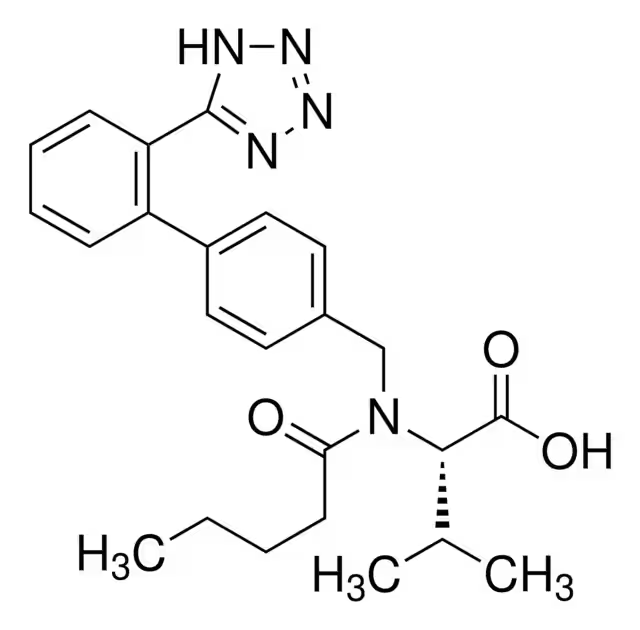
CAS Number137862-53-4
SynonymsValsartan; (S)-N-(1-Carboxy-2-methylprop-1-yl)-N-pentanoyl-N-[2'-(1H-tetrazol-5-yl)-biphenyl-4-ylmethyl]amine; N-Pentanoyl-N-{[2'-(1H-tetrazol-5-yl)-4-biphenylyl]methyl}-L-valine; N-Pentanoyl-N-{[2'-(2H-tetrazol-5-yl)biphenyl-4-yl]methyl}-L-valine; N-Pentanoyl-N-{[2'-(1H-tetrazol-5-yl)biphenyl-4-yl]methyl}-L-valine; N-Valeryl-N-[2'-(1H-tetrazol-5-yl)biphenyl-4-ylmethyl]-L-valine; N-Pentanoyl-N-{[2'-(2H-tetrazol-5-yl)-4-biphenylyl]methyl}valine; N-(1-Oxopentyl)-N-[[2'-(2H-tetrazol-5-yl)[1,1'-biphenyl]-4-yl]methyl]-L-valine; (2S)-3-Methyl-2-(pentanoyl{[2'-(1H-tetrazol-5-yl)biphenyl-4-yl]methyl}amino)butanoic acid; N-[p-(o-1H-Tetrazol-5-ylphenyl)benzyl]-N-valeryl-L-valine; 3-Methyl-2-[pentanoyl-[[4-[2-(2H-tetrazol-5-yl)phenyl]phenyl]methyl]amino]-butanoic acid; Nisis; N-Pentanoyl-N-{[2'-(1H-t
Molecular FormulaC24H29N5O3
Molecular Weight435.52
Purity99%
Density1.2±0.1 g/cm3
Boiling Point684.9±65.0 °C at 760 mmHg
Melting Point116-117°C
AppearanceWhite crystalline powder
| Chemical & Physical Properties | |
|---|---|
| CAS Number | 137862-53-4 |
| Catalog No. | 2A-9012910 |
| Chinese Name | 缬沙坦 |
| Synonyms | Valsartan; (S)-N-(1-Carboxy-2-methylprop-1-yl)-N-pentanoyl-N-[2'-(1H-tetrazol-5-yl)-biphenyl-4-ylmethyl]amine; N-Pentanoyl-N-{[2'-(1H-tetrazol-5-yl)-4-biphenylyl]methyl}-L-valine; N-Pentanoyl-N-{[2'-(2H-tetrazol-5-yl)biphenyl-4-yl]methyl}-L-valine; N-Pentanoyl-N-{[2'-(1H-tetrazol-5-yl)biphenyl-4-yl]methyl}-L-valine; N-Valeryl-N-[2'-(1H-tetrazol-5-yl)biphenyl-4-ylmethyl]-L-valine; N-Pentanoyl-N-{[2'-(2H-tetrazol-5-yl)-4-biphenylyl]methyl}valine; N-(1-Oxopentyl)-N-[[2'-(2H-tetrazol-5-yl)[1,1'-biphenyl]-4-yl]methyl]-L-valine; (2S)-3-Methyl-2-(pentanoyl{[2'-(1H-tetrazol-5-yl)biphenyl-4-yl]methyl}amino)butanoic acid; N-[p-(o-1H-Tetrazol-5-ylphenyl)benzyl]-N-valeryl-L-valine; 3-Methyl-2-[pentanoyl-[[4-[2-(2H-tetrazol-5-yl)phenyl]phenyl]methyl]amino]-butanoic acid; Nisis; N-Pentanoyl-N-{[2'-(1H-t |
| Molecular Formula | C24H29N5O3 |
| Molecular Weight | 435.52 |
| Purity | 99 |
| Density | 1.2±0.1 g/cm3 |
| Boiling Point | 684.9±65.0 °C at 760 mmHg |
| Melting Point | 116-117°C |
| Appearance | White crystalline powder |
| Water Solubility | Soluble in: methanol |
| Storage Condition | -20°C Freezer, Under inert atmosphere |
| Application | Valsarta (CGP-48933) is an angiotensin II receptor antagonist used to treat hypertension and heart failure. |
| HTC | 2933990090 |
| PubChem ID | 329823301 |
| MDL Number | MFCD00865840 |
| SMILES | CCCCC(=O)N(Cc1ccc(cc1)-c2ccccc2-c3nnn[nH]3)[C@@H](C(C)C)C(O)=O |
| InChI | 1S/C24H29N5O3/c1-4-5-10-21(30)29(22(16(2)3)24(31)32)15-17-11-13-18(14-12-17)19-8-6-7-9-20(19)23-25-27-28-26-23/h6-9,11-14,16,22H,4-5,10,15H2,1-3H3,(H,31,32)(H,25,26,27,28)/t22-/m0/s1 |
| InChI Key | ACWBQPMHZXGDFX-QFIPXVFZSA-N |
| NACRES Code | NA.24 |
| UNSPSC | 41116107 |
| MSDS | msds/12910_1_137862_53_4.pdf |
| Bioactivity | Valsartan (CGP-48933) is an angiotensin II receptor antagonist for treatment of high blood pressure and heart failure. Related Catalog Signaling Pathways >> GPCR/G Protein >> Angiotensin Receptor Research Areas >> Cardiovascular Disease In Vitro Valsartan is a synthetic non-peptide angiotensin II type 1 receptor antagonist that dilates blood vessels and reduces blood pressure by blocking the action of angiotensin. Valsartan significantly decreases the expression of AT1R in ageing aorta endothelial cells[1]. The pretreatment of valsartan results in an inhibition of TLR2 signaling and proinflammatory cytokines. The expression of AGTR1 is up-regulated after alcohol exposure, and is blocked by valsartan pretreatment[2]. In Vivo Valsartan significantly attenuates the expression of TGF-β/Smad, Hif-1α and fibrosis-related protein in rats after MI. Heart function, infarcted size, wall thickness as well as myocardial vascularization of ischaemic hearts are also significantly improved by valsartan compared with saline and hydralazine[3]. Valsartan partially reverses the effects of high-salt diet on hypertension, cardiac injuries such as fibrosis and inflammatory cell infiltration, and inhibition of aquaporin 1 and angiogenic factors; valsartan alone does not exert such effects[4]. Valsartan is an effective antidepressant/antianxiety reagent and can promote the hippocampal neurogenesis and expression of BDNF. Chronic administration of valsartan (5-40 mg/kg/d, p.o.) increases the time spent in the center of the field in OFT and the latency to eat in NSF, reduces the immobility time in both TST and FST, and increases the sucrose preference in SPT[5]. Animal Admin Rats: Rats are randomly divided into two groups: (i) valsartan-treated group that is given intravenously 3 mg/kg/day valsartan in 0.5 mL normal saline via the vein daily for 1 week; (ii) hydralazine-treated group receiving 0.2 mg/kg/day hydralazine injection in saline; and (iii) control group that receives saline injection in the same way (n=15 for each group)[4]. Mice: Valsartan is dissolved in water containing 0.5% methylcellulose solution. Valsartan (5-40 mg/kg/d) is administered by oral (p.o.) route in a volume of 10 mL/kg body weight using the gavage technique. Potential alteration in blood pressure in response to chronic treatment with valsartan is assessed with a commercial blood pressure analysis systemdesigned. The mice are trained for at least 2 consecutive days to adapt to the apparatus before the study is initiated. To record the blood pressure, the mice are placed on a heated pad (35°C) and measured with a programmable tail-cuff sphygmomanometer in steady state. The average of 10 readings from each mouse is recorded[5]. References [1]. Shan H, et al. Valsartan ameliorates ageing-induced aorta degeneration via angiotensin II type 1 receptor-mediated ERK activity. J Cell Mol Med. 2014 Jun;18(6):1071-80. [2]. Wang Y, et al. Valsartan blocked alcohol-induced, Toll-like receptor 2 signaling-mediated inflammation in human vascular endothelial cells. Alcohol Clin Exp Res. 2014 Oct;38(10):2529-40. [3]. Sui X, et al. Novel mechanism of cardiac protection by valsartan: synergetic roles of TGF-β1 and HIF-1α in Ang II-mediated fibrosis after myocardial infarction. J Cell Mol Med. 2015 Aug;19(8):1773-82. [4]. Jiang Y, et al. Cardioprotective effect of valsartan in mice with short-term high-salt diet by regulating cardiac aquaporin 1 and angiogenic factor expression. Cardiovasc Pathol. 2015 Jul-Aug;24(4):224-9. [5]. Ping G, et al. Valsartan reverses depressive/anxiety-like behavior and induces hippocampal neurogenesis and expression of BDNF protein in unpredictable chronic mild stress mice. Pharmacol Biochem Behav. 2014 Sep;124:5-12. Chemical & Physical Properties Density 1.2±0.1 g/cm3 Boiling Point 684.9±65.0 °C at 760 mmHg Melting Point 116-117°C Molecular Formula C24H29N5O3 Molecular Weight 435.519 Flash Point 368.0±34.3 °C Exact Mass 435.227051 PSA 112.07000 LogP 4.75 Vapour Pressure 0.0±2.2 mmHg at 25°C Index of Refraction 1.587 InChIKey ACWBQPMHZXGDFX-QFIPXVFZSA-N SMILES CCCCC(=O)N(Cc1ccc(-c2ccccc2-c2nn[nH]n2)cc1)C(C(=O)O)C(C)C Storage condition -20°C Freezer, Under inert atmosphere Stability Hygroscopic |
| Use of | Valsartan (CGP-48933) is an angiotensin II receptor antagonist for treatment of high blood pressure and heart failure. Properties Articles125 Name valsartan Synonym More Synonyms Valsartan Biological Activity Description Valsartan (CGP-48933) is an angiotensin II receptor antagonist for treatment of high blood pressure and heart failure. Related Catalog Signaling Pathways >> GPCR/G Protein >> Angiotensin Receptor Research Areas >> Cardiovascular Disease In Vitro Valsartan is a synthetic non-peptide angiotensin II type 1 receptor antagonist that dilates blood vessels and reduces blood pressure by blocking the action of angiotensin. Valsartan significantly decreases the expression of AT1R in ageing aorta endothelial cells[1]. The pretreatment of valsartan results in an inhibition of TLR2 signaling and proinflammatory cytokines. The expression of AGTR1 is up-regulated after alcohol exposure, and is blocked by valsartan pretreatment[2]. References [1]. Shan H, et al. Valsartan ameliorates ageing-induced aorta degeneration via angiotensin II type 1 receptor-mediated ERK activity. J Cell Mol Med. 2014 Jun;18(6):1071-80. [2]. Wang Y, et al. Valsartan blocked alcohol-induced, Toll-like receptor 2 signaling-mediated inflammation in human vascular endothelial cells. Alcohol Clin Exp Res. 2014 Oct;38(10):2529-40. [3]. Sui X, et al. Novel mechanism of cardiac protection by valsartan: synergetic roles of TGF-β1 and HIF-1α in Ang II-mediated fibrosis after myocardial infarction. J Cell Mol Med. 2015 Aug;19(8):1773-82. [4]. Jiang Y, et al. Cardioprotective effect of valsartan in mice with short-term high-salt diet by regulating cardiac aquaporin 1 and angiogenic factor expression. Cardiovasc Pathol. 2015 Jul-Aug;24(4):224-9. [5]. Ping G, et al. Valsartan reverses depressive/anxiety-like behavior and induces hippocampal neurogenesis and expression of BDNF protein in unpredictable chronic mild stress mice. Pharmacol Biochem Behav. 2014 Sep;124:5-12. Chemical & Physical Properties Molecular Formula C24H29N5O3 Exact Mass 435.227051 PSA 112.07000 Index of Refraction 1.587 InChIKey ACWBQPMHZXGDFX-QFIPXVFZSA-N Stability Hygroscopic |
| Tax Rebate | 13.0% |
| Supervision | None. MFN tariff: 6.5%. Ordinary tariff: 20.0% |
| Transport Info | Product name: Purity: 98.0% |
| MSDS Transport Info | Module 14. Shipping information United Nations classification: inconsistent with United Nations classification standards UN number: not specified |
| Related Products in API & Advanced Intermediates | ||
|---|---|---|
| Trimethoprim lactate | 23256-42-0 | 2A-9012850 |
| Valaciclovir | 124832-26-4 | 2A-9012898 |
| valaciclovir hydrochloride | 124832-27-5 | 2A-9012899 |
| Valganciclovir | 175865-60-8 | 2A-9012903 |
| Valganciclovir Hydrochloride | 175865-59-5 | 2A-0201620 |
| Vancomycin hydrochloride | 1404-93-9 | 2A-9012914 |
| Vardenafil | 224785-90-4 | 2A-9012917 |
| Verapamil | 52-53-9 | 2A-9012923 |
| Verapamil hydrochloride | 152-11-4 | 2A-9012924 |
| Vinblastine sulfate | 143-67-9 | 2A-9012929 |
| Browse all API & Advanced Intermediates products » | ||
Phone:
630-322-8886
630-322-8887
Email:
Office Locations:
Chicago, IL, USA
San Francisco, CA, USA


 EN
EN


 SDS
SDS