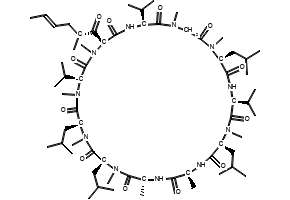
CAS Number121584-18-7
SynonymsSdz-nvi-085; 6-((R-(E))-6,7-Didehydro-N,4-dimethyl-3-oxo-L-2-aminooctanoic acid)-7-L-valine-cyclosporin A; PSC833; Valspodar
Molecular FormulaC63H111O12N11
Molecular Weight1214.64
Purity98.00%
Density1.0±0.1 g/cm3
Boiling Point1290.1±65.0 °C at 760 mmHg
Symbol
Signal WordWarning
| Chemical & Physical Properties | |
|---|---|
| CAS Number | 121584-18-7 |
| Catalog No. | 2A-9012911 |
| Chinese Name | 伐司扑达 |
| Synonyms | Sdz-nvi-085; 6-((R-(E))-6,7-Didehydro-N,4-dimethyl-3-oxo-L-2-aminooctanoic acid)-7-L-valine-cyclosporin A; PSC833; Valspodar |
| Molecular Formula | C63H111O12N11 |
| Molecular Weight | 1214.64 |
| Purity | 98.00 |
| Density | 1.0±0.1 g/cm3 |
| Boiling Point | 1290.1±65.0 °C at 760 mmHg |
| Storage Condition | 2-8℃ |
| Application | Valspodar is a p-glycoprotein (P-gp) inhibitor that is widely used as a modulator to overcome multidrug resistance. |
| MDL Number | MFCD00907207 |
| SMILES | CC=CCC(C)C(=O)C1C(=O)NC(C(C)C)C(=O)N(C)CC(=O)N(C)C(CC(C)C)C(=O)NC(C(C)C)C(=O)N(C)C(CC(C)C)C(=O)NC(C)C(=O)NC(C)C(=O)N(C)C(CC(C)C)C(=O)N(C)C(CC(C)C)C(=O)N(C)C(C(C)C)C(=O)N1C |
| InChI | InChI=1S/C63H111N11O12/c1-26-27-28-41(16)53(76)52-57(80)67-49(38(10)11)61(84)68(19)33-48(75)69(20)44(29-34(2)3)56(79)66-50(39(12)13)62(85)70(21)45(30-35(4)5)55(78)64-42(17)54(77)65-43(18)58(81)71(22)46(31-36(6)7)59(82)72(23)47(32-37(8)9)60(83)73(24)51(40(14)15)63(86)74(52)25/h26-27,34-47,49-52H,28-33H2,1-25H3,(H,64,78)(H,65,77)(H,66,79)(H,67,80)/b27-26+/t41-,42+,43-,44+,45+,46+,47+,49+,50+,51+,52+/m1/s1 |
| InChI Key | YJDYDFNKCBANTM-QCWCSKBGSA-N |
| Hazard Symbols | Transport |
| MSDS | msds/12911_1_121584_18_7.pdf |
| Bioactivity | Valspodar is a P-glycoprotein (P-gp) inhibitor widely used as overcoming multidrug resistance modulator. Related Catalog Signaling Pathways >> Membrane Transporter/Ion Channel >> P-glycoprotein Research Areas >> Cancer In Vitro Valspodar (PSC 833) has no cytotoxicity effects at up to the concentration of 0.75 μg/mL. Valspodar (0.25, 0.5 and 0.75 μg/mL) and DOX-L are added to the DOX resistant cells, and cell kill efficacy of MDR cell type increases significantly when valspodar is administered alongside DOX-L. Valspodar (0.5 and 0.75 μg/mL), in combination with all concentrations of DOX, are most toxic and kill more than 70% of the resistant cells[1]. Pretreatment with PSC833 decreases the IC50 value of mitoxantrone in MDA-MB-435mdr cells to 0.4±0.02 μM in MDR cells and almost completely reverses the resistance of MDR cells to mitoxantrone[3]. In Vivo valspodar (10 mg/kg, o.p.) exhibits minimal blood-cell partitioning as reflected in its low mean blood-to-plasma ratio of approximately 0.52. Valspodar displays properties of slow clearance and a large volume of distribution. Valspodar shows properties of low hepatic extraction and wide distribution, similar to that of its structural analogue cyclosporine A[2]. Preadministration of PSC833 to mice increases mitoxantrone fluorescent intensity in MDR tumor to 94% of that in the wild-type tumors[3]. Cell Assay The in vitro cytotoxicity of various formulations against T47D/TAMR-6 cells is investigated by MTT assay. A 104 T47D/TAMR-6 cells are cultured in 96-well plate containing RPMI medium and incubated overnight to allow cell attachment. After 48 hours incubation, fresh medium containing serial concentration of various drug formulations, including free DOX, DOX-L, mixture of DOX-L and free Valspodar (PSC 833), mixture of DOX-L and PSC-L and DOX/PSC-L are added. The plates are then incubated for an additional 48 hours before washing with normal saline followed by adding MTT solution (0.5 mg/mL) to each well, and incubated for 4 h at 37°C. Then, the medium is removed, and DMSO is added to dissolve the formazan crystals. The plates are mildly shaken for 10 min to ensure the dissolution of formazan. The formazan dye is measured spectrophotometrically using microplate reader at 570 nm with reference standard of 690 nm as described before. Animal Admin Male Sprague-Dawley rats (250-350 g) are housed in temperature-controlled rooms with 12 h of light per day. The animals had free access to food and water prior to experimentation. Rats are divided into two groups: one group (n=6) receives intravenous dose (5 mg/kg) of valspodar and the other group administered valspodar orally (10 mg/kg). Stereoselective pharmacokinetics of desbutylhalofantrine, a metabolite of halofantrine, in the rat after administration of the racemic metabolite or parent drug. After surgery, the rats are transferred to their regular holding cages and allowed free access to water, but food is withheld overnight. The next morning, rats are transferred to the metabolic cages and dosed with valspodar. References [1]. Bajelan E, et al. Co-delivery of doxorubicin and PSC 833 (Valspodar) by stealth nanoliposomes for efficient overcoming of multidrug resistance. J Pharm Pharm Sci. 2012 Sep;15(4):568-82. [2]. PermissionsZ., et al. Pharmacokinetics of PSC 833 (valspodar) in its Cremophor EL formulation in rat.2010,40(1):55-61. [3]. Fei Shen, et al. Dynamic Assessment of Mitoxantrone Resistance and Modulation of Multidrug Resistance by Valspodar (PSC833) in Multidrug Resistance Human Cancer Cells. JPET August 2009,330 (2): 423-429 Chemical & Physical Properties Density 1.0±0.1 g/cm3 Boiling Point 1290.1±65.0 °C at 760 mmHg Molecular Formula C63H111N11O12 Molecular Weight 1214.622 Flash Point 734.0±34.3 °C Exact Mass 1213.841309 PSA 275.64000 LogP 4.10 Vapour Pressure 0.0±0.3 mmHg at 25°C Index of Refraction 1.467 InChIKey YJDYDFNKCBANTM-QCWCSKBGSA-N SMILES CC=CCC(C)C(=O)C1C(=O)NC(C(C)C)C(=O)N(C)CC(=O)N(C)C(CC(C)C)C(=O)NC(C(C)C)C(=O)N(C)C(CC(C)C)C(=O)NC(C)C(=O)NC(C)C(=O)N(C)C(CC(C)C)C(=O)N(C)C(CC(C)C)C(=O)N(C)C(C(C)C)C(=O)N1C Storage condition 2-8℃ |
| Use of | Valspodar is a P-glycoprotein (P-gp) inhibitor widely used as overcoming multidrug resistance modulator. Properties Articles28 Name Valspodar Synonym More Synonyms Valspodar Biological Activity Description Valspodar is a P-glycoprotein (P-gp) inhibitor widely used as overcoming multidrug resistance modulator. Related Catalog Signaling Pathways >> Membrane Transporter/Ion Channel >> P-glycoprotein Research Areas >> Cancer References [1]. Bajelan E, et al. Co-delivery of doxorubicin and PSC 833 (Valspodar) by stealth nanoliposomes for efficient overcoming of multidrug resistance. J Pharm Pharm Sci. 2012 Sep;15(4):568-82. [2]. PermissionsZ., et al. Pharmacokinetics of PSC 833 (valspodar) in its Cremophor EL formulation in rat.2010,40(1):55-61. [3]. Fei Shen, et al. Dynamic Assessment of Mitoxantrone Resistance and Modulation of Multidrug Resistance by Valspodar (PSC833) in Multidrug Resistance Human Cancer Cells. JPET August 2009,330 (2): 423-429 Chemical & Physical Properties Molecular Formula C63H111N11O12 Exact Mass 1213.841309 PSA 275.64000 Index of Refraction 1.467 InChIKey YJDYDFNKCBANTM-QCWCSKBGSA-N Storage condition 2-8℃ |
| Transport Info | Shipping Name: UN |
| MSDS Transport Info | Module 14. Shipping information 14.1 UN dangerous goods number European Land Transport Dangerous Regulations: -International Maritime Dangerous Regulations: -International Air Transport Dangerous Regulations: - 14.2 United Nations shipping name European Land Transport Dangerous Regulations: Non-dangerous goods IMDG Code: Non-dangerous goods International air transport dangerous goods regulations: non-dangerous goods 14.3 Transport hazard categories European Land Transport Dangerous Regulations: -International Maritime Dangerous Regulations: -International Air Transport Dangerous Regulations: - 14.4 Package group European Land Transport Dangerous Regulations: -International Maritime Dangerous Regulations: -International Air Transport Dangerous Regulations: - 14.5 Environmental hazards European Land Transport Danger Regulations: No International Maritime Danger Regulations International Air Transport Danger Regulations: No Marine pollutants (yes/no): No 14.6 Special reminder to users No data available |
| Related Products in Polymer Intermediates | ||
|---|---|---|
| Seratrodast | 112665-43-7 | 2A-9012424 |
| Siguazodan | 115344-47-3 | 2A-9012437 |
| Siguazodan | 99591-83-0 | 2A-9012438 |
| Sodiun lopodats | 1221-56-3 | 2A-9012475 |
| Tiodazosin | 66969-81-1 | 2A-9012736 |
| 2,4-/2,6-Toluene diisocyanate mixture | 26471-62-5 | 2A-9013198 |
| 2-methoxyethyl acrylate | 3121-61-7 | 2A-9013333 |
| Ammonium iodate | 13446-09-8 | 2A-9013704 |
| Anhydrous soda | 497-19-8 | 2A-9013728 |
| Barium iodate | 10567-69-8 | 2A-9013785 |
| Browse all Polymer Intermediates products » | ||
Phone:
630-322-8886
630-322-8887
Email:
Office Locations:
Chicago, IL, USA
San Francisco, CA, USA


 EN
EN


 SDS
SDS