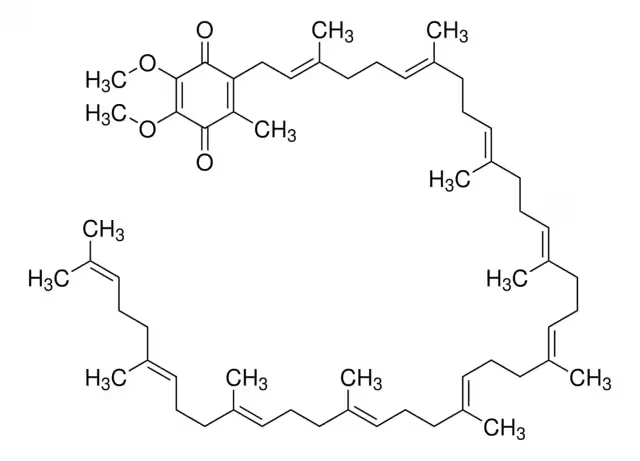
CAS Number303-98-0
Synonymscoenzyme Q-10; CoQ10; Ube-Q; Coenzyme Q; Ubiquinone 50; Coenzyme Q 10; Ubiquinone 10; Coenzyme Q10; Ensorb; Liquid-Q; Carenone; ubiquinone; EINECS 206-147-9; ubiquinone (50); Coenz10; neuqinon; ubiquinone Q10; MFCD00042919; eiquinon; Q-Gel; ubidecarenone; Bio-Quinon; Ubiquinone-10; Coenzyme Q10,Q-10,Ubiquinone 50; Q-10; Kudesan; Q-10 Ubiquinone 50 Ubiquinone-10
Molecular FormulaC59H90O4
Molecular Weight863.34
Purity≥98 (HPLC)%
Density1.0±0.1 g/cm3
Boiling Point869.0±65.0 °C at 760 mmHg
Melting Point49 °C
Appearancepowder
EINECS206-147-9
Symbol
Signal WordWarning
| Chemical & Physical Properties | |
|---|---|
| CAS Number | 303-98-0 |
| Catalog No. | 2A-9012883 |
| Chinese Name | 辅酶Q10 |
| Synonyms | coenzyme Q-10; CoQ10; Ube-Q; Coenzyme Q; Ubiquinone 50; Coenzyme Q 10; Ubiquinone 10; Coenzyme Q10; Ensorb; Liquid-Q; Carenone; ubiquinone; EINECS 206-147-9; ubiquinone (50); Coenz10; neuqinon; ubiquinone Q10; MFCD00042919; eiquinon; Q-Gel; ubidecarenone; Bio-Quinon; Ubiquinone-10; Coenzyme Q10,Q-10,Ubiquinone 50; Q-10; Kudesan; Q-10 Ubiquinone 50 Ubiquinone-10 |
| Molecular Formula | C59H90O4 |
| Molecular Weight | 863.34 |
| Purity | ≥98 (HPLC) |
| Density | 1.0±0.1 g/cm3 |
| Boiling Point | 869.0±65.0 °C at 760 mmHg |
| Melting Point | 49 °C |
| Appearance | powder |
| Water Solubility | Water solubility: insoluble; soluble in: ether; ve |
| Storage Condition | Brown glass bottle, light-shielding and sealed pac |
| Application | Coenzyme Q10 is an important cofactor in the electron transport chain and an effective antioxidant. |
| EINECS | 206-147-9 |
| HTC | 2932999099 |
| PubChem ID | 24893170 |
| MDL Number | MFCD00042919 |
| SMILES | O=C(C(OC)=C1OC)C(C/C=C(C)/CC/C=C(CC/C=C(CC/C=C(CC/C=C(CC/C=C(CC/C=C(C)/CC/C=C(C)/CC/C=C(C)/CCC=C(C)C)\C)\C)\C)\C)\C)=C(C)C1=O |
| InChI | 1S/C59H90O4/c1-44(2)24-15-25-45(3)26-16-27-46(4)28-17-29-47(5)30-18-31-48(6)32-19-33-49(7)34-20-35-50(8)36-21-37-51(9)38-22-39-52(10)40-23-41-53(11)42-43-55-54(12)56(60)58(62-13)59(63-14)57(55)61/h24,26,28,30,32,34,36,38,40,42H,15-23,25,27,29,31,33,35,37,39,41,43H2,1-14H3/b45-26+,46-28+,47-30+,48-32+,49-34+,50-36+,51-38+,52-40+,53-42+ |
| InChI Key | ACTIUHUUMQJHFO-UPTCCGCDSA-N |
| Beilstein/REAXYS | 1900141 |
| NACRES Code | NA.77 |
| UNSPSC | 12352200 |
| Hazard Symbols | Transport |
| MSDS | msds/12883_1_303_98_0.pdf |
| Bioactivity | Coenzyme Q10 is an essential cofactor of the electron transport chain and a potent antioxidant agent. Related Catalog Research Areas >> Cancer Research Areas >> Inflammation/Immunology Research Areas >> Metabolic Disease Research Areas >> Neurological Disease Natural Products >> Quinones Target Human Endogenous Metabolite In Vitro Coenzyme Q10 is an obligatory member of the respiratory chain in the mitochondria of all cells. Therefore, it is an essential ingredient in the formation of adenosine triphosphate (ATP), the source of energy in most cellular processes. Coenzyme Q10 is located in the mitochondria, lysosomes, and Golgi and plasma membranes, and provides an antioxidant action either by direct reaction with free radicals or by regeneration of tocopherol and ascorbate from their oxidised state[1]. Coenzyme Q10 is a popular dietary supplement because of its recognition by the public as an important nutrient in supporting human health. The rationale for the use of Coenzyme Q10 as a therapeutic agent in several cardiovascular and degenerative neurologic and neuromuscular diseases is based upon its fundamental role in mitochondrial function and cellular bioenergetics[2]. In Vivo Because of its hydrophobicity and large molecular weight, absorption of dietary Coenzyme Q10 is slow and limited. In the case of dietary supplements, solubilized Coenzyme Q10 formulations show enhanced bioavailability. The Tmax is around 6 h, with an elimination half-life of about 33 h. The reference intervals for plasma Coenzyme Q10 range from 0.40 to 1.91 mM in healthy subjects. With Coenzyme Q10 supplements there is reasonable correlation between increase in plasma Coenzyme Q10 and ingested dose up to a certain point. Animal data show that Coenzyme Q10 in large doses is taken up by all tissues including heart and brain mitochondria[2]. In 12-month-old rats administration of coenzyme Q10 results in significant increases in cerebral cortex mitochondrial concentrations of coenzyme Q10. Oral administration of coenzyme Q10 markedly attenuates striatal lesions produced by systemic administration of 3-nitropropionic acid and significantly increases life span in a transgenic mouse model of familial amyotrophic lateral sclerosis[3]. Animal Admin Rats[3] The effects of oral administration of coenzyme Q10 on 3-NP-induced striatal lesions are examined in 300- to 350-g rats (n=5-10). Animals receive either rat chow supplemented with coenzyme Q10 at 200 mg/kg or unsupplemented rat chow. After 1 week they are treated with 3-NP at a dose of 10 mgykg i.p. twice a day until either a control or treated animal became symptomatic with hindlimb dystonia, and then sacrificed in pairs[3]. Mice[3] To determine whether coenzyme Q10 exerts neuroprotective effects in a transgenic mouse model of a human neurodegenerative disorder, coenzyme Q10 (200 mg/kg) is administered orally to 16 transgenic mice overexpressing a human CuyZn superoxide dismutase (SOD1) mutation, as compared with 13 animals that receive unsupplemented rat chow. The mice used are the G1 line, which expresses high levels of human SOD with the G93A mutation. Treatment is started at 50 days after birth. Treatment is continued until mice reach end-stage disease[3]. References [1]. Yang YK, et al. Coenzyme Q10 treatment of cardiovascular disorders of ageing including heart failure, hypertension and endothelial dysfunction. Clin Chim Acta. 2015 Oct 23;450:83-9. [2]. Bhagavan HN, et al. Coenzyme Q10: absorption, tissue uptake, metabolism and pharmacokinetics. Free Radic Res. 2006 May;40(5):445-53. [3]. Matthews RT, et al. Coenzyme Q10 administration increases brain mitochondrial concentrations and exerts neuroprotective effects. Proc Natl Acad Sci U S A. 1998 Jul 21;95(15):8892-7. Chemical & Physical Properties Density 1.0±0.1 g/cm3 Boiling Point 869.0±65.0 °C at 760 mmHg Melting Point 49-51 °C Molecular Formula C59H90O4 Molecular Weight 863.344 Flash Point 324.6±34.3 °C Exact Mass 862.683899 PSA 52.60000 LogP 20.93 Vapour Pressure 0.0±3.3 mmHg at 25°C Index of Refraction 1.526 InChIKey ACTIUHUUMQJHFO-UPTCCGCDSA-N SMILES COC1=C(OC)C(=O)C(CC=C(C)CCC=C(C)CCC=C(C)CCC=C(C)CCC=C(C)CCC=C(C)CCC=C(C)CCC=C(C)CCC=C(C)CCC=C(C)C)=C(C)C1=O Storage condition −20°C Stability Stable, but may be light or heat sensitive. Store in the dark at -20 C. Incompatible with strong oxidizing agents. |
| Use of | Coenzyme Q10 is an essential cofactor of the electron transport chain and a potent antioxidant agent. Properties Articles99 Name coenzyme Q10 Synonym More Synonyms coenzyme Q10 Biological Activity Description Coenzyme Q10 is an essential cofactor of the electron transport chain and a potent antioxidant agent. Related Catalog Research Areas >> Cancer Research Areas >> Inflammation/Immunology Research Areas >> Metabolic Disease Research Areas >> Neurological Disease Natural Products >> Quinones Human Endogenous Metabolite In Vitro Coenzyme Q10 is an obligatory member of the respiratory chain in the mitochondria of all cells. Therefore, it is an essential ingredient in the formation of adenosine triphosphate (ATP), the source of energy in most cellular processes. Coenzyme Q10 is located in the mitochondria, lysosomes, and Golgi and plasma membranes, and provides an antioxidant action either by direct reaction with free radicals or by regeneration of tocopherol and ascorbate from their oxidised state[1]. Coenzyme Q10 is a popular dietary supplement because of its recognition by the public as an important nutrient in supporting human health. The rationale for the use of Coenzyme Q10 as a therapeutic agent in several cardiovascular and degenerative neurologic and neuromuscular diseases is based upon its fundamental role in mitochondrial function and cellular bioenergetics[2]. References [1]. Yang YK, et al. Coenzyme Q10 treatment of cardiovascular disorders of ageing including heart failure, hypertension and endothelial dysfunction. Clin Chim Acta. 2015 Oct 23;450:83-9. [2]. Bhagavan HN, et al. Coenzyme Q10: absorption, tissue uptake, metabolism and pharmacokinetics. Free Radic Res. 2006 May;40(5):445-53. [3]. Matthews RT, et al. Coenzyme Q10 administration increases brain mitochondrial concentrations and exerts neuroprotective effects. Proc Natl Acad Sci U S A. 1998 Jul 21;95(15):8892-7. Chemical & Physical Properties Molecular Formula C59H90O4 Exact Mass 862.683899 PSA 52.60000 LogP 20.93 Index of Refraction 1.526 InChIKey ACTIUHUUMQJHFO-UPTCCGCDSA-N SMILES COC1=C(OC)C(=O)C(CC=C(C)CCC=C(C)CCC=C(C)CCC=C(C)CCC=C(C)CCC=C(C)CCC=C(C)CCC=C(C)CCC=C(C)CCC=C(C)C)=C(C)C1=O |
| Tax Rebate | 13.0% |
| Supervision | None. MFN tariff: 6.5%. Ordinary tariff: 20.0% |
| Transport Info | Product name: Purity: 98.0% |
| MSDS Transport Info | Module 14. Shipping information 14.1 UN number European Land Transport Dangerous Regulations: -International Maritime Dangerous Regulations: -International Air Transport Dangerous Regulations: - 14.2 Names specified by the United Nations (UN) European Land Transport Dangerous Regulations: No dangerous goods IMDG Code: No dangerous goods International Air Transport Dangerous Regulations: No dangerous goods 14.3 Transport hazard categories European Land Transport Dangerous Regulations: -International Maritime Dangerous Regulations: -International Air Transport Dangerous Regulations: - 14.4 Package group European Land Transport Dangerous Regulations: -International Maritime Dangerous Regulations: -International Air Transport Dangerous Regulations: - 14.5 Environmental hazards European Land Transport Dangerous Regulations: No International Maritime Transport Dangerous Regulations Maritime Pollutants: No International Air Transport Risk Regulations: No 14.6 Special reminder to users No data available |
| Related Products in Nutritional Ingredients | ||
|---|---|---|
| Toldimfos | 57808-64-7 | 2A-9012766 |
| Triclabendazole | 68786-66-3 | 2A-9012823 |
| Triclacetamol | 6340-87-0 | 2A-9012824 |
| Tricyclazole | 41814-78-2 | 2A-9012826 |
| Troxerutin | 7085-55-4 | 2A-9012868 |
| Vitamin B1 | 59-43-8 | 2A-9012947 |
| Vitamin B7 | 58-85-5 | 2A-9012948 |
| Vitamin D2 | 50-14-6 | 2A-9012949 |
| Zeaxanthin | 144-68-3 | 2A-9012986 |
| Cadmium sulfoselenide | 12626-36-7 | 2A-9013924 |
| Browse all Nutritional Ingredients products » | ||
Phone:
630-322-8886
630-322-8887
Email:
Office Locations:
Chicago, IL, USA
San Francisco, CA, USA


 EN
EN


 SDS
SDS