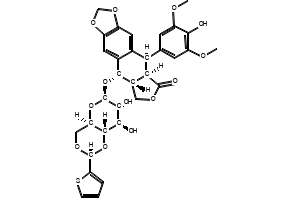
CAS Number29767-20-2
Synonymsetp; Pipodophyllotoxin VM 26; Teniposide/VM-26; vm-26; vehem; Teniposide; Teniposide(VuMon); EINECS 249-831-2; MFCD00866516; Vumon
Molecular FormulaC32H32O13S1
Molecular Weight656.66
Purity98%
Density1.6±0.1 g/cm3
Boiling Point864.3±65.0 °C at 760 mmHg
Melting Point274 - 277ºC
AppearanceSolid;White to Almost white powder to crystaline
| Chemical & Physical Properties | |
|---|---|
| CAS Number | 29767-20-2 |
| Catalog No. | 2A-9012624 |
| Chinese Name | 替尼泊苷 |
| Synonyms | etp; Pipodophyllotoxin VM 26; Teniposide/VM-26; vm-26; vehem; Teniposide; Teniposide(VuMon); EINECS 249-831-2; MFCD00866516; Vumon |
| Molecular Formula | C32H32O13S1 |
| Molecular Weight | 656.66 |
| Purity | 98 |
| Density | 1.6±0.1 g/cm3 |
| Boiling Point | 864.3±65.0 °C at 760 mmHg |
| Melting Point | 274 - 277ºC |
| Appearance | Solid;White to Almost white powder to crystaline |
| Water Solubility | Water solubility: insoluble; water solubility: 5.9 |
| Storage Condition | Keep the receptacle sealed, stored in a cool, dry |
| Application | Teniposide is a podotoxin derivative, an inhibitor of topoisomerase II, and a chemotherapeutic agent. |
| MDL Number | MFCD00866516 |
| SMILES | COc1cc(C2c3cc4c(cc3C(OC3OC5COC(c6cccs6)OC5C(O)C3O)C3COC(=O)C23)OCO4)cc(OC)c1O |
| InChI Key | NRUKOCRGYNPUPR-QBPJDGROSA-N |
| MSDS | msds/12624_1_29767_20_2.pdf |
| Bioactivity | Teniposide is a podophyllotoxin derivative, acts as a topoisomerase II inhibitor, and used as a chemotherapeutic agent. Related Catalog Signaling Pathways >> Cell Cycle/DNA Damage >> Topoisomerase Research Areas >> Cancer Target Topoisomerase II In Vitro Teniposide is a topoisomerase II inhibitor. Teniposide (VM-26, 0.15-45 mg/L) inhibits the proliferation of Tca8113 cells in a dose-dependent manner, with an IC50 of 0.35 mg/L. Teniposide (5 mg/L) induces apoptosis of Tca8113 cells. Teniposide (5.0 mg/L) causes cell arrested at G2/M phase in Tca8113 cells[2]. Teniposide is active on primary cultured glioma cells from patients, when the level of miR-181b is high in the cells, with an IC50 of 1.3 ± 0.34 μg/mL. Cells treated with teniposide with low MDM2 have decreased viability compared with control cells, and the IC50 decreases from 5.86 ± 0.36 μg/mL to 2.90 ± 0.35 μg/mL upon MDM2 suppression. Teniposide also inhibits the viability of glioma cell with high level of miR-181b, through mediation of MDM2[3]. In Vivo Teniposide (0.5 mg/kg, i.p.) significantly increases micronucleated polychromatic erythrocyte (MNPCE) frequencies, which is directly related to bone marrow toxicity as significant suppression of bone marrow is noted. Teniposide (24 mg/kg, i.p.) markedly decreases the frequencies of BrdU-labelled sperm. Teniposide (12, 24 mg/kg, i.p.) also dramatically induces disomic sperm in the germ cell of male mice[1]. Cell Assay Logarithmically growing Tca8113 cells are trypsinized and made into single cell suspension then plated in 96-well culture plate at a concentration of 5 × 10⁴ cells/well, eight columns for Teniposide and seven columns for CDDP in each plate, 3 wells in each column. After 24 hours of incubation, the medium of the 3 wells in each column are replaced with medium containing Teniposide of 0.15 mg/L, 0.5 mg/L, 1.5 mg/L, 5.0 mg/L, 15 mg/L and 45 mg/L or CDDP of 0.1 mg/L, 0.3 mg/L, 1.0 mg/L, 3.0 mg/L and 9.0 mg/L, respectively. Blank control wells are added medium without drugs. Cells are then cultured for another 24 hours, 48 hours, 72 hours, 96 hours and 120 hours. The supernatants are removed and 20 μL MTT solution is added in each well, followed with another 4 hours of culture. The supernatants are discarded carefully and 200 μL dimethyl sulphoxide (DMSO) is added and shaken vigorously to dissolve the purple precipitation formation. Optical density (OD) of each well is tested using Spectrophotometer with a wavelength of 450 nm. The experiment is repeated in triplicate[2]. Animal Admin Animals (mice) are treated with 0.5 mg/kg teniposide and bone marrow is sampled 24 h after treatment. Colchicine and mitomycin C are used as a positive control aneugen and clastogen, respectively, at the dose of 2 mg/kg each. Bone marrow smears are prepared and stained with May-Gruenwald/Giemsa solutions. At least four slides are made for each animal and allowed to dry overnight. One slide per animal is stained with May-Gruenwald/Giemsa solutions for conventional assessment of the micronuclei (MN) frequencies in polychromatic erythrocytes (PCEs) and normochromatic erythrocytes (NCEs). The remaining unstained slides are stored at −20°C for the distinction between the clastogenic and aneugenic effects by identifying the origin of MN with the mouse DNA probes. Per animal, 1000 PCE of coded slides are scored for the presence of MN. In addition, the number of PCEs among 1000 NCE per animal is recorded to evaluate bone marrow suppression and mitotic activity is calculated as %PCE = [PCE/(PCE + NCE)] × 100[1]. References [1]. Attia SM, et al. Molecular cytogenetic evaluation of the aneugenic effects of teniposide in somatic and germinal cells of male mice. Mutagenesis. 2012 Jan;27(1):31-9. [2]. Li J, et al. Topoisomerase II trapping agent teniposide induces apoptosis and G2/M or S phase arrest of oral squamous cell carcinoma. World J Surg Oncol. 2006 Jul 6;4:41. [3]. Sun YC, et al. MiR-181b sensitizes glioma cells to teniposide by targeting MDM2. BMC Cancer. 2014 Aug 25;14:611. Chemical & Physical Properties Density 1.6±0.1 g/cm3 Boiling Point 864.3±65.0 °C at 760 mmHg Melting Point 274 - 277ºC Molecular Formula C32H32O13S Molecular Weight 656.654 Flash Point 476.5±34.3 °C Exact Mass 656.156372 PSA 189.07000 LogP 1.71 Vapour Pressure 0.0±0.3 mmHg at 25°C Index of Refraction 1.697 InChIKey NRUKOCRGYNPUPR-QBPJDGROSA-N SMILES COc1cc(C2c3cc4c(cc3C(OC3OC5COC(c6cccs6)OC5C(O)C3O)C3COC(=O)C23)OCO4)cc(OC)c1O Storage condition -20°C Freezer |
| Use of | Teniposide is a podophyllotoxin derivative, acts as a topoisomerase II inhibitor, and used as a chemotherapeutic agent. Properties Articles42 Name teniposide Synonym More Synonyms Teniposide Biological Activity Description Teniposide is a podophyllotoxin derivative, acts as a topoisomerase II inhibitor, and used as a chemotherapeutic agent. Related Catalog Signaling Pathways >> Cell Cycle/DNA Damage >> Topoisomerase Research Areas >> Cancer Topoisomerase II References [1]. Attia SM, et al. Molecular cytogenetic evaluation of the aneugenic effects of teniposide in somatic and germinal cells of male mice. Mutagenesis. 2012 Jan;27(1):31-9. [3]. Sun YC, et al. MiR-181b sensitizes glioma cells to teniposide by targeting MDM2. BMC Cancer. 2014 Aug 25;14:611. Chemical & Physical Properties Molecular Formula C32H32O13S Exact Mass 656.156372 PSA 189.07000 Index of Refraction 1.697 InChIKey NRUKOCRGYNPUPR-QBPJDGROSA-N |
| Transport Info | Product name: Purity: 98.0% |
| MSDS Transport Info | Module 14. Shipping information United Nations classification: inconsistent with United Nations classification standards UN number: not specified |
| Related Products in Specialty Chemicals | ||
|---|---|---|
| Temodox | 34499-96-2 | 2A-9012619 |
| Temozolomide | 85622-93-1 | 2A-9012620 |
| Temurtide | 66112-59-2 | 2A-9012621 |
| Tenatoprazole | 113712-98-4 | 2A-9012622 |
| Tenidap | 120210-48-2 | 2A-9012623 |
| Tenoxican | 59804-37-4 | 2A-9012627 |
| Teopranitol | 81792-35-0 | 2A-9012628 |
| Tepraloxydim | 149979-41-9 | 2A-9012629 |
| Teprenone | 6809-52-5 | 2A-9012630 |
| Terallethrin | 15589-31-8 | 2A-9012632 |
| Browse all Specialty Chemicals products » | ||
Phone:
630-322-8886
630-322-8887
Email:
Office Locations:
Chicago, IL, USA
San Francisco, CA, USA


 EN
EN


 SDS
SDS