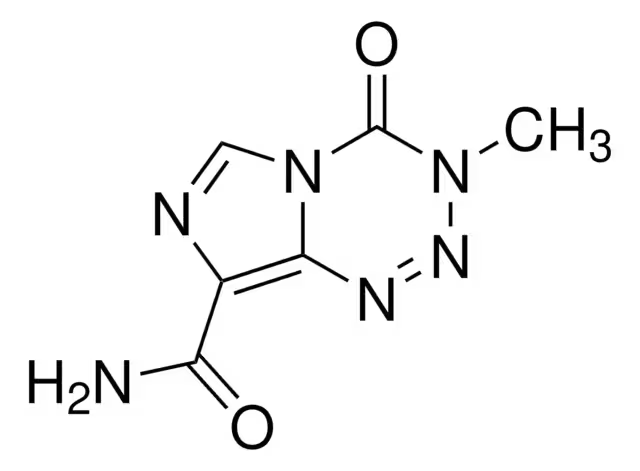
CAS Number85622-93-1
SynonymsTemodal; Temozolamide; 3-Methyl-4-oxo-3,4-dihydroimidazo[5,1-d][1,2,3,5]tetrazine-8-carboxamide; TZM; M&B 39831; TEMODAR; Temozolomide; MFCD00866492; temosolomide
Molecular FormulaC6H6N6O2
Molecular Weight194.15
Purity≥98 (HPLC)%
Density2.0±0.1 g/cm3
Boiling Point526.6±42.0 °C at 760 mmHg
Melting Point212°C dec.
Appearancepowder
| Chemical & Physical Properties | |
|---|---|
| CAS Number | 85622-93-1 |
| Catalog No. | 2A-9012620 |
| Chinese Name | 替莫唑胺 |
| Synonyms | Temodal; Temozolamide; 3-Methyl-4-oxo-3,4-dihydroimidazo[5,1-d][1,2,3,5]tetrazine-8-carboxamide; TZM; M&B 39831; TEMODAR; Temozolomide; MFCD00866492; temosolomide |
| Molecular Formula | C6H6N6O2 |
| Molecular Weight | 194.15 |
| Purity | ≥98 (HPLC) |
| Density | 2.0±0.1 g/cm3 |
| Boiling Point | 526.6±42.0 °C at 760 mmHg |
| Melting Point | 212°C dec. |
| Appearance | powder |
| Storage Condition | 2-8°C |
| Application | Temozolomide (NSC 362856; CCRG 81045) is an orally available DNA alkylating agent used to treat certain brain cancers. |
| HTC | 2933990090 |
| PubChem ID | 329826714 |
| MDL Number | MFCD00866492 |
| SMILES | CN1N=Nc2c(ncn2C1=O)C(N)=O |
| InChI | 1S/C6H6N6O2/c1-11-6(14)12-2-8-3(4(7)13)5(12)9-10-11/h2H,1H3,(H2,7,13) |
| InChI Key | BPEGJWRSRHCHSN-UHFFFAOYSA-N |
| NACRES Code | NA.77 |
| UNSPSC | 12352200 |
| MSDS | msds/12620_1_85622_93_1.pdf |
| Bioactivity | Temozolomide (NSC 362856; CCRG 81045) is an oral DNA alkylating agent used to treat some brain cancers. Related Catalog Signaling Pathways >> Autophagy >> Autophagy Signaling Pathways >> Cell Cycle/DNA Damage >> DNA Alkylator/Crosslinker Research Areas >> Cancer Target DNA alkylator[1] In Vitro Temozolomide (TZM) is a methylating agent that crosses the blood-brain barrier and is indicated for malignant gliomas and metastatic melanomas. Temozolomide is effective against tumor cells that are characterized by low levels of O6-alkylguanine DNA alkyltransferase (OGAT) and a functional mismatch repair system (MR)[1]. Determination of the IC50 for Temozolomide (TZM) in different cell lines gave values ranging from 14.1 to 234.6 μM that fell into two clearly differentiated groups: cell lines with low IC50 values (<50 μM), which include A172 (14.1±1.1 μM) and LN229 cells (14.5±1.1 μM), and those with high IC50 values (>100 μM), which include SF268 (147.2±2.1 μM) and SK-N-SH cells (234.6±2.3 μM)[2]. In Vivo Temozolomide (TZM), as a single agent, does not significantly increase mdian survival time (MST) with respect to control. Noteworthy, intracranial injection of NU1025, immediately before the administration of 100 or 200 mg/kg Temozolomide, significantly increases lifespans with respect to controls or to groups treated with Temozolomide only. When Temozolomide is fractionated, the increase in lifespan (ILS) obtained with this schedule is higher than that observed when NU1025 is combined with a single injection of Temozolomide (statistical comparison of survival curves: NU1025 intracranially+Temozolomide 100 mg/kg×2 vs NU1025+Temozolomide 200 mg/kg; P=0.023)[1]. Cell Assay The murine lymphoma cell line L5178Y of DBA/2 (H-2d/H-2d) origin is cultured in RPMI-1640 containing 10% fetal calf serum and antibiotics. Inhibition of PARP is obtained by treating cells (105 cells/mL) with 8-hydroxy-2-methylquinazolin-4[3H]-1 (NU1025), at a concentration (25 μM) that abrogates PARP activity. Cells are then exposed to Temozolomide (7.5-125 μM) and are cultured for 3 days. Cell growth is evaluated by counting viable cells in quadruplicate, and apoptosis is assessed by flow cytometry analysis of DNA content. Long-term survival is analyzed by colony-formation assay[1]. Animal Admin Mice[1] Male B6D2F1 (C57BL/6×DBA/2) mice are anesthetized with ketamine (100 mg/kg) and xylazine (5 mg/kg) in 0.9% NaCl solution (10 mL/kg intraperitoneally). L5178Y cells (104 in 0.03 mL RPMI-1640) are then injected intracranially, through the center-middle area of the frontal bone to a 2-mm depth, using a 0.1-mL glass microsyringe and a 27-gauge disposable needle. To evaluate tumor cell growth, brains are fixed in 10% phosphate-buffered formaldehyde, and histologic sections (5 μm) are cut along the axial plane, stained with hematoxylin-eosin, and analyzed by light microscopy. Temozolomide is dissolved in DMSO (40 mg/mL), diluted in saline (5 mg/mL), and administered intraperitoneally on day 2 after tumor injection at 100 mg/kg or 200 mg/kg, doses commonly used for in vivo preclinical studies. Because cytotoxicity induced by Temozolomide and PARP inhibitors can be improved by fractionated modality of treatment, in selected groups a total dose of 200 mg/kg Temozolomide is divided in 2 doses of 100 mg/kg given on days 2 and 3. References [1]. Tentori L, et al. Combined treatment with temozolomide and poly(ADP-ribose) polymerase inhibitor enhances survival of mice bearing hematologic malignancy at the central nervous system site. Blood. 2002 Mar 15;99(6):2241-4. [2]. Perazzoli G, et al. Temozolomide Resistance in Glioblastoma Cell Lines: Implication of MGMT, MMR, P-Glycoprotein and CD133 Expression. PLoS One. 2015 Oct 8;10(10):e0140131. Chemical & Physical Properties Density 2.0±0.1 g/cm3 Boiling Point 526.6±42.0 °C at 760 mmHg Melting Point 212°C dec. Molecular Formula C6H6N6O2 Molecular Weight 194.151 Flash Point 272.3±27.9 °C Exact Mass 194.055222 PSA 108.17000 LogP -1.32 Vapour Pressure 0.0±1.4 mmHg at 25°C Index of Refraction 1.895 InChIKey BPEGJWRSRHCHSN-UHFFFAOYSA-N SMILES Cn1nnc2c(C(N)=O)ncn2c1=O Storage condition 2-8°C |
| Use of | Temozolomide (NSC 362856; CCRG 81045) is an oral DNA alkylating agent used to treat some brain cancers. Properties Articles206 Name temozolomide Synonym More Synonyms Temozolomide Biological Activity Description Temozolomide (NSC 362856; CCRG 81045) is an oral DNA alkylating agent used to treat some brain cancers. Related Catalog Signaling Pathways >> Autophagy >> Autophagy Signaling Pathways >> Cell Cycle/DNA Damage >> DNA Alkylator/Crosslinker Research Areas >> Cancer DNA alkylator[1] References [1]. Tentori L, et al. Combined treatment with temozolomide and poly(ADP-ribose) polymerase inhibitor enhances survival of mice bearing hematologic malignancy at the central nervous system site. Blood. 2002 Mar 15;99(6):2241-4. [2]. Perazzoli G, et al. Temozolomide Resistance in Glioblastoma Cell Lines: Implication of MGMT, MMR, P-Glycoprotein and CD133 Expression. PLoS One. 2015 Oct 8;10(10):e0140131. Chemical & Physical Properties Molecular Formula C6H6N6O2 Exact Mass 194.055222 PSA 108.17000 LogP -1.32 Index of Refraction 1.895 InChIKey BPEGJWRSRHCHSN-UHFFFAOYSA-N |
| Tax Rebate | 13.0% |
| Supervision | None. MFN tariff: 6.5%. Ordinary tariff: 20.0% |
| Transport Info | Product name: Purity: 98.0% |
| MSDS Transport Info | Module 14. Shipping information United Nations classification: inconsistent with United Nations classification standards UN number: not specified |
| Related Products in Specialty Chemicals | ||
|---|---|---|
| Temeguard | 3383-96-8 | 2A-9012615 |
| Temocapril | 111902-57-9 | 2A-9012616 |
| Temocaprilat | 110221-53-9 | 2A-9012617 |
| Temocillin | 61545-06-0 | 2A-0202384 |
| Temodox | 34499-96-2 | 2A-9012619 |
| Temurtide | 66112-59-2 | 2A-9012621 |
| Tenatoprazole | 113712-98-4 | 2A-9012622 |
| Tenidap | 120210-48-2 | 2A-9012623 |
| Teniposide | 29767-20-2 | 2A-9012624 |
| Tenoxican | 59804-37-4 | 2A-9012627 |
| Browse all Specialty Chemicals products » | ||
Phone:
630-322-8886
630-322-8887
Email:
Office Locations:
Chicago, IL, USA
San Francisco, CA, USA


 EN
EN


 SDS
SDS