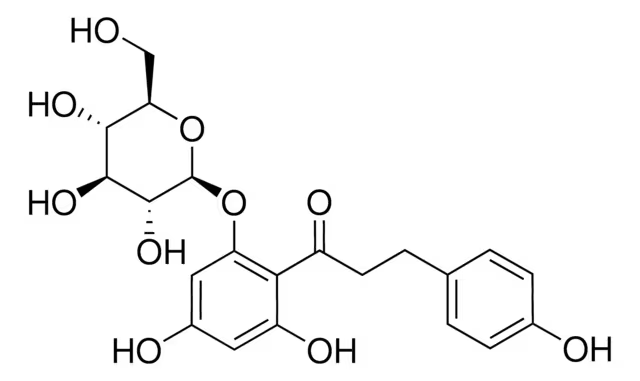
CAS Number60-81-1
Synonymsphlorizoside; 4,6-dihydroxy-2-(β-D-glucosido)-β-(p-hydroxyphenyl)propiophenone; 3,5-Dihydroxy-2-[3-(4-hydroxyphenyl)propanoyl]phenyl-β-D-glucopyranoside; phloridzosid; phloridzine; Phlorrhizen; phloretin 2'-O-glucoside; Phlorizin; Isosalipurposide; Phloretin-2'-b-glucoside; Phloridzin; Phlorhizin; 3,5-Dihydroxy-2-[3-(4-hydroxyphenyl)propanoyl]phenyl β-D-glucopyranoside; 1-[2-(β-D-Glucopyranosyloxy)-4,6-dihydroxyphenyl]-3-(4-hydroxyphenyl)-1-propanone; 2'-(β-D-glucopyranosyloxy)-4',6'-dihydroxy-3-(4-hydroxyphenyl)propiophenone; 4,6-Dihydroxy-2-(b-D-glucosido)-b-(p-hydroxyphenyl)propiophenone; Phloretin-2'-O-glucoside; Floridzin; MFCD00006591; 1-[2-(b-D-Glucopyranosyloxy)-4,6-dihydroxyphenyl]-3-(4-hydroxyphenyl)-1-propanone; Phloretin-2'-β-glucoside; phlorrhizin; EINECS 200-487-1
Molecular FormulaC21H24O10
Molecular Weight436.41
Purity≥98.0 (HPLC)%
Density1.6±0.1 g/cm3
Boiling Point770.0±60.0 °C at 760 mmHg
Melting Point113-114 °C(lit.)
AppearanceLight yellow powder
| Chemical & Physical Properties | |
|---|---|
| CAS Number | 60-81-1 |
| Catalog No. | 2A-9011990 |
| Chinese Name | 根皮苷 |
| Synonyms | phlorizoside; 4,6-dihydroxy-2-(β-D-glucosido)-β-(p-hydroxyphenyl)propiophenone; 3,5-Dihydroxy-2-[3-(4-hydroxyphenyl)propanoyl]phenyl-β-D-glucopyranoside; phloridzosid; phloridzine; Phlorrhizen; phloretin 2'-O-glucoside; Phlorizin; Isosalipurposide; Phloretin-2'-b-glucoside; Phloridzin; Phlorhizin; 3,5-Dihydroxy-2-[3-(4-hydroxyphenyl)propanoyl]phenyl β-D-glucopyranoside; 1-[2-(β-D-Glucopyranosyloxy)-4,6-dihydroxyphenyl]-3-(4-hydroxyphenyl)-1-propanone; 2'-(β-D-glucopyranosyloxy)-4',6'-dihydroxy-3-(4-hydroxyphenyl)propiophenone; 4,6-Dihydroxy-2-(b-D-glucosido)-b-(p-hydroxyphenyl)propiophenone; Phloretin-2'-O-glucoside; Floridzin; MFCD00006591; 1-[2-(b-D-Glucopyranosyloxy)-4,6-dihydroxyphenyl]-3-(4-hydroxyphenyl)-1-propanone; Phloretin-2'-β-glucoside; phlorrhizin; EINECS 200-487-1 |
| Molecular Formula | C21H24O10 |
| Molecular Weight | 436.41 |
| Purity | ≥98.0 (HPLC) |
| Density | 1.6±0.1 g/cm3 |
| Boiling Point | 770.0±60.0 °C at 760 mmHg |
| Melting Point | 113-114 °C(lit.) |
| Appearance | Light yellow powder |
| Storage Condition | This product should be stored in a sealed, cool, d |
| Application | Phlorizin is a non-selective SGLT inhibitor with Ki values of 300 and 39 nM for hSGLT1 and hSGLT2, respectively. Phlorizin is also a Na+/K+-ATPase inhibitor. |
| MDL Number | MFCD00006591 |
| SMILES | O1[C@H]([C@@H]([C@H]([C@@H]([C@H]1CO)O)O)O)Oc2c(c(cc(c2)O)O)C(=O)CCc3ccc(cc3)O |
| InChI | 1S/C21H24O10/c22-9-16-18(27)19(28)20(29)21(31-16)30-15-8-12(24)7-14(26)17(15)13(25)6-3-10-1-4-11(23)5-2-10/h1-2,4-5,7-8,16,18-24,26-29H,3,6,9H2/t16-,18-,19+,20-,21-/m1/s1 |
| InChI Key | IOUVKUPGCMBWBT-QNDFHXLGSA-N |
| NACRES Code | NA.24 |
| UNSPSC | 41116107 |
| MSDS | msds/11990_1_60_81_1.pdf |
| Bioactivity | Phlorizin is a non-selective SGLT inhibitor with Kis of 300 and 39 nM for hSGLT1 and hSGLT2, respectively. Phlorizin is also a Na+/K+-ATPase inhibitor. Related Catalog Signaling Pathways >> Membrane Transporter/Ion Channel >> Na+/K+ ATPase Signaling Pathways >> Membrane Transporter/Ion Channel >> SGLT Natural Products >> Flavonoids Research Areas >> Metabolic Disease Target Ki: 300 nM (hSGLT1), 39 nM (hSGLT2)[1] Na+/K+-ATPase[2] In Vitro Phlorizin is a non-selective SGLT inhibitor with Kis of 300 and 39 nM for hSGLT1 and hSGLT2, respectively[1]. Phlorizin is also a Na+/K+-ATPase inhibitor[2]. Phlorizin at 2×10⁻⁴ M inhibits Na+ and Rb+-activated ATPase activities in human red cell membranes by 43 %. At 1 mM and 7 mM RbCl, rubidium uptake is not changed or is slightly inhibited (less than 15 %) by 2×10⁻⁴ M Phlorizin[2]. Cell viability is not significantly altered by doses of Phlorizin <100 μM. Pretreating cells with Phlorizin does not significantly reduce nitrite or PGE2 levels. Phlorizin does not suppress IL-6 or TNF-α production, although 100 μM Phlorizin can significantly inhibit TNF-α expression[3]. In Vivo Prior to Phlorizin treatment, the blood glucose level in SDT fatty rats is 370±49 mg/dL. Six hours after dosing, the blood glucose level in the Phlorizin treated group decreases to an almost normal level (139±32 mg/dL). Phlorizin-treated SDT fatty rats are heavier than vehicle-treated SDT fatty rats after 12 weeks. Phlorizin treatment significantly decreases glucose excretion and delays insulin decreases. Creatinine clearance decreases significantly with Phlorizin treatment. 23 weeks of Phlorizin treatment prevents the decrease of nerve fibers (23.6±3.2 fibers/mm). Retinal abnormalities are completely prevented with Phlorizin[4]. Kinase Assay Resealed ghosts are obtained with the addition of 4×10⁻³ M ATP and 5×10⁻³ M MgCl2 with or without 5×10⁻⁴ M Phlorizin (final concentration) when red cells are hemolyzed. Ghosts corresponding to 0.4-0.45 mL of the original blood cells are incubated with 0.9 mL of Medium A and 86RbCl for 45 or 90 min and the radioactivity in 200 μL of the supernatant is determined. The ATPase activity in the resealed ghosts is determined from the increase in inorganic phosphate after incubation[1]. Cell Assay The RAW264.7 murine macrophage-derived cell line is used. Cell viability is measured using the 3-(4,5-Dimethylthiazol-2-yl)-2,5-diphenyltetrazolium bromide (MTT) assay. Cells (105 cells/well) are cultured in 96-well plates and treated with varying concentrations of Phlorizin for 24 h. Next, the supernatant is removed and the cells are incubated with MTT (50 mg/mL) for 4 h at 37°C. The plates are washed and isopropanol is added to dissolve formazone crystals, then the absorbance values are measured at 570 nm using a microplate reader[3]. Animal Admin Female SDT fatty rats are used in this study. At six weeks of age, SDT fatty rats are divided into two groups (n=8); a Phlorizin treated group and a vehicle treated group. Age-matched female Sprague-Dawley (SD) rats are used as control animals (n=8). Animals are housed in a climate-controlled room (temperature 23±3°C, humidity 55±15%, 12 h lighting cycle) and allowed free access to basal diet and water. Phlorizin is injected subcutaneously once daily (100 mg/kg/day) to animals in the Phlorizin treated group for 23 weeks. Twenty % propylene glycol is administered to animals in the vehicle treated group and control SD rats[4]. References [1]. Pajor AM, et al. Inhibitor binding in the human renal low- and high-affinity Na+/glucose cotransporters. J Pharmacol Exp Ther. 2008 Mar;324(3):985-91. [2]. Nakagawa A, et al. Localization of the phlorizin site on Na, K-ATPase in red cell membranes. J Biochem. 1977 May;81(5):1511-5. [3]. Chang WT, et al. Evaluation of the anti-inflammatory effects of phloretin and phlorizin in lipopolysaccharide-stimulated mouse macrophages. Food Chem. 2012 Sep 15;134(2):972-9. [4]. Katsuda Y, et al. Contribution of hyperglycemia on diabetic complications in obese type 2 diabetic SDT fatty rats: effects of SGLT inhibitor phlorizin. Exp Anim. 2015;64(2):161-9. Chemical & Physical Properties Density 1.6±0.1 g/cm3 Boiling Point 770.0±60.0 °C at 760 mmHg Melting Point 113-114 °C(lit.) Molecular Formula C21H24O10 Molecular Weight 436.409 Flash Point 270.7±26.4 °C Exact Mass 436.136932 PSA 177.14000 LogP 0.45 Vapour Pressure 0.0±2.8 mmHg at 25°C Index of Refraction 1.686 Storage condition 2-8°C |
| Use of | Phlorizin is a non-selective SGLT inhibitor with Kis of 300 and 39 nM for hSGLT1 and hSGLT2, respectively. Phlorizin is also a Na+/K+-ATPase inhibitor. Properties Name phlorizin Synonym More Synonyms Phlorizin Biological Activity Description Phlorizin is a non-selective SGLT inhibitor with Kis of 300 and 39 nM for hSGLT1 and hSGLT2, respectively. Phlorizin is also a Na+/K+-ATPase inhibitor. Related Catalog Signaling Pathways >> Membrane Transporter/Ion Channel >> Na+/K+ ATPase Signaling Pathways >> Membrane Transporter/Ion Channel >> SGLT Natural Products >> Flavonoids Research Areas >> Metabolic Disease Ki: 300 nM (hSGLT1), 39 nM (hSGLT2)[1] Na+/K+-ATPase[2] References [1]. Pajor AM, et al. Inhibitor binding in the human renal low- and high-affinity Na+/glucose cotransporters. J Pharmacol Exp Ther. 2008 Mar;324(3):985-91. [2]. Nakagawa A, et al. Localization of the phlorizin site on Na, K-ATPase in red cell membranes. J Biochem. 1977 May;81(5):1511-5. [3]. Chang WT, et al. Evaluation of the anti-inflammatory effects of phloretin and phlorizin in lipopolysaccharide-stimulated mouse macrophages. Food Chem. 2012 Sep 15;134(2):972-9. [4]. Katsuda Y, et al. Contribution of hyperglycemia on diabetic complications in obese type 2 diabetic SDT fatty rats: effects of SGLT inhibitor phlorizin. Exp Anim. 2015;64(2):161-9. Chemical & Physical Properties Molecular Formula C21H24O10 Exact Mass 436.136932 PSA 177.14000 Index of Refraction 1.686 |
| Transport Info | Product Name: Phlorizin |
| Related Products in Botanical Reference Standards | ||
|---|---|---|
| Oleanolic acid ethyl ester | 110700-49-7 | 2A-9011753 |
| Ononin | 486-62-4 | 2A-9011775 |
| Orientin | 28608-75-5 | 2A-9011787 |
| Osthole | 484-12-8 | 2A-9011799 |
| Phloretin | 60-82-2 | 2A-9011989 |
| Stigmasterol | 83-48-7 | 2A-9012002 |
| Picroside II | 39012-20-9 | 2A-9012013 |
| Polisaponin | 8063-80-7 | 2A-9012073 |
| Propofol glucuronide | 114991-26-3 | 2A-9012169 |
| Psoralen | 66-97-7 | 2A-9012193 |
| Browse all Botanical Reference Standards products » | ||
Phone:
630-322-8886
630-322-8887
Email:
Office Locations:
Chicago, IL, USA
San Francisco, CA, USA


 EN
EN


 SDS
SDS