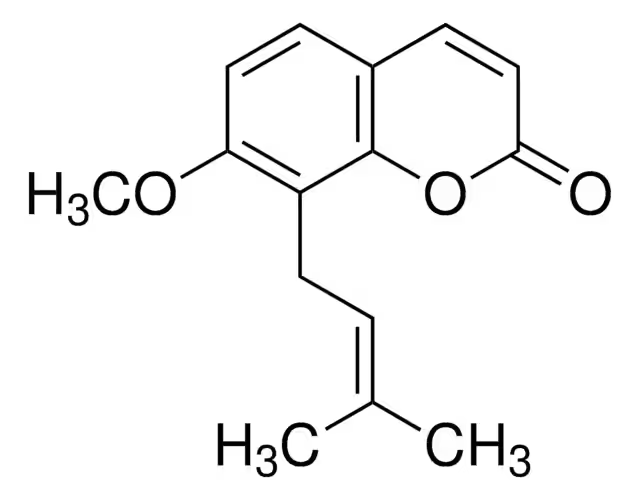
CAS Number484-12-8
SynonymsOstol; 7-methoxy-8-(3-methylbut-2-en-1-yl)-2H-1-benzopyran-2-one; MFCD00076049; Cnidium Monnieri Extract; DaMiana Extract; 7-methoxy-8-(3-methylbut-2-enyl)chromen-2-one; 7-Methoxy-8-isopentenylcoumarin; 7-Methoxy-8-(3-methyl-2-butenyl)coumarin; Osthol/Osthole; 7-Methoxy-8-(3-methyl-2-buten-1-yl)-2H-chromen-2-one; 7-methoxy-8-(3-methylbut-2-enyl)-2H-chromen-2-one; 7-methoxy-8-(3-methyl-2-buten-1-yl)-2H-1-benzopyran-2-one; Ostole; 7-methoxy-8-isopentenoxycoumarin; 7-Methoxy-8-(3-Methyl-But-2-Enyl)-Chromen-2-One; Chuanxiongzine; Osthole; 7-methoxy-8-(3-methylbut-2-en-1-yl)-2H-chromen-2-one; OSTHOL; Cnidium; 7-Methoxy-8-(3-methyl-2-butenyl)coumarin,7-Methoxy-8-isopentenylcoumarin,Osthol; 7-Méthoxy-8-(3-méthyl-2-butèn-1-yl)-2H-chromén-2-one
Molecular FormulaC15H16O3
Molecular Weight244.29
Purity≥95 (HPLC)%
Density1.1±0.1 g/cm3
Boiling Point396.7±42.0 °C at 760 mmHg
Melting Point83-84°C
Appearancepowder
Symbol
Signal WordWarning
| Chemical & Physical Properties | |
|---|---|
| CAS Number | 484-12-8 |
| Catalog No. | 2A-9011799 |
| Chinese Name | 蛇床子素 |
| Synonyms | Ostol; 7-methoxy-8-(3-methylbut-2-en-1-yl)-2H-1-benzopyran-2-one; MFCD00076049; Cnidium Monnieri Extract; DaMiana Extract; 7-methoxy-8-(3-methylbut-2-enyl)chromen-2-one; 7-Methoxy-8-isopentenylcoumarin; 7-Methoxy-8-(3-methyl-2-butenyl)coumarin; Osthol/Osthole; 7-Methoxy-8-(3-methyl-2-buten-1-yl)-2H-chromen-2-one; 7-methoxy-8-(3-methylbut-2-enyl)-2H-chromen-2-one; 7-methoxy-8-(3-methyl-2-buten-1-yl)-2H-1-benzopyran-2-one; Ostole; 7-methoxy-8-isopentenoxycoumarin; 7-Methoxy-8-(3-Methyl-But-2-Enyl)-Chromen-2-One; Chuanxiongzine; Osthole; 7-methoxy-8-(3-methylbut-2-en-1-yl)-2H-chromen-2-one; OSTHOL; Cnidium; 7-Methoxy-8-(3-methyl-2-butenyl)coumarin,7-Methoxy-8-isopentenylcoumarin,Osthol; 7-Méthoxy-8-(3-méthyl-2-butèn-1-yl)-2H-chromén-2-one |
| Molecular Formula | C15H16O3 |
| Molecular Weight | 244.29 |
| Purity | ≥95 (HPLC) |
| Density | 1.1±0.1 g/cm3 |
| Boiling Point | 396.7±42.0 °C at 760 mmHg |
| Melting Point | 83-84°C |
| Appearance | powder |
| Water Solubility | Water solubility: insoluble; soluble in: methanol; |
| Storage Condition | Store in a sealed container in a ventilated and dr |
| Application | Osthole is a natural antihistamine replacement agent. Osthole effectively inhibits histamine H1 receptor activity. |
| HTC | 29081000 |
| PubChem ID | 329818938 |
| MDL Number | MFCD00076049 |
| SMILES | COc1ccc2C=CC(=O)Oc2c1C\C=C(\C)C |
| InChI | 1S/C15H16O3/c1-10(2)4-7-12-13(17-3)8-5-11-6-9-14(16)18-15(11)12/h4-6,8-9H,7H2,1-3H3 |
| InChI Key | MBRLOUHOWLUMFF-UHFFFAOYSA-N |
| NACRES Code | NA.25 |
| UNSPSC | 12352205 |
| Hazard Symbols | Transport |
| MSDS | msds/11799_1_484_12_8.pdf |
| Bioactivity | Osthole is a natural antihistamine alternative. Osthole may be a potential inhibitor of histamine H1 receptor activity. Related Catalog Signaling Pathways >> GPCR/G Protein >> Histamine Receptor Signaling Pathways >> Immunology/Inflammation >> Histamine Receptor Research Areas >> Cancer Natural Products >> Phenylpropanoids Target Histamine H1 receptor[1] In Vitro Osthole (p<0.0001) and Fexofenadine (p<0.001) inhibit increased HRH-1 mRNA expression induced by histamine in the study group. This result is also observed in cells cultured with histamine/Osthole; where combined substances decreased HRH-1 mRNA expression compared to histamine (p<0.0001)[1]. Assessment of cell viability does not detect obvious toxicity when Osthole is used at a dose up to 100 µM. However, when the dose reached 500 µM, Osthole started to show toxic effect. Based on these observations, Osthole is used in all in vitro studies at the dose range of 10 to 100 µM. Osthole dose-dependently promotes osteoblast differentiation, as shown by the upregulation of osteoblast differentiation marker genes such as type I collagen (col1), bone sialoprotein (BSP) and osteocalcin (OC) (2 days of culture). Osthole promotes ALP activity in mouse primary osteoblasts in a dose-dependent manner[2]. In Vivo Subcutaneous injection of Osthole at a dose of 5 mg/kg per day onto mouse calvariae significantly stimulates local bone formation, as shown by histologic analysis of calvarial samples harvested 2 weeks after the last injection and stained with H&E orange G. Histomorphometric analysis reveals that Osthole has a significant effect on bone formation as potent as the positive control, the microtubule inhibitor TN-16. This effect, however, is not seen when Osthole is used at a dose of 1 mg/kg per day. Intraperitoneal injection of Osthole for 8 weeks significantly reverses bone loss in the ovariectomized rats. Histologic examination of the L4samples stained with trinitrophenol poinsettia demonstrates a partial recovery of the trabecular structure in ovariectomized rats treated with Osthole. Histomorphometric analysis shows that treatment with Osthole significantly increases total BMD, trabecular bone volume, and trabecular thickness and decreases trabecular separation[2]. Cell Assay Peripheral blood samples are collected from participants between 7.00 and 9.00 a.m. on the first study day and these are concentrated in grouping tubes with K3EDTA. Fresh PBMCs are then prepared. Isolated cells are seeded on 24-well plates at 1×10⁶ per well with RPMI-1640 and supplemented with 1% heat inactivated human AB serum, 1% gentamicin and 0.25% PHA. Active reagents are added to each well after 24 h and pure medium formed the control for each substance. Cells are then harvested after a further three days[1]. Animal Admin Mice[2] Four-week-old ICR Swiss mice are injected subcutaneously over the calvarial surface with or without the treatment of Osthole twice a day for 5 consecutive days at the doses of 1 and 5 mg/kg per day (3 mice per group). Microtubule inhibitor TN-16 is used as a positive control (5 mg/kg per day, by subcutaneous injection, twice a day for 2 days; 3 mice per group). All mice are euthanized 3 weeks after treatment, and calvariae are dissected, fixed in 10% phosphate-buffered formalin for 2 days, decalcified in 10% EDTA for 2 weeks, and embedded in paraffin. Histologic sections are cut and stained with hematoxylin and eosine orange G. New bone area over the calvarial surface is quantified by histomorphometry using the OsteoMeasure System. To measure mineral appositional rate (MAR) and bone-formation rate (BFR), double calcein labeling is performed at days 7 and 14 by intraperitoneal injection (20 mg/kg), and mice are euthanized 7 days after the second labeling. The labeling is examined in plastic sections. The dissected calvarial samples are fixed in 75% ethanol and embedded in methyl methacrylate. Unstained transverse sections (3 µm thick) are examined with a fluorescent microscope. MAR and BFR are measured using the OsteoMeasure System. Rats[2] Thirty 6-month-old female Sprague-Dawley rats are used. After anesthesia with intraperitoneal nembutal injection (30 mg/kg), the rats are randomized by body weight into three groups for the surgery (n=10/group): group 1: sham surgery followed by PBS vehicle treatment (sham+VEH); group 2: ovariectomy followed by vehicle treatment (OVX+VEH); and group 3: ovariectomy followed by Osthole treatment (OVX+OST). The treatment is started 1 month after surgery and continued for 8 weeks. Vehicle or Osthole (100 mg/kg per day) is administered orally once a day for 8 weeks. Before rats are euthanized at the end of the experiments, the total bone mineral density (BMD, g/m2) is measured using dual-energy X-ray absorptiometry. The fourth lumbar vertebrae (L4) then are dissected for histomorphometric and micro-computed tomographic (µCT) analysis, and the left femoral shafts are used for biomechanical testing. References [1]. Kordulewska NK, et al. Changes in gene expression induced by histamine, fexofenadine and osthole: Expression of histamine H1 receptor, COX-2, NF-κB, CCR1, chemokine CCL5/RANTES and interleukin-1β in PBMC allergic and non-allergic patients. Immunobiology. [2]. Tang DZ, et al. Osthole stimulates osteoblast differentiation and bone formation by activation of beta-catenin-BMP signaling. J Bone Miner Res. 2010 Jun;25(6):1234-45. [3]. Sun W, et al. Osthole pretreatment alleviates TNBS-induced colitis in mice via both cAMP/PKA-dependent and independent pathways. Acta Pharmacol Sin. 2017 Aug;38(8):1120-1128. Chemical & Physical Properties Density 1.1±0.1 g/cm3 Boiling Point 396.7±42.0 °C at 760 mmHg Melting Point 83-84°C Molecular Formula C15H16O3 Molecular Weight 244.286 Flash Point 167.6±22.5 °C Exact Mass 244.109940 PSA 39.44000 LogP 3.87 Vapour Pressure 0.0±0.9 mmHg at 25°C Index of Refraction 1.557 InChIKey MBRLOUHOWLUMFF-UHFFFAOYSA-N SMILES COc1ccc2ccc(=O)oc2c1CC=C(C)C Storage condition room temp |
| Use of | Osthole is a natural antihistamine alternative. Osthole may be a potential inhibitor of histamine H1 receptor activity. Properties Name osthol Synonym More Synonyms Osthole Biological Activity Description Osthole is a natural antihistamine alternative. Osthole may be a potential inhibitor of histamine H1 receptor activity. Related Catalog Signaling Pathways >> GPCR/G Protein >> Histamine Receptor Signaling Pathways >> Immunology/Inflammation >> Histamine Receptor Research Areas >> Cancer Natural Products >> Phenylpropanoids Histamine H1 receptor[1] Cell Assay Peripheral blood samples are collected from participants between 7.00 and 9.00 a.m. on the first study day and these are concentrated in grouping tubes with K3EDTA. Fresh PBMCs are then prepared. Isolated cells are seeded on 24-well plates at 1×10⁶ per well with RPMI-1640 and supplemented with 1% heat inactivated human AB serum, 1% gentamicin and 0.25% PHA. Active reagents are added to each well after 24 h and pure medium formed the control for each substance. Cells are then harvested after a further three days[1]. References [2]. Tang DZ, et al. Osthole stimulates osteoblast differentiation and bone formation by activation of beta-catenin-BMP signaling. J Bone Miner Res. 2010 Jun;25(6):1234-45. [3]. Sun W, et al. Osthole pretreatment alleviates TNBS-induced colitis in mice via both cAMP/PKA-dependent and independent pathways. Acta Pharmacol Sin. 2017 Aug;38(8):1120-1128. Chemical & Physical Properties Molecular Formula C15H16O3 Exact Mass 244.109940 PSA 39.44000 Index of Refraction 1.557 InChIKey MBRLOUHOWLUMFF-UHFFFAOYSA-N Storage condition room temp |
| Tax Rebate | 13.0% |
| Supervision | None. MFN tariff: 6.5%. Ordinary tariff: 20.0% |
| Transport Info | Product name: Purity: 98.0% |
| MSDS Transport Info | Module 14. Shipping information 14.1 UN dangerous goods number European Land Transport Dangerous Regulations: -International Maritime Dangerous Regulations: -International Air Transport Dangerous Regulations: - 14.2 Names specified by the United Nations (UN) European Land Transport Dangerous Regulations: Non-dangerous goods IMDG Code: Non-dangerous goods International air transport dangerous goods regulations: non-dangerous goods 14.3 Transport hazard categories European Land Transport Dangerous Regulations: -International Maritime Dangerous Regulations: -International Air Transport Dangerous Regulations: - 14.4 Package group European Land Transport Dangerous Regulations: -International Maritime Dangerous Regulations: -International Air Transport Dangerous Regulations: - 14.5 Environmental hazards European Land Transport Dangerous Regulations: No International Maritime Transport Dangerous Regulations Maritime Pollutants: No International Air Transport Risk Regulations: No 14.6 Special reminder to users No data available |
| Related Products in Botanical Reference Standards | ||
|---|---|---|
| Oleanolic acid | 508-02-1 | 2A-9011751 |
| Oleanolic acid 3-O-alpha -L-rhamnopyranosyl glucopyranosyl ester | 2A-302835 | 2A-9011752 |
| Oleanolic acid ethyl ester | 110700-49-7 | 2A-9011753 |
| Ononin | 486-62-4 | 2A-9011775 |
| Orientin | 28608-75-5 | 2A-9011787 |
| Phloretin | 60-82-2 | 2A-9011989 |
| Phloridzin | 60-81-1 | 2A-9011990 |
| Stigmasterol | 83-48-7 | 2A-9012002 |
| Picroside II | 39012-20-9 | 2A-9012013 |
| Polisaponin | 8063-80-7 | 2A-9012073 |
| Browse all Botanical Reference Standards products » | ||
Phone:
630-322-8886
630-322-8887
Email:
Office Locations:
Chicago, IL, USA
San Francisco, CA, USA


 EN
EN


 SDS
SDS