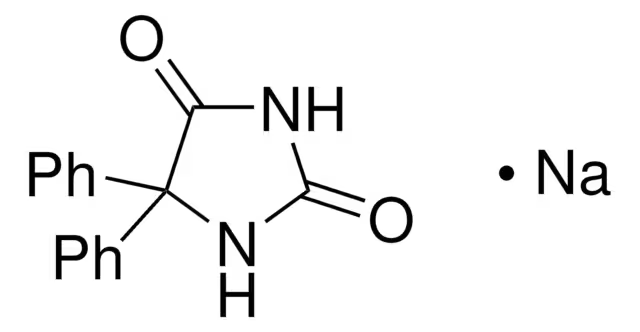
CAS Number630-93-3
Synonymsepelin; tacosal; 5,5-diphenylhydantoin sodium; dilantin sodium; ditoin; MFCD00069674; alepsin; di-len; eptoin; 5,5-diphenylimidazolidine-2,4-dione sodium salt; enkefal; dihydan; epinat; 5,5-diphenyl-hydantoine; solantyl; phenytoin sodium salt; EINECS 211-148-2
Molecular FormulaC15H11N2O2Na
Molecular Weight274.25
Purity≥99%
Boiling Point428.2ºC at 760 mmHg
Melting Point290-299ºC
Appearancepowder
EINECS211-148-2
Symbol
Signal WordWarning
| Chemical & Physical Properties | |
|---|---|
| CAS Number | 630-93-3 |
| Catalog No. | 2A-9011987 |
| Chinese Name | 苯妥英钠 |
| Synonyms | epelin; tacosal; 5,5-diphenylhydantoin sodium; dilantin sodium; ditoin; MFCD00069674; alepsin; di-len; eptoin; 5,5-diphenylimidazolidine-2,4-dione sodium salt; enkefal; dihydan; epinat; 5,5-diphenyl-hydantoine; solantyl; phenytoin sodium salt; EINECS 211-148-2 |
| Molecular Formula | C15H11N2O2Na |
| Molecular Weight | 274.25 |
| Purity | ≥99 |
| Boiling Point | 428.2ºC at 760 mmHg |
| Melting Point | 290-299ºC |
| Appearance | powder |
| Water Solubility | aqueous base: soluble |
| Storage Condition | Store in an airtight container in a cool, dry plac |
| Packaging | III |
| Application | Phenytoin sodium is an inactive voltage-gated sodium channel stabilizer. |
| EINECS | 211-148-2 |
| HTC | 2933990090 |
| PubChem ID | 24277707 |
| MDL Number | MFCD00069674 |
| SMILES | [Na]N1C(=O)NC(C1=O)(c2ccccc2)c3ccccc3 |
| InChI | 1S/C15H12N2O2.Na/c18-13-15(17-14(19)16-13,11-7-3-1-4-8-11)12-9-5-2-6-10-12;/h1-10H,(H2,16,17,18,19);/q;+1/p-1 |
| InChI Key | FJPYVLNWWICYDW-UHFFFAOYSA-M |
| NACRES Code | NA.77 |
| UNSPSC | 12352200 |
| Hazard Symbols | 6.1(b) |
| MSDS | msds/11987_1_630_93_3.pdf |
| Bioactivity | Phenytoin sodium is an inactive voltage-gated sodium channel stabilizer.Target: Sodium ChannelPhenytoin sodium is an antiepileptic drug. It is useful to treat partial seizures and generalized tonic-clonic seizures but not primary generalized seizures such as absence seizures or myoclonic seizures. Phenytoin is believed to protect against seizures by causing voltage-dependent block of voltage-gated sodium channels [1]. Phenytoin has low affinity for resting sodium channels at hyperpolarized membrane potentials [2]. When neurons are depolarized and the channels transition into the open and inactivated states, greater binding and block occur. The inhibitory potency is strongly use dependent, so that block accumulates with prolonged or repetitive activation, such as occurs during a seizure discharge. The blocking of sodium channels by phenytoin is of slow onset. The time course of fast sodium currents is therefore not altered in the presence of the drug and action potentials evoked by synaptic depolarizations of ordinary duration are not blocked. Thus phenytoin is able to selectively inhibit pathological hyperexcitability in epilepsy without unduly impairing ongoing activity. Phenytoin also blocks persistent sodium current and this may be of particular importance in seizure control. Phenytoin is a class 1b antiarrhythmic [3]. Related Catalog Signaling Pathways >> Membrane Transporter/Ion Channel >> Sodium Channel Research Areas >> Neurological Disease References [1]. Rogawski, M.A. and W. Loscher, The neurobiology of antiepileptic drugs. Nat Rev Neurosci, 2004. 5(7): p. 553-64. [2]. Porter, R.J., et al., Mechanisms of action of antiseizure drugs. Handb Clin Neurol, 2012. 108: p. 663-81. [3]. Balaji, S., Medical therapy for sudden death. Pediatr Clin North Am, 2004. 51(5): p. 1379-87. Chemical & Physical Properties Boiling Point 428.2ºC at 760 mmHg Melting Point 290-299ºC Molecular Formula C15H11N2NaO2 Molecular Weight 274.250 Flash Point 212.8ºC Exact Mass 274.071808 PSA 49.41000 LogP 2.21300 InChIKey FJPYVLNWWICYDW-UHFFFAOYSA-M SMILES O=C1[N-]C(=O)C(c2ccccc2)(c2ccccc2)N1.[Na+] Water Solubility aqueous base: soluble |
| Use of | Phenytoin sodium is an inactive voltage-gated sodium channel stabilizer.Target: Sodium ChannelPhenytoin sodium is an antiepileptic drug. It is useful to treat partial seizures and generalized tonic-clonic seizures but not primary generalized seizures such as absence seizures or myoclonic seizures. Phenytoin is believed to protect against seizures by causing voltage-dependent block of voltage-gated sodium channels [1]. Phenytoin has low affinity for resting sodium channels at hyperpolarized membrane potentials [2]. When neurons are depolarized and the channels transition into the open and inactivated states, greater binding and block occur. The inhibitory potency is strongly use dependent, so that block accumulates with prolonged or repetitive activation, such as occurs during a seizure discharge. The blocking of sodium channels by phenytoin is of slow onset. The time course of fast sodium currents is therefore not altered in the presence of the drug and action potentials evoked by synaptic depolarizations of ordinary duration are not blocked. Thus phenytoin is able to selectively inhibit pathological hyperexcitability in epilepsy without unduly impairing ongoing activity. Phenytoin also blocks persistent sodium current and this may be of particular importance in seizure control. Phenytoin is a class 1b antiarrhythmic [3]. Properties Articles17 Name Phenytoin sodium Synonym More Synonyms Phenytoin sodium Biological Activity Description Phenytoin sodium is an inactive voltage-gated sodium channel stabilizer.Target: Sodium ChannelPhenytoin sodium is an antiepileptic drug. It is useful to treat partial seizures and generalized tonic-clonic seizures but not primary generalized seizures such as absence seizures or myoclonic seizures. Phenytoin is believed to protect against seizures by causing voltage-dependent block of voltage-gated sodium channels [1]. Phenytoin has low affinity for resting sodium channels at hyperpolarized membrane potentials [2]. When neurons are depolarized and the channels transition into the open and inactivated states, greater binding and block occur. The inhibitory potency is strongly use dependent, so that block accumulates with prolonged or repetitive activation, such as occurs during a seizure discharge. The blocking of sodium channels by phenytoin is of slow onset. The time course of fast sodium currents is therefore not altered in the presence of the drug and action potentials evoked by synaptic depolarizations of ordinary duration are not blocked. Thus phenytoin is able to selectively inhibit pathological hyperexcitability in epilepsy without unduly impairing ongoing activity. Phenytoin also blocks persistent sodium current and this may be of particular importance in seizure control. Phenytoin is a class 1b antiarrhythmic [3]. Related Catalog Signaling Pathways >> Membrane Transporter/Ion Channel >> Sodium Channel Research Areas >> Neurological Disease References [1]. Rogawski, M.A. and W. Loscher, The neurobiology of antiepileptic drugs. Nat Rev Neurosci, 2004. 5(7): p. 553-64. [2]. Porter, R.J., et al., Mechanisms of action of antiseizure drugs. Handb Clin Neurol, 2012. 108: p. 663-81. [3]. Balaji, S., Medical therapy for sudden death. Pediatr Clin North Am, 2004. 51(5): p. 1379-87. Chemical & Physical Properties Molecular Formula C15H11N2NaO2 Exact Mass 274.071808 PSA 49.41000 LogP 2.21300 InChIKey FJPYVLNWWICYDW-UHFFFAOYSA-M Water Solubility aqueous base: soluble |
| Tax Rebate | 13.0% |
| Supervision | None. MFN tariff: 6.5%. Ordinary tariff: 20.0% |
| Transport Info | Product name: Purity: 98.0% |
| MSDS Transport Info | Module 14. Shipping information 14.1 UN dangerous goods number European Dangerous Regulations for land transport: 2811 International Dangerous Regulations for sea transport: 2811 International Dangerous Regulations for air transport: 2811 14.2 Names specified by the United Nations (UN) European Land Transport Dangerous Regulations: TOXIC SOLID, ORGANIC, N.O.S. (Phenytoin sodium) IMDG: TOXIC SOLID, ORGANIC, N.O.S. (Phenytoin sodium) International air transport hazard regulations: Toxic solid, organic, n.o.s. (Phenytoin sodium) 14.3 Transport hazard categories European Land Transport Danger Regulations: 6.1 International Maritime Transport Danger Regulations: 6.1 International Air Transport Danger Regulations: 6.1 14.4 Package group European Land Transport Danger Regulations: III International Maritime Transport Danger Regulations: III International Air Transport Danger Regulations: III 14.5 Environmental hazards European Land Transport Dangerous Regulations: No International Maritime Transport Dangerous Regulations Maritime Pollutants: No International Air Transport Risk Regulations: No 14.6 Special reminder to users No data available |
| Related Products in API & Advanced Intermediates | ||
|---|---|---|
| Pemetrexed disodium | 150399-23-8 | 2A-9011903 |
| Penicillin G sodium salt | 69-57-8 | 2A-9011915 |
| Perindopril | 82834-16-0 | 2A-9011937 |
| Perindopril erbumine | 107133-36-8 | 2A-9011938 |
| Perindoprilat | 95153-31-4 | 2A-9011939 |
| Pioglitazone | 111025-46-8 | 2A-9012027 |
| Pioglitazone hydrochloride | 112529-15-4 | 2A-9012028 |
| Piroxicamum | 36322-90-4 | 2A-9012051 |
| Pitavastatin calcium | 147526-32-7 | 2A-9012056 |
| Poly(estradiol phosphate) | 34828-67-6 | 2A-0202304 |
| Browse all API & Advanced Intermediates products » | ||
Phone:
630-322-8886
630-322-8887
Email:
Office Locations:
Chicago, IL, USA
San Francisco, CA, USA


 EN
EN


 SDS
SDS