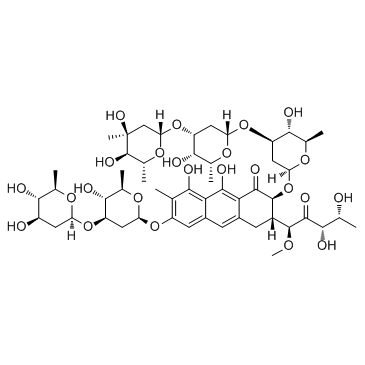
CAS Number18378-89-7
SynonymsAntibiotic LA-7017; aurlelicacid; MFCD00135618; EINECS 232-455-8; MITHRAMYCIN; Mithramycin A From Streptomyces Argillaceus; aurelicacid; PlicatoMycin; a-2371; mitramycin; pa144; AURLELIC ACID; Aurelic acid; PLICAMYCIN; MITHRACIN; aureolic acid; Mithramycin A
Molecular FormulaC52H76O24
Molecular Weight1085.145
Purity98.00%
Density1.5±0.1 g/cm3
Boiling Point1169.8±65.0 °C at 760 mmHg
Melting Point180-183ºC
Appearanceyellow powder
Symbol
Signal WordWarning
| Chemical & Physical Properties | |
|---|---|
| CAS Number | 18378-89-7 |
| Catalog No. | 2A-9011466 |
| Chinese Name | 光辉霉素 |
| Synonyms | Antibiotic LA-7017; aurlelicacid; MFCD00135618; EINECS 232-455-8; MITHRAMYCIN; Mithramycin A From Streptomyces Argillaceus; aurelicacid; PlicatoMycin; a-2371; mitramycin; pa144; AURLELIC ACID; Aurelic acid; PLICAMYCIN; MITHRACIN; aureolic acid; Mithramycin A |
| Molecular Formula | C52H76O24 |
| Molecular Weight | 1085.145 |
| Purity | 98.00 |
| Density | 1.5±0.1 g/cm3 |
| Boiling Point | 1169.8±65.0 °C at 760 mmHg |
| Melting Point | 180-183ºC |
| Appearance | yellow powder |
| Packaging | III |
| Application | Plicamycin is a selective inhibitor of Sp1 transcription factor. Plicamycin inhibits cancer cell growth by reducing Sp1 protein expression. |
| SMILES | COC(C(=O)C(O)C(C)O)C1Cc2cc3cc(OC4CC(OC5CC(O)C(O)C(C)O5)C(O)C(C)O4)c(C)c(O)c3c(O)c2C(=O)C1OC1CC(OC2CC(OC3CC(C)(O)C(O)C(C)O3)C(O)C(C)O2)C(O)C(C)O1 |
| InChI | InChI=1S/C52H76O24/c1-18-29(72-34-14-30(43(58)21(4)68-34)73-33-13-28(54)42(57)20(3)67-33)12-26-10-25-11-27(49(66-9)48(63)41(56)19(2)53)50(47(62)39(25)46(61)38(26)40(18)55)76-36-16-31(44(59)23(6)70-36)74-35-15-32(45(60)22(5)69-35)75-37-17-52(8,65)51(64)24(7)71-37/h10,12,19-24,27-28,30-37,41-45,49-51,53-61,64-65H,11,13-17H2,1-9H3/t19-,20-,21-,22-,23-,24-,27+,28-,30-,31-,32-,33+,34+,35+,36+,37+,41+,42-,43-,44-,45-,49+,50+,51-,52+/m1/s1 |
| InChI Key | CFCUWKMKBJTWLW-UHFFFAOYSA-N |
| Hazard Symbols | 6.1(b) |
| Bioactivity | Plicamycin is a selective specificity protein 1 (Sp1) inhibitor. Plicamycin inhibits the growth of various cancers by decreasing Sp1 protein. Related Catalog Signaling Pathways >> Cell Cycle/DNA Damage >> DNA/RNA Synthesis Research Areas >> Cancer Target Sp1 transcription factor[1] In Vitro Sp1 is a zinc-finger transcription factor that regulates multiple cellular functions and promotes tumor progression by controlling expression of genes involved in cell cycle, apoptosis and DNA damage. Sp1 binds to GC-rich motifs of promoters and interacts with components of the general transcriptional machinery and co-activator complexes of multiple signaling pathways. Plicamycin (Mith) decreases Sp1 protein by inducing proteasome-dependent degradation, thereby suppressing cervical cancer growth through a DR5/caspase-8/Bid signaling pathway. To assess the antiproliferative effects of Plicamycin on cervical cancer cells, two cervical cancer cell lines with different genetic backgrounds are grown with or without treatment with Plicamycin at different concentrations. Plicamycin inhibits HEp-2 and KB cell growth in a concentration-dependent manner after 48 h. Apoptotic cell death is qualitatively estimated by DAPI staining for nuclear condensation and fragmentation. Plicamycin leads to significant DNA fragmentation compared to untreated controls[1]. In Vivo The antitumorigenic activity of Plicamycin (0.2 mg/kg/day) is determined in a xenograft model and observed reduction in tumor volume and weight. No significant mouse body weight loss is observed in Plicamycin-treatment groups, indicating that Plicamycin-associated toxicity is minimal. Plicamycin also increases TUNEL-positive cells in tumor xenografts. No notable intergroup differences are observed among organs, indicating no marked signs of systemic toxicity at the Plicamycin dose used in this study[1]. Cell Assay HEp-2 cells and KB cells are cultured in DMEM 100 U/mL each of Penicillin and Streptomycin and 10% FBS for HEp-2 cells and 5% FBS for KB in a humidified atmosphere containing 5% CO2 at 37°C. Equal numbers of cells are seeded and allowed to attach. At 50-60% confluence, cells are treated with DMSO or indicated concentrations of Plicamycin (50, 100, and 200 nM for HEp-2 cells; 20, 40, and 80 nM for KB cells). Cell viability is determined using CellTiter 96 Aqueous One Solution Cell Proliferation Assay Kits. In brief, cells are seeded in 96-well plates and incubated with Plicamycin. After treatment, 30 µL MTS solution is added to each well and cells are incubated for 2 h at 37°C. MTS solution is analyzed using a microplate reader at 490 nm and 690 nm[1]. Animal Admin Mice[1] Female nude mice are used. KB cells are suspended in sterile PBS and injected subcutaneously into the right flank of mice. Mice are randomized into two groups containing five mice each and treated with 0.2 mg/kg/day of Plicamycin (i.p.) three times per week for 29 days. Control mice receive an equal volume of vehicle. After 29 days, bodies, organs and tumors are weighed and tumor volumes determined. Tumors are measured[1]. References [1]. Choi ES, et al. Modulation of specificity protein 1 by mithramycin A as a novel therapeutic strategy for cervical cancer. Sci Rep. 2014 Nov 24;4:7162. Chemical & Physical Properties Density 1.5±0.1 g/cm3 Boiling Point 1169.8±65.0 °C at 760 mmHg Melting Point 180-183ºC Molecular Formula C52H76O24 Molecular Weight 1085.145 Flash Point 327.4±27.8 °C Exact Mass 1084.472656 PSA 358.20000 LogP 1.29 Vapour Pressure 0.0±0.3 mmHg at 25°C Index of Refraction 1.640 InChIKey CFCUWKMKBJTWLW-UHFFFAOYSA-N SMILES COC(C(=O)C(O)C(C)O)C1Cc2cc3cc(OC4CC(OC5CC(O)C(O)C(C)O5)C(O)C(C)O4)c(C)c(O)c3c(O)c2C(=O)C1OC1CC(OC2CC(OC3CC(C)(O)C(O)C(C)O3)C(O)C(C)O2)C(O)C(C)O1 |
| Use of | Plicamycin is a selective specificity protein 1 (Sp1) inhibitor. Plicamycin inhibits the growth of various cancers by decreasing Sp1 protein. Properties Articles27 Name mithramycin Synonym More Synonyms Mithramycin A Biological Activity Description Plicamycin is a selective specificity protein 1 (Sp1) inhibitor. Plicamycin inhibits the growth of various cancers by decreasing Sp1 protein. Related Catalog Signaling Pathways >> Cell Cycle/DNA Damage >> DNA/RNA Synthesis Research Areas >> Cancer Sp1 transcription factor[1] References [1]. Choi ES, et al. Modulation of specificity protein 1 by mithramycin A as a novel therapeutic strategy for cervical cancer. Sci Rep. 2014 Nov 24;4:7162. Chemical & Physical Properties Molecular Formula C52H76O24 Exact Mass 1084.472656 PSA 358.20000 Index of Refraction 1.640 InChIKey CFCUWKMKBJTWLW-UHFFFAOYSA-N |
| Transport Info | Product Name: Pukanasin |
| Related Products in Specialty Chemicals | ||
|---|---|---|
| Minoxidil | 38304-91-5 | 2A-9011459 |
| Minoxidil sulfate | 83701-22-8 | 2A-0200856 |
| Mirimostim | 121547-04-4 | 2A-9011462 |
| Misoprostol | 59122-46-2 | 2A-9011464 |
| PYRIMIDIFEN STANDARD | 105779-78-0 | 2A-9011465 |
| Mitiglinide | 145375-43-5 | 2A-9011467 |
| Mitocarcin | 11056-14-7 | 2A-9011468 |
| Mitoxantrone | 65271-80-9 | 2A-9011470 |
| Mitoxantrone hydrochloride | 70476-82-3 | 2A-9011471 |
| Mitozolomide | 85622-95-3 | 2A-9011472 |
| Browse all Specialty Chemicals products » | ||
Phone:
630-322-8886
630-322-8887
Email:
Office Locations:
Chicago, IL, USA
San Francisco, CA, USA


 EN
EN


 SDS
SDS