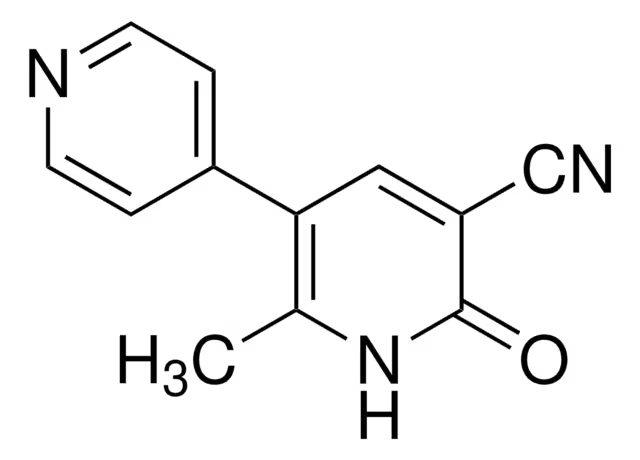
CAS Number78415-72-2
Synonyms6-Hydroxy-2-methyl-3,4'-bipyridine-5-carbonitrile; EINECS 278-903-6; MFCD00133539; 1,6-dihydro-2-methyl-6-oxo-(3,4′-bipyridine)-5-carbonitrile; Milrinonum; 1,6-Dihydro-2-methyl-6-oxo-(3,4'-bipyridine)-5-carbonitrile; Milrila; Milrinone; 1,2-Dihydro-6-methyl-2-oxo-5-(4-pyridinyl)nicotinonitrile; 6-methyl-2-oxo-5-pyridin-4-yl-1H-pyridine-3-carbonitrile; Corotrope; Milrinona; Primacor; Corotrop; 2-Methyl-6-oxo-1,6-dihydro-3,4'-bipyridine-5-carbonitrile
Molecular FormulaC12H9N3O
Molecular Weight211.22
Purity98%
Density1.3±0.1 g/cm3
Boiling Point448.7±45.0 °C at 760 mmHg
Melting Point>3000C
Appearanceoff-white solid
Symbol
Signal WordWarning
| Chemical & Physical Properties | |
|---|---|
| CAS Number | 78415-72-2 |
| Catalog No. | 2A-0200652 |
| Chinese Name | 米力农 |
| Synonyms | 6-Hydroxy-2-methyl-3,4'-bipyridine-5-carbonitrile; EINECS 278-903-6; MFCD00133539; 1,6-dihydro-2-methyl-6-oxo-(3,4′-bipyridine)-5-carbonitrile; Milrinonum; 1,6-Dihydro-2-methyl-6-oxo-(3,4'-bipyridine)-5-carbonitrile; Milrila; Milrinone; 1,2-Dihydro-6-methyl-2-oxo-5-(4-pyridinyl)nicotinonitrile; 6-methyl-2-oxo-5-pyridin-4-yl-1H-pyridine-3-carbonitrile; Corotrope; Milrinona; Primacor; Corotrop; 2-Methyl-6-oxo-1,6-dihydro-3,4'-bipyridine-5-carbonitrile |
| Molecular Formula | C12H9N3O |
| Molecular Weight | 211.22 |
| Purity | 98 |
| Density | 1.3±0.1 g/cm3 |
| Boiling Point | 448.7±45.0 °C at 760 mmHg |
| Melting Point | >3000C |
| Appearance | off-white solid |
| Water Solubility | DMSO: >10 mg/mL |
| Storage Condition | Store in an airtight container at 2-8 ºC. |
| Packaging | III |
| Application | Milrinone is a PDE3 inhibitor, a cardiac drug, and a vasodilator. |
| HTC | 2933399090 |
| PubChem ID | 329750470 |
| MDL Number | MFCD00133539 |
| SMILES | CC1=C(C=C(C#N)C(=O)N1)c2ccncc2 |
| InChI | 1S/C12H9N3O/c1-8-11(9-2-4-14-5-3-9)6-10(7-13)12(16)15-8/h2-6H,1H3,(H,15,16) |
| InChI Key | PZRHRDRVRGEVNW-UHFFFAOYSA-N |
| NACRES Code | NA.24 |
| UNSPSC | 41116107 |
| Hazard Symbols | 6.1(b) |
| MSDS | msds/11451_1_78415_72_2.pdf |
| Bioactivity | Milrinone is a PDE3 inhibitor, and also an inotrope and vasodilator. Related Catalog Signaling Pathways >> Metabolic Enzyme/Protease >> Phosphodiesterase (PDE) Research Areas >> Cardiovascular Disease In Vitro Milrinone (1 µM) increases PKA activity in hypoxic myocytes to normoxic levels. Milrinone (50 nM) normalizes TP receptor sensitivity in hypoxic myocytes by restoring PKA-mediated regulatory TP receptor phosphorylation[1]. Milrinone significantly reduces NE-induced vasoconstriction, attenuating both NE sensitivity and maximal tension generation. Inhibition of ATP-sensitive K+ channels or voltage-gated K+ channels do not prevent the milrinone-induced attenuation of NE responses[4]. In Vivo Milrinone (1 μg/kg/min, i.v.) significantly reduces PAP, PVR (−18.96 ± 1.7%), and LAP (−26.03 ± 2.3%) in congestive heart failure (CHF) rats. Milrinone (1 mg/mL, inhalation) results in a near-maximal reduction of PAP without significant effects on AP, decreases pulmonary artery pressure similarly in a larger collective of CHF rats. Milrinone inhalation selectively increases cAMP but not cGMP plasma concentrations in both groups. Repeated milrinone inhalations even reduce lung wet/dry weight ratio[2]. Milrinone (49.5 μg) largely shifts the ESPVR upwards and significantly increases end-systolic pressure (ESP(0.08)) and the systolic pressure-volume area (PVA(0.08)) at a mid-range LV volume (0.08 mL/g myocardium). Milrinone also slightly decreases LV ESP(ESV) and decreased Ea[3]. Animal Admin In juvenile rats of 100 ± 8 g body weight (bw), CHF is induced by supracoronary aortic banding. In brief, rats are anesthetized by intraperitoneal injection of ketamine (87 mg/kg bw) and xylazine (13 mg/kg bw). Rats are placed in the supine position, the chest wall is shaved, and a left thoracotomy is performed in the third intercostal space during ventilation with 100% O2. The ascending aorta is freed from connective tissue and partially occluded by implantation of a titanium clip with a defined internal diameter of 0.8 mm. After surgical closure of the thorax, the rats are allowed to recover from anesthesia. For postoperative analgesia, rats receive 250 mg/kg bw of metamizole intramuscularly immediately after the operation and on the first postoperative day. Sham-operated rats serve as controls. After recovery from anesthesia, the animals are placed in cages with free access to water and standard laboratory diet. For inhalation, milrinone (0.2-5 mg/mL) or NaCl (0.9%) are nebulized using an ultrasonic nebulizer and inhaled for 3 min at identical peak inspiratory pressures as used throughout the experiment. A 3-min nebulization of 1 mg/mL milrinone results in vaporization of 14 μg of the phosphodiesterase-3 inhibitor as determined by microgravimetry. Therefore, the respective dose of 39 μg/kg is analog to inhaled doses in human studies. For intravenous delivery, milrinone (initial bolus of 2-10 μg/kg, followed by 0.2-1 μg/kg/min) or equivalent volumes of NaCl (0.9%; initial bolus of 1.6 mL/kg, followed by 10 μL/kg/h) are administered by an infusion pump for 10 min. References [1]. Santhosh KT, et al. Milrinone attenuates thromboxane receptor-mediated hyperresponsiveness in hypoxic pulmonary arterial myocytes. Br J Pharmacol. 2011 Jul;163(6):1223-36. [2]. Hentschel T, et al. Inhalation of the phosphodiesterase-3 inhibitor milrinone attenuates pulmonary hypertension in a rat model of congestive heart failure. Anesthesiology. 2007 Jan;106(1):124-31. [3]. Kishi T, et al. Effects of milrinone on left ventricular end-systolic pressure-volume relationship of rat hearts in situ. Clin Exp Pharmacol Physiol. 2001 Sep;28(9):737-42. [4]. Taylor MS, et al. Effect of milrinone on small mesenteric artery vasoconstriction: role of K(+) channels. Am J Physiol. 1999 Jul;277(1 Pt 1):G69-78. Chemical & Physical Properties Density 1.3±0.1 g/cm3 Boiling Point 448.7±45.0 °C at 760 mmHg Melting Point >3000C Molecular Formula C12H9N3O Molecular Weight 211.219 Flash Point 225.2±28.7 °C Exact Mass 211.074554 PSA 69.54000 LogP 0.41 Vapour Pressure 0.0±1.1 mmHg at 25°C Index of Refraction 1.622 InChIKey PZRHRDRVRGEVNW-UHFFFAOYSA-N SMILES Cc1[nH]c(=O)c(C#N)cc1-c1ccncc1 Storage condition 2-8°C Stability Stable. Incompatible with strong oxidizing agents. Water Solubility DMSO: >10 mg/mL |
| Use of | Milrinone is a PDE3 inhibitor, and also an inotrope and vasodilator. Properties Articles70 Name milrinone Synonym More Synonyms Milrinone Biological Activity Description Milrinone is a PDE3 inhibitor, and also an inotrope and vasodilator. Related Catalog Signaling Pathways >> Metabolic Enzyme/Protease >> Phosphodiesterase (PDE) Research Areas >> Cardiovascular Disease In Vitro Milrinone (1 µM) increases PKA activity in hypoxic myocytes to normoxic levels. Milrinone (50 nM) normalizes TP receptor sensitivity in hypoxic myocytes by restoring PKA-mediated regulatory TP receptor phosphorylation[1]. Milrinone significantly reduces NE-induced vasoconstriction, attenuating both NE sensitivity and maximal tension generation. Inhibition of ATP-sensitive K+ channels or voltage-gated K+ channels do not prevent the milrinone-induced attenuation of NE responses[4]. References [1]. Santhosh KT, et al. Milrinone attenuates thromboxane receptor-mediated hyperresponsiveness in hypoxic pulmonary arterial myocytes. Br J Pharmacol. 2011 Jul;163(6):1223-36. [2]. Hentschel T, et al. Inhalation of the phosphodiesterase-3 inhibitor milrinone attenuates pulmonary hypertension in a rat model of congestive heart failure. Anesthesiology. 2007 Jan;106(1):124-31. [3]. Kishi T, et al. Effects of milrinone on left ventricular end-systolic pressure-volume relationship of rat hearts in situ. Clin Exp Pharmacol Physiol. 2001 Sep;28(9):737-42. [4]. Taylor MS, et al. Effect of milrinone on small mesenteric artery vasoconstriction: role of K(+) channels. Am J Physiol. 1999 Jul;277(1 Pt 1):G69-78. Chemical & Physical Properties Molecular Formula C12H9N3O Exact Mass 211.074554 PSA 69.54000 Index of Refraction 1.622 InChIKey PZRHRDRVRGEVNW-UHFFFAOYSA-N Stability Stable. Incompatible with strong oxidizing agents. |
| Tax Rebate | 13.0% |
| Supervision | None. MFN tariff: 6.5%. Ordinary tariff: 20.0% |
| Transport Info | Shipping Name: UN |
| MSDS Transport Info | Module 14. Shipping information 14.1 UN dangerous goods number European Dangerous Regulations for land transport: 2811 International Dangerous Regulations for sea transport: 2811 International Dangerous Regulations for air transport: 2811 14.2 United Nations shipping name European Land Transport Dangerous Regulations: TOXIC SOLID, ORGANIC, N.O.S. (Milrinone) IMDG Code: TOXIC SOLID, ORGANIC, N.O.S. (Milrinone) International air transport hazard regulations: Toxic solid, organic, n.o.s. (Milrinone) 14.3 Transport hazard categories European Land Transport Danger Regulations: 6.1 International Maritime Transport Danger Regulations: 6.1 International Air Transport Danger Regulations: 6.1 14.4 Package group European Land Transport Danger Regulations: III International Maritime Transport Danger Regulations: III International Air Transport Danger Regulations: III 14.5 Environmental hazards European Land Transport Danger Regulations: No International Maritime Danger Regulations International Air Transport Danger Regulations: No Marine pollutants (yes/no): No 14.6 Special reminder to users No data available |
| Related Products in Specialty Chemicals | ||
|---|---|---|
| milacainide | 141725-10-2 | 2A-9011446 |
| Mildonate | 76144-81-5 | 2A-9011447 |
| Milfasartan | 148564-47-0 | 2A-9011448 |
| Milnacipran | 92623-85-3 | 2A-9011449 |
| Milodistim | 137463-76-4 | 2A-9011450 |
| Milverine | 75437-14-8 | 2A-9011453 |
| Minalrestat | 129688-50-2 | 2A-9011454 |
| Minaprin dihydrochloride | 25905-77-5 | 2A-9011455 |
| Mindodilol | 70260-53-6 | 2A-9011456 |
| Minodronic acid | 127657-42-5 | 2A-9011458 |
| Browse all Specialty Chemicals products » | ||
Phone:
630-322-8886
630-322-8887
Email:
Office Locations:
Chicago, IL, USA
San Francisco, CA, USA


 EN
EN


 SDS
SDS