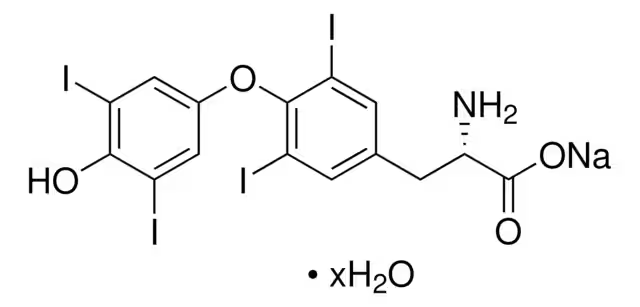
CAS Number6106-07-6
SynonymsMFCD00149110; EINECS 200-221-4; Sodium (2S)-2-amino-3-[4-(4-hydroxy-3,5-diiodophenoxy)-3,5-diiodophenyl]propanoate hydrate (1:1:5); L-Tyrosine, O-(4-hydroxy-3,5-diiodophenyl)-3,5-diiodo-, sodium salt, hydrate (1:1:5); sodium,(2S)-2-amino-3-[4-(4-hydroxy-3,5-diiodophenoxy)-3,5-diiodophenyl]propanoate,pentahydrate; L-Thyroxine (sodium salt pentahydrate)
Molecular FormulaC15H20I4NNaO9
Molecular Weight798.85 (anhydrous basis)
Purity98%
Density2.381
Melting Point207-210 (dec.)(lit.)
Appearancepowder
| Chemical & Physical Properties | |
|---|---|
| CAS Number | 6106-07-6 |
| Catalog No. | 2A-9011252 |
| Chinese Name | L-甲状腺素钠五水合物(左甲状腺素钠) |
| Synonyms | MFCD00149110; EINECS 200-221-4; Sodium (2S)-2-amino-3-[4-(4-hydroxy-3,5-diiodophenoxy)-3,5-diiodophenyl]propanoate hydrate (1:1:5); L-Tyrosine, O-(4-hydroxy-3,5-diiodophenyl)-3,5-diiodo-, sodium salt, hydrate (1:1:5); sodium,(2S)-2-amino-3-[4-(4-hydroxy-3,5-diiodophenoxy)-3,5-diiodophenyl]propanoate,pentahydrate; L-Thyroxine (sodium salt pentahydrate) |
| Molecular Formula | C15H20I4NNaO9 |
| Molecular Weight | 798.85 (anhydrous basis) |
| Purity | 98 |
| Density | 2.381 |
| Melting Point | 207-210 (dec.)(lit.) |
| Appearance | powder |
| Water Solubility | cell culture medium: 0.1 mg/mL |
| Storage Condition | 2-8°C |
| Application | L-Thyroxine sodium salt pentahydrate (Levothyroxine; T4) is a synthetic thyroid hormone used to treat hypothyroidism. The DIO enzyme converts L-Thyroxine (T4) into the biologically active triiodothyro |
| PubChem ID | 329750053 |
| MDL Number | MFCD06408007 |
| SMILES | O.[Na+].N[C@@H](Cc1cc(I)c(Oc2cc(I)c(O)c(I)c2)c(I)c1)C([O-])=O |
| InChI | 1S/C15H11I4NO4.Na.H2O/c16-8-4-7(5-9(17)13(8)21)24-14-10(18)1-6(2-11(14)19)3-12(20)15(22)23;;/h1-2,4-5,12,21H,3,20H2,(H,22,23);;1H2/q;+1;/p-1/t12-;;/m0../s1 |
| InChI Key | ANMYAHDLKVNJJO-LTCKWSDVSA-M |
| NACRES Code | NA.24 |
| UNSPSC | 41116107 |
| MSDS | msds/11252_1_6106_07_6.pdf |
| Bioactivity | L-Thyroxine sodium salt pentahydrate (Levothyroxine; T4) is a synthetic hormone in the treatment of hypothyroidism. DIO enzymes convert biologically active thyroid hormone (Triiodothyronine,T3) from L-Thyroxine (T4). Related Catalog Signaling Pathways >> Others >> Thyroid Hormone Receptor Research Areas >> Endocrinology Target Thyroid Hormone Receptor In Vivo Deiodinases (DIOs), which catalyse the conversion of thyroxine (pro-hormone) to the active thyroid hormone, are associated with thyroid stimulating hormone (TSH) levels. DIO1 and DIO2 catalyze activation of thyroid hormone secretion in contrast to DIO3 playing role inactivation of the secretion. Activities of DIO1 and DIO2 play pivotal role in the negative feedback regulation of pituitary TSH secretion[1]. L-Thyroxine (T4) and Triiodothyronine (T3) hormones are known to modulate the expression of ionic channels, pumps and regulatory contractile proteins. Moreover, thyroid hormones have been shown to influence calcium homeostasis and flux responsible for excitation and contractility, with L-Thyroxine and Triiodothyronine modulating its pharmacological control and secretion. In rats fed 12 weeks with the iodine-free diet, a significant decrease in the levels of both Triiodothyronine and L-Thyroxine is observed when compared to the control group fed with standard diet (p<0.001). In the group treated with low doses of L-Thyroxine, an increase in L-Thyroxine levels is observed (p=0.02) while Triiodothyronine levels remain virtually similar to the control group (p=0.19). Rats treated with high doses of L-Thyroxine display a significant increase in both Triiodothyronine and L-Thyroxine circulating concentrations compared to the non-treated hypothyroid group (p<0.001 and p=0.004, respectively) and a significant increase in L-Thyroxine levels when compared to the control values (p=0.03)[2]. Animal Admin Rats[2] Sprague-Dawley female rats (N=22) are used. Non-pregnant rats are divided into four groups: 1) control, 2) hypothyroidism, 3) hypothyroidism treated with low doses of L-Thyroxine (20 μg/kg/day) and 4) with high doses of L-Thyroxine (100 μg/kg/day). Control rats (group 1) are fed with standard diet, while the intervention rats are fed with iodine-free diet for 12 weeks to induce hypothyroidism (groups 2-4) which is continued for four more weeks to allow screening of hypothyroid status and L-Thyroxine-treatment. Food and water (iodine-free diet) are available ad libitum. The hypothyroid group treated with low (group 3) or high doses of L-Thyroxine (group 4) are injected intraperitoneally every 24 h with respectively 20 μg/kg/day and 100 μg/kg/day. Blood samples are collected for thyroid function screening at week 12 and 16 following the initiation of either the control or iodine-free diet. Hysterectomy is performed under general anesthesia (isoflurane 2%) at the end of the treatment and the two uterine horns are placed in physiological Krebs' solution until isometric tension measurements within no more than 1 h. References [1]. Arici M, et al. Association between genetic polymorphism and levothyroxine bioavailability in hypothyroid patients. Endocr J. 2018 Jan 11. [2]. Corriveau S, et al. Levothyroxine treatment generates an abnormal uterine contractility patterns in an in vitro animalmodel. J Clin Transl Endocrinol. 2015 Sep 9;2(4):144-149. Chemical & Physical Properties Density 2.381 Melting Point 207-210 (dec.)(lit.) Molecular Formula C15H20I4NNaO9 Molecular Weight 888.928 Exact Mass 888.721436 PSA 141.76000 LogP 3.60140 Appearance of Characters powder InChIKey JMHCCAYJTTWMCX-QWPJCUCISA-M SMILES NC(Cc1cc(I)c(Oc2cc(I)c(O)c(I)c2)c(I)c1)C(=O)[O-].O.O.O.O.O.[Na+] Storage condition 2-8°C Water Solubility cell culture medium: 0.1 mg/mL |
| Use of | L-Thyroxine sodium salt pentahydrate (Levothyroxine; T4) is a synthetic hormone in the treatment of hypothyroidism. DIO enzymes convert biologically active thyroid hormone (Triiodothyronine,T3) from L-Thyroxine (T4). Properties Articles979 Name L-Thyroxine sodium salt pentahydrate Synonym More Synonyms Sodium levothyroxine pentahydrate Biological Activity Description L-Thyroxine sodium salt pentahydrate (Levothyroxine; T4) is a synthetic hormone in the treatment of hypothyroidism. DIO enzymes convert biologically active thyroid hormone (Triiodothyronine,T3) from L-Thyroxine (T4). Related Catalog Signaling Pathways >> Others >> Thyroid Hormone Receptor Research Areas >> Endocrinology Thyroid Hormone Receptor Animal Admin Rats[2] Sprague-Dawley female rats (N=22) are used. Non-pregnant rats are divided into four groups: 1) control, 2) hypothyroidism, 3) hypothyroidism treated with low doses of L-Thyroxine (20 μg/kg/day) and 4) with high doses of L-Thyroxine (100 μg/kg/day). Control rats (group 1) are fed with standard diet, while the intervention rats are fed with iodine-free diet for 12 weeks to induce hypothyroidism (groups 2-4) which is continued for four more weeks to allow screening of hypothyroid status and L-Thyroxine-treatment. Food and water (iodine-free diet) are available ad libitum. The hypothyroid group treated with low (group 3) or high doses of L-Thyroxine (group 4) are injected intraperitoneally every 24 h with respectively 20 μg/kg/day and 100 μg/kg/day. Blood samples are collected for thyroid function screening at week 12 and 16 following the initiation of either the control or iodine-free diet. Hysterectomy is performed under general anesthesia (isoflurane 2%) at the end of the treatment and the two uterine horns are placed in physiological Krebs' solution until isometric tension measurements within no more than 1 h. References [1]. Arici M, et al. Association between genetic polymorphism and levothyroxine bioavailability in hypothyroid patients. Endocr J. 2018 Jan 11. [2]. Corriveau S, et al. Levothyroxine treatment generates an abnormal uterine contractility patterns in an in vitro animalmodel. J Clin Transl Endocrinol. 2015 Sep 9;2(4):144-149. Chemical & Physical Properties Molecular Formula C15H20I4NNaO9 Exact Mass 888.721436 PSA 141.76000 LogP 3.60140 Appearance of Characters powder InChIKey JMHCCAYJTTWMCX-QWPJCUCISA-M |
| Transport Info | Product name: L-thyroxine sodium pentahydrate (levothyroxine sodium) |
| Related Products in Specialty Chemicals | ||
|---|---|---|
| Loxiglumide | 107097-80-3 | 2A-9011246 |
| Loxoprofen sodium | 80382-23-6 | 2A-9011247 |
| Lozomic acid | 31598-07-9 | 2A-9011248 |
| L-phenylephrine hydrochloride | 61-76-7 | 2A-9011249 |
| L-Tetrandrine | 1263-79-2 | 2A-9011250 |
| Lufenuron | 103055-07-8 | 2A-9011253 |
| Lumichrome | 1086-80-2 | 2A-9011255 |
| Lumiracoxib | 220991-20-8 | 2A-9011256 |
| Lupane | 464-99-3 | 2A-9011257 |
| Lupeol | 545-47-1 | 2A-9011258 |
| Browse all Specialty Chemicals products » | ||
Phone:
630-322-8886
630-322-8887
Email:
Office Locations:
Chicago, IL, USA
San Francisco, CA, USA


 EN
EN


 SDS
SDS