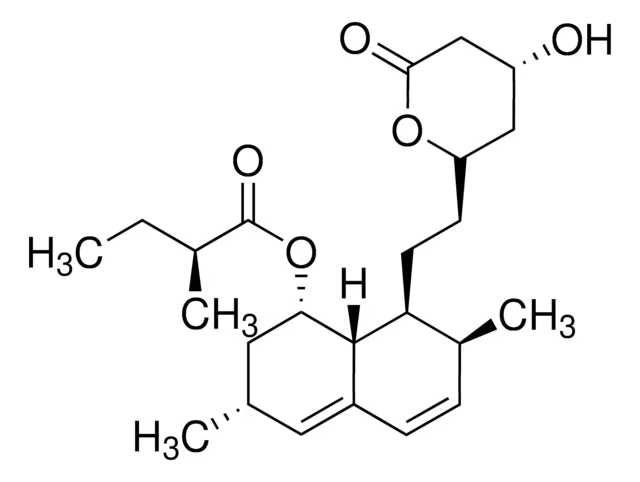
CAS Number75330-75-5
SynonymsMEVINOLIN; LOVALIP; Lovastatin; 2b,6a-Dimethyl-8a-(2-methyl-1-oxobutoxy)mevinic Acid Lactone; (+)-Mevinolin; LOVASTIN; Altocor; MEVACOR; Antibiotic MB 530B; Rovacor; 6a-Methylcompactin; Sivlor; MFCD00072164; mevlor; msd803; Paschol
Molecular FormulaC24H36O5
Molecular Weight404.54
Purity98%
Density1.1±0.1 g/cm3
Boiling Point559.2±50.0 °C at 760 mmHg
Melting Point175°C
Appearancewhite solid
Symbol
Signal WordWarning
| Chemical & Physical Properties | |
|---|---|
| CAS Number | 75330-75-5 |
| Catalog No. | 2A-9011245 |
| Chinese Name | 洛伐他汀 |
| Synonyms | MEVINOLIN; LOVALIP; Lovastatin; 2b,6a-Dimethyl-8a-(2-methyl-1-oxobutoxy)mevinic Acid Lactone; (+)-Mevinolin; LOVASTIN; Altocor; MEVACOR; Antibiotic MB 530B; Rovacor; 6a-Methylcompactin; Sivlor; MFCD00072164; mevlor; msd803; Paschol |
| Molecular Formula | C24H36O5 |
| Molecular Weight | 404.54 |
| Purity | 98 |
| Density | 1.1±0.1 g/cm3 |
| Boiling Point | 559.2±50.0 °C at 760 mmHg |
| Melting Point | 175°C |
| Appearance | white solid |
| Water Solubility | 0.0004 mg/mL at 25 ºC |
| Storage Condition | Store in an airtight container in a cool, dry plac |
| Packaging | III |
| Application | Lovastatin is an HMG-CoA reductase inhibitor used to reduce the cell permeability of cholesterol. |
| HTC | 2932999099 |
| SMILES | O1[C@@H](C[C@H](CC1=O)O)CC[C@@H]2[C@H]3[C@H](C[C@H](C=C3C=C[C@@H]2C)C)OC(=O)[C@H](CC)C |
| InChI | 1S/C24H36O5/c1-5-15(3)24(27)29-21-11-14(2)10-17-7-6-16(4)20(23(17)21)9-8-19-12-18(25)13-22(26)28-19/h6-7,10,14-16,18-21,23,25H,5,8-9,11-13H2,1-4H3/t14-,15-,16-,18+,19+,20-,21-,23-/m0/s1 |
| InChI Key | PCZOHLXUXFIOCF-BXMDZJJMSA-N |
| NACRES Code | NA.24 |
| UNSPSC | 41116107 |
| Hazard Symbols | 9 |
| MSDS | msds/11245_1_75330_75_5.pdf |
| Bioactivity | Lovastatin is a cell-permeable HMG-CoA reductase inhibitor used to lower cholesterol. Related Catalog Signaling Pathways >> Metabolic Enzyme/Protease >> HMG-CoA Reductase (HMGCR) Research Areas >> Cardiovascular Disease Target HMG-CoA reductase[1] In Vitro Lovastatin is an inactive lactone prodrug that must be chemically or enzymatically converted to its dihydroxy open-acid form in order to elicit inhibitory activity. Lovastatin in its hydroxy acid form is an exceptionally potent competitive inhibitor of liver HMG CoA reductase[1]. Lovastatin, other than its anticholesterol property, has diverse applications in the field of osteoporosis, neuro-degeneration, rheumatoid arthritis, antifungals and also is reported to reduce proliferation of lung cancer cells, breast cancer (MCF-7), liver cancer (HepG2). Lovastatin treatments show significant dose dependent cytotoxic effect on HeLa cells with IC50 value of 160 μg/mL. Lovastatin is effective to accelerate hydroxyl radical scavenging activity (54.06%) at an IC50 of 3601 μg/mL[2]. In Vivo Lovastatin is an inactive lactone that is hydrolyzed in the liver to an active f3-hydroxyacid form. This principal metabolite is the inhibitor of the enzyme HMG-CoA reductase. The Ki is 1 nM. Lovastatin and its β-hydroxyacid metabolite are highly bound to human plasma proteins. Lovastatin crosses the blood-brain and placental barriers[3]. Lovastatin produces a profound reduction of apolipoprotein-B-containing lipoproteins, especially LDL cholesterol and, to a lesser extent, plasma triglycerides, and a small increase in HDL cholesterol[4]. Cell Assay Hela cells are treated with lovastatin (0, 5, 10, 20, 40, 80, 160, 320 μg/mL) for 24 h. Cells treated with culture medium serves as a negative control. cell viability is measured using the MTT based colorimetric assay [2]. References [1]. Alberts AW, et al. Discovery, biochemistry and biology of lovastatin. Am J Cardiol. 1988 Nov 11;62(15):10J-15J. [2]. Bhargavi S, et al. Purification of Lovastatin from Aspergillus terreus (KM017963) and Evaluation of its Anticancer and Antioxidant Properties. Asian Pac J Cancer Prev. 2016;17(8):3797-803. [3]. Frishman WH, et al. Lovastatin: an HMG-CoA reductase inhibitor for lowering cholesterol. Med Clin North Am. 1989 Mar;73(2):437-48. [4]. Tobert JA, et al. Lovastatin and beyond: the history of the HMG-CoA reductase inhibitors. Nat Rev Drug Discov. 2003 Jul;2(7):517-26. Chemical & Physical Properties Density 1.1±0.1 g/cm3 Boiling Point 559.2±50.0 °C at 760 mmHg Melting Point 175°C Molecular Formula C24H36O5 Molecular Weight 404.540 Flash Point 185.3±23.6 °C Exact Mass 404.256287 PSA 72.83000 LogP 4.07 Vapour Pressure 0.0±3.4 mmHg at 25°C Index of Refraction 1.532 InChIKey PCZOHLXUXFIOCF-BXMDZJJMSA-N SMILES CCC(C)C(=O)OC1CC(C)C=C2C=CC(C)C(CCC3CC(O)CC(=O)O3)C21 Storage condition 2-8°C Water Solubility 0.0004 mg/mL at 25 ºC |
| Use of | Lovastatin is a cell-permeable HMG-CoA reductase inhibitor used to lower cholesterol. Properties Articles145 Name lovastatin Synonym More Synonyms Lovastatin Biological Activity Description Lovastatin is a cell-permeable HMG-CoA reductase inhibitor used to lower cholesterol. Related Catalog Signaling Pathways >> Metabolic Enzyme/Protease >> HMG-CoA Reductase (HMGCR) Research Areas >> Cardiovascular Disease HMG-CoA reductase[1] In Vitro Lovastatin is an inactive lactone prodrug that must be chemically or enzymatically converted to its dihydroxy open-acid form in order to elicit inhibitory activity. Lovastatin in its hydroxy acid form is an exceptionally potent competitive inhibitor of liver HMG CoA reductase[1]. Lovastatin, other than its anticholesterol property, has diverse applications in the field of osteoporosis, neuro-degeneration, rheumatoid arthritis, antifungals and also is reported to reduce proliferation of lung cancer cells, breast cancer (MCF-7), liver cancer (HepG2). Lovastatin treatments show significant dose dependent cytotoxic effect on HeLa cells with IC50 value of 160 μg/mL. Lovastatin is effective to accelerate hydroxyl radical scavenging activity (54.06%) at an IC50 of 3601 μg/mL[2]. In Vivo Lovastatin is an inactive lactone that is hydrolyzed in the liver to an active f3-hydroxyacid form. This principal metabolite is the inhibitor of the enzyme HMG-CoA reductase. The Ki is 1 nM. Lovastatin and its β-hydroxyacid metabolite are highly bound to human plasma proteins. Lovastatin crosses the blood-brain and placental barriers[3]. Lovastatin produces a profound reduction of apolipoprotein-B-containing lipoproteins, especially LDL cholesterol and, to a lesser extent, plasma triglycerides, and a small increase in HDL cholesterol[4]. Cell Assay Hela cells are treated with lovastatin (0, 5, 10, 20, 40, 80, 160, 320 μg/mL) for 24 h. Cells treated with culture medium serves as a negative control. cell viability is measured using the MTT based colorimetric assay [2]. References [1]. Alberts AW, et al. Discovery, biochemistry and biology of lovastatin. Am J Cardiol. 1988 Nov 11;62(15):10J-15J. [2]. Bhargavi S, et al. Purification of Lovastatin from Aspergillus terreus (KM017963) and Evaluation of its Anticancer and Antioxidant Properties. Asian Pac J Cancer Prev. 2016;17(8):3797-803. [3]. Frishman WH, et al. Lovastatin: an HMG-CoA reductase inhibitor for lowering cholesterol. Med Clin North Am. 1989 Mar;73(2):437-48. [4]. Tobert JA, et al. Lovastatin and beyond: the history of the HMG-CoA reductase inhibitors. Nat Rev Drug Discov. 2003 Jul;2(7):517-26. Chemical & Physical Properties Molecular Formula C24H36O5 Exact Mass 404.256287 PSA 72.83000 Index of Refraction 1.532 InChIKey PCZOHLXUXFIOCF-BXMDZJJMSA-N |
| Tax Rebate | 13.0% |
| Supervision | None. MFN tariff: 6.5%. Ordinary tariff: 20.0% |
| Transport Info | Product name: Purity: 98.0% |
| MSDS Transport Info | Module 14. Shipping information United Nations classification: inconsistent with United Nations classification standards UN number: not specified |
| Related Products in Specialty Chemicals | ||
|---|---|---|
| losulamide meglumine | 2A-302323 | 2A-9011240 |
| Losulazine | 72141-57-2 | 2A-9011241 |
| Loteprednol | 82034-46-6 | 2A-9011242 |
| Lotranic acid | 26887-04-7 | 2A-9011243 |
| Loureirin B | 119425-90-0 | 2A-9011244 |
| Loxiglumide | 107097-80-3 | 2A-9011246 |
| Loxoprofen sodium | 80382-23-6 | 2A-9011247 |
| Lozomic acid | 31598-07-9 | 2A-9011248 |
| L-phenylephrine hydrochloride | 61-76-7 | 2A-9011249 |
| L-Tetrandrine | 1263-79-2 | 2A-9011250 |
| Browse all Specialty Chemicals products » | ||
Phone:
630-322-8886
630-322-8887
Email:
Office Locations:
Chicago, IL, USA
San Francisco, CA, USA


 EN
EN


 SDS
SDS