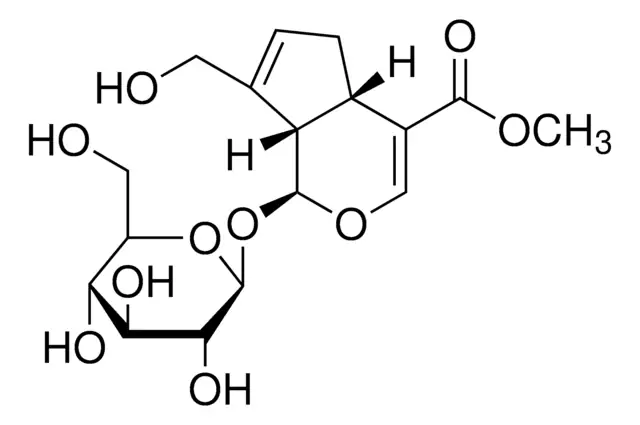
CAS Number24512-63-8
SynonymsOlea europaea L; Geniposide; Geniposidic; Jasminoidin; Genipin 1-glucoside; MFCD00016659
Molecular FormulaC17H24O10
Molecular Weight388.37
Purity≥98 (HPLC)%
Density1.5±0.1 g/cm3
Boiling Point641.4±55.0 °C at 760 mmHg
Melting Point161-162ºC
Appearancepowder
Symbol
Signal WordWarning
| Chemical & Physical Properties | |
|---|---|
| CAS Number | 24512-63-8 |
| Catalog No. | 2A-9010711 |
| Chinese Name | 京尼平甙; 栀子甙 |
| Synonyms | Olea europaea L; Geniposide; Geniposidic; Jasminoidin; Genipin 1-glucoside; MFCD00016659 |
| Molecular Formula | C17H24O10 |
| Molecular Weight | 388.37 |
| Purity | ≥98 (HPLC) |
| Density | 1.5±0.1 g/cm3 |
| Boiling Point | 641.4±55.0 °C at 760 mmHg |
| Melting Point | 161-162ºC |
| Appearance | powder |
| Water Solubility | Soluble in: ethanol |
| Storage Condition | ?20°C |
| Application | Geniposide is an iridoid glycoside extracted from gardenia flowers; has multiple biological activities, such as anti-diabetic, antioxidant, anti-proliferative and neuroprotective activities. |
| PubChem ID | 329825201 |
| MDL Number | MFCD16036219 |
| SMILES | COC(=O)C1=CO[C@@H](O[C@@H]2O[C@H](CO)[C@@H](O)[C@H](O)[C@H]2O)[C@H]3[C@@H]1CC=C3CO |
| InChI | 1S/C17H24O10/c1-24-15(23)9-6-25-16(11-7(4-18)2-3-8(9)11)27-17-14(22)13(21)12(20)10(5-19)26-17/h2,6,8,10-14,16-22H,3-5H2,1H3/t8-,10-,11-,12-,13+,14-,16+,17+/m1/s1 |
| InChI Key | IBFYXTRXDNAPMM-BVTMAQQCSA-N |
| NACRES Code | NA.77 |
| UNSPSC | 12352200 |
| Hazard Symbols | Transport |
| MSDS | msds/10711_1_24512_63_8.pdf |
| Bioactivity | Geniposide is an iridoid glucoside extracted from Gardenia jasminoides Ellis fruits; exhibits a varity of biological activities such as anti-diabetic, antioxidative, antiproliferative and neuroprotective activities. Related Catalog Signaling Pathways >> Neuronal Signaling >> Amyloid-β Research Areas >> Neurological Disease Natural Products >> Terpenoids and Glycosides In Vitro Geniposide exhibits a variety of activities, such as on antithrombosis, anti-inflammation, anti-diabetes, anti-atherosclerosis, antidepression, healing Alzheimer's disease (AD), anti-hypertension, toxicology, and untoward reaction are summarized[1]. Geniposide markedly declines the production of IL-8, IL-1β and MCP-1 in OGD-induced brain microvascular endothelial cells, the expression of P2Y14 receptor is significantly down-regulated, the phosphorylation of RAF-1, MEK1/2, ERK1/2 are suppressed[2]. In Vivo Geniposide (200 and 400 mg/kg) significantly decreases the blood glucose, insulin and TG levels in diabetic mice in a dose-dependent manner. This compound also decreases the expression of GP and G6Pase at mRNA and immunoreactive protein levels, as well as enzyme activity[3]. Geniposide (20.0, 40.0, or 80 mg/kg) significantly reverses the excessive, alcohol-induced elevation in both serum ALT/AST and hepatic LPO levels. Geniposide upregulates the expression of heme oxygenase-1 (HO-1) to attenuate the cell apoptosis induced by 3-morpholinosydnonimine hydrochloride (SIN-1) in primary cultured hippocampal neurons[4]. Geniposide inhibits photochemistry-induced thromboembolism model in vivo. Geniposide are very effective depressants on NF-κB by interrupting IκB degradation[1]. Cell Assay The third passages of brain microvascular endothelial cells (BMECs) are used for the experiment. The BMECs are divided into four groups: (1)normal control group: the normal cultured BMECs without treatment; (2)OGD group: the BMECs injured by OGD according to the above method; (3) geniposide group: the OGD-injured BMECs treated with 33.2 μg/mL geniposide for 6 h; (4)PTX group: the OGD-injured BMECs administrated with 100 ng/mL PTX. PTX, known as an inhibitor of Gi-coupled receptor is used to assess the activation of P2Y14 receptor induced by OGD in this experiment[2]. Animal Admin Mice: Type 2 diabetic mice, induced by a high-fat diet and streptozotocin injection, are treated with or without geniposide for 2 weeks. Blood glucose levels are monitored by a glucometer. Insulin concentrations are analyzed by the ELISA method. Total cholesterol (TC) and triglyceride (TG) levels are measured using Labassay kits. Activities of hepatic GP and G6Pase are measured by glucose-6-phosphate dehydrogenase-coupled reaction. Real-time RT-PCR and Western blotting are used to determine the mRNA and protein levels of both enzymes[3]. References [1]. Liu H, et al. Fructus Gardenia (Gardenia jasminoides J. Ellis) phytochemistry, pharmacology ofcardiovascular, and safety with the perspective of new drugs development. J Asian Nat Prod Res. 2013;15(1):94-110. [2]. Li F, et al. Geniposide attenuates inflammatory response by suppressing P2Y14 receptor and downstream ERK1/2 signaling pathway in oxygen and glucose deprivation-induced brain microvascular endothelial cells. J Ethnopharmacol. 2016 Jun 5;185:77-86. [3]. Wu SY, et al. Effect of geniposide, a hypoglycemic glucoside, on hepatic regulating enzymes in diabetic mice induced by a high-fat diet and streptozotocin. Acta Pharmacol Sin. 2009 Feb;30(2):202-8. [4]. Wang J, et al. Geniposide protects against acute alcohol-induced liver injury in mice via up-regulating the expression of the main antioxidant enzymes. Can J Physiol Pharmacol. 2015 Apr;93(4):261-7. Chemical & Physical Properties Density 1.5±0.1 g/cm3 Boiling Point 641.4±55.0 °C at 760 mmHg Melting Point 161-162ºC Molecular Formula C17H24O10 Molecular Weight 388.366 Flash Point 231.5±25.0 °C Exact Mass 388.136932 PSA 155.14000 LogP -1.92 Vapour Pressure 0.0±4.3 mmHg at 25°C Index of Refraction 1.621 InChIKey IBFYXTRXDNAPMM-UHFFFAOYSA-N SMILES COC(=O)C1=COC(OC2OC(CO)C(O)C(O)C2O)C2C(CO)=CCC12 Storage condition ?20°C |
| Use of | Geniposide is an iridoid glucoside extracted from Gardenia jasminoides Ellis fruits; exhibits a varity of biological activities such as anti-diabetic, antioxidative, antiproliferative and neuroprotective activities. Properties Articles27 Name Geniposide Synonym More Synonyms Geniposide Biological Activity Description Geniposide is an iridoid glucoside extracted from Gardenia jasminoides Ellis fruits; exhibits a varity of biological activities such as anti-diabetic, antioxidative, antiproliferative and neuroprotective activities. Related Catalog Signaling Pathways >> Neuronal Signaling >> Amyloid-β Research Areas >> Neurological Disease Natural Products >> Terpenoids and Glycosides Cell Assay The third passages of brain microvascular endothelial cells (BMECs) are used for the experiment. The BMECs are divided into four groups: (1)normal control group: the normal cultured BMECs without treatment; (2)OGD group: the BMECs injured by OGD according to the above method; (3) geniposide group: the OGD-injured BMECs treated with 33.2 μg/mL geniposide for 6 h; (4)PTX group: the OGD-injured BMECs administrated with 100 ng/mL PTX. PTX, known as an inhibitor of Gi-coupled receptor is used to assess the activation of P2Y14 receptor induced by OGD in this experiment[2]. Animal Admin Mice: Type 2 diabetic mice, induced by a high-fat diet and streptozotocin injection, are treated with or without geniposide for 2 weeks. Blood glucose levels are monitored by a glucometer. Insulin concentrations are analyzed by the ELISA method. Total cholesterol (TC) and triglyceride (TG) levels are measured using Labassay kits. Activities of hepatic GP and G6Pase are measured by glucose-6-phosphate dehydrogenase-coupled reaction. Real-time RT-PCR and Western blotting are used to determine the mRNA and protein levels of both enzymes[3]. References [1]. Liu H, et al. Fructus Gardenia (Gardenia jasminoides J. Ellis) phytochemistry, pharmacology ofcardiovascular, and safety with the perspective of new drugs development. J Asian Nat Prod Res. 2013;15(1):94-110. [3]. Wu SY, et al. Effect of geniposide, a hypoglycemic glucoside, on hepatic regulating enzymes in diabetic mice induced by a high-fat diet and streptozotocin. Acta Pharmacol Sin. 2009 Feb;30(2):202-8. [4]. Wang J, et al. Geniposide protects against acute alcohol-induced liver injury in mice via up-regulating the expression of the main antioxidant enzymes. Can J Physiol Pharmacol. 2015 Apr;93(4):261-7. Chemical & Physical Properties Molecular Formula C17H24O10 Exact Mass 388.136932 PSA 155.14000 LogP -1.92 Index of Refraction 1.621 InChIKey IBFYXTRXDNAPMM-UHFFFAOYSA-N |
| Transport Info | Product name: Purity: 98.0% |
| MSDS Transport Info | Module 14. Shipping information 14.1 UN dangerous goods number European Land Transport Dangerous Regulations: -International Maritime Dangerous Regulations: -International Air Transport Dangerous Regulations: - 14.2 Names specified by the United Nations (UN) European Land Transport Dangerous Regulations: Non-dangerous goods IMDG Code: Non-dangerous goods International air transport dangerous goods regulations: non-dangerous goods 14.3 Transport hazard categories European Land Transport Dangerous Regulations: -International Maritime Dangerous Regulations: -International Air Transport Dangerous Regulations: - 14.4 Package group European Land Transport Dangerous Regulations: -International Maritime Dangerous Regulations: -International Air Transport Dangerous Regulations: - 14.5 Environmental hazards European Land Transport Dangerous Regulations: No International Maritime Transport Dangerous Regulations Maritime Pollutants: No International Air Transport Risk Regulations: No 14.6 Special reminder to users No data available |
| Related Products in Specialty Chemicals | ||
|---|---|---|
| Geldanamycin | 30562-34-6 | 2A-9010702 |
| Gemcadiol | 35449-36-6 | 2A-9010703 |
| Gemifioxacin mesylate | 210353-53-0 | 2A-9010707 |
| Geneticin | 49863-47-0 | 2A-9010709 |
| Genipin | 6902-77-8 | 2A-9010710 |
| Geniposidic acid | 27741-01-1 | 2A-9010712 |
| Gepefrine | 18840-47-6 | 2A-9010717 |
| Geraldol | 21511-25-1 | 2A-9010718 |
| Geroquinol | 10457-66-6 | 2A-9010719 |
| Gestonorone caproate | 1253-28-7 | 2A-9010721 |
| Browse all Specialty Chemicals products » | ||
Phone:
630-322-8886
630-322-8887
Email:
Office Locations:
Chicago, IL, USA
San Francisco, CA, USA


 EN
EN


 SDS
SDS