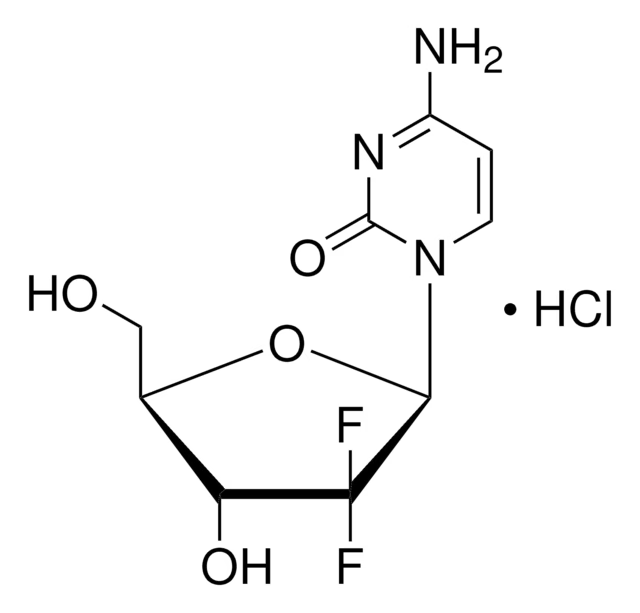
CAS Number122111-03-9
SynonymsdFdC,Gemzar,Lilly); MFCD01735988; dFdC Gemzar (Lilly) LY-188011 dFdC dFdCyd; Gemcitabine hydrochloride; 2'-Deoxy-2',2'-difluorocytidine; Cytidine, 2'-deoxy-2',2'-difluoro-, hydrochloride (1:1); 2'-Deoxy-2',2'-difluorocytidine hydrochloride (1:1); Gemcitabine HCl; Gemcitabine HCl(TABINES); Gemcitabine (Hydrochloride)
Molecular FormulaC9H12ClF2N3O4
Molecular Weight299.66
Purity95%
Boiling Point482.7ºC at 760 mmHg
Melting Point>250°C dec.
AppearanceSolid;White to Almost white powder to crystal
| Chemical & Physical Properties | |
|---|---|
| CAS Number | 122111-03-9 |
| Catalog No. | 2A-9010705 |
| Chinese Name | 盐酸吉西他滨 |
| Synonyms | dFdC,Gemzar,Lilly); MFCD01735988; dFdC Gemzar (Lilly) LY-188011 dFdC dFdCyd; Gemcitabine hydrochloride; 2'-Deoxy-2',2'-difluorocytidine; Cytidine, 2'-deoxy-2',2'-difluoro-, hydrochloride (1:1); 2'-Deoxy-2',2'-difluorocytidine hydrochloride (1:1); Gemcitabine HCl; Gemcitabine HCl(TABINES); Gemcitabine (Hydrochloride) |
| Molecular Formula | C9H12ClF2N3O4 |
| Molecular Weight | 299.66 |
| Purity | 95 |
| Boiling Point | 482.7ºC at 760 mmHg |
| Melting Point | >250°C dec. |
| Appearance | Solid;White to Almost white powder to crystal |
| Storage Condition | Desiccate at +4°C |
| Application | Gemcitabine hydrochloride is a DNA synthesis inhibitor with IC50 of 37.6, 42.9, 92.7, 89.3 and 131.4 nM in PANC-1, PL-45 and AsPC-1 cells at 131.4 nM -2, respectively. |
| HTC | 2934999090 |
| PubChem ID | 329749929 |
| MDL Number | MFCD01735988 |
| SMILES | Cl.NC1=NC(=O)N(C=C1)[C@@H]2O[C@H](CO)[C@@H](O)C2(F)F |
| InChI | 1S/C9H11F2N3O4.ClH/c10-9(11)6(16)4(3-15)18-7(9)14-2-1-5(12)13-8(14)17;/h1-2,4,6-7,15-16H,3H2,(H2,12,13,17);1H/t4-,6-,7-;/m1./s1 |
| InChI Key | OKKDEIYWILRZIA-OSZBKLCCSA-N |
| NACRES Code | NA.24 |
| UNSPSC | 41116107 |
| MSDS | msds/10705_1_122111_03_9.pdf |
| Bioactivity | Gemcitabine hydrochloride is a DNA synthesis inhibitor with IC50s of 37.6, 42.9, 92.7, 89.3 and 131.4 nM in BxPC-3, Mia Paca-2, PANC-1, PL-45 and AsPC-1 cells, respectively. Related Catalog Signaling Pathways >> Autophagy >> Autophagy Signaling Pathways >> Cell Cycle/DNA Damage >> DNA/RNA Synthesis Signaling Pathways >> Cell Cycle/DNA Damage >> Nucleoside Antimetabolite/Analog Research Areas >> Cancer Target DNA synthesis[1] In Vitro MTS assay demonstrates that Gemcitabine at 15 nM, indole-3-carbinol (I3C) at 50 μM and the combination does not affect hTERT-HPNE cell viability. However, treatment with Gemcitabine at 15 nM, I3C at 50 μM and the combination results in 31%, 19% and 72% cell death of BxPC-3 cells, respectively[1]. In Vivo The aim of study is to formulate PLGA nanoparticles (NPs) of Gemcitabine Hydrochloride (Gemcitabine HCl) for enhanced oral bioavailability via absorption through M cells of Peyer's patches. Gemcitabine HCl is available as i.v. infusion due to its short half life (8-17 min), rapid metabolism and limited tumor uptake. Gemcitabine loaded PLGA NPs shows 21.47-fold increase in relative bioavailability in comparison to plain drug solution after oral delivery[2]. After i.v. injection of Gemcitabine at doses of 50, 100, and 120, and 300 mg/kg, the highest dose caused considerable body weight loss (p<0.05 at all the time points evaluated, starting from day 3 of first injection) compared with that of the untreated group and complete mortality, whereas 120 mg/kg is determined as the lethal dose 10% (LD10) and 100 mg/kg is considered as the maximal tolerated dose, which does not cause any mortality and a minimal body weight loss[3]. Cell Assay Cells (the human pancreatic cell lines, Mia PaCa-2, BxPC-3, AsPC-1, PANC-1, PL-45, and normal pancreatic ductal epithelial cells, hTERT-HPNE cells) are seeded into 96-well plates (3000 cells/well) in triplicate. After overnight incubation, the medium is changed and cells are treated with I3C and/or NBMPR for 24 h. The medium is changed again and cells are cultured in medium containing different concentrations of Gemcitabine in the presence or absence of the same concentrations of I3C and/or NBMPR for 48 h. The cells are then subjected to CellTiter 96 AQueous One Solution Cell Proliferation Assay (MTS). Absorbance at 490 nm is measured 2 h after the addition of 20 μL of MTS reagent/well[1]. The in vitro cytotoxicity of Gemcitabine HCl loaded NPs on Caco-2 cells are performed for 6 h to check the toxicity of NPs during the transport/permeability studies and antiproliferative effect on K562 cells is evaluated for 48 h using the MTT assay. The cells are cultured in 96-well plates at a seeding density of 1.0×10⁴ cells/well for 48 h. Experiments are initiated by replacing the culture medium in each well with 150 μL of sample solutions (0.1, 1, 10, 100 μg/mL) at 37°C in the CO2 incubator. After 4, 24 and 48 h of incubation, the medium is removed and 150 μL of MTT reagent (1 mg/mL) in the serum-free medium is added to each well. The plates are then incubated at 37°C for another 4 h. At the end of the incubation period, the medium is removed and the intracellular formazan is solubilized with 150 μL DMSO and quantified by reading the absorbance at 590 nm on a micro-plate multi-detection instrument, SpectraMax M2 with Soft Max Pro. The medium treated cells serve as controls. Percentage cell viability is calculated based on the absorbance measured relative to the absorbance of cells exposed to the negative control[2]. Animal Admin Rats[2] Three groups of male Wistar rats (n=6) are subjected to single oral dose bioavailability study. The formulations are administered orally with the aid of a syringe and infant feeding tube. The 1st group is given distilled water, the 2nd group is given a solution of Gemcitabine HCl in distilled water, and the third group received Gemcitabine HCl loaded NPs at a dose of 10 mg/kg. Blood samples (0.3 mL) are drawn by retro-orbital venous plexus puncture with the aid of capillary tubes at 0.5, 1, 2, 4, 24, 48, 72 h post oral dose. The samples are collected in heparinised Eppendorf tubes containing 10 μM tetrahydrouridine, centrifuged at 3400 rpm for 15 min and plasma is collected. To this, 200 μL of Acetonitrile is added and vortexed for 5 min followed by centrifugation at 5000 rpm for 15 min. The organic phase is separated and evaporated under reduced pressure in a vacuum oven. The residue is dissolved in mobile phase (0.15 mL), vortexed for 1 min followed by centrifugation at 13,000 rpm for 5 min. Then 20 μL of supernatant is injected into the HPLC column and analyzed by HPLC. Mice[3] DBA/2 mice (5-6 weeks old), weighing approximately 15 to 18 g, are used for the study. The mice are provided with standard mouse food and water ad libitum. The L1210 wt leukemia cells are maintained in vitro, and they are injected intravenously (1×10⁵) into the mice, to develop a systemic metastatic leukemia model. The mice are divided into six groups of seven to eight mice each: untreated, treated with squalene nanoparticles, treated with 100 mg/kg Gemcitabine, treated with 20 mg/kg equivalent SQgem nanoassemblies in Gemcitabine, treated with 100 mg/kg cytarabine, and treated with 100 mg/kg cytarabine every day for 5 days. After injection of leukemia cells (day 0), all groups of mice received the treatment by i.v. injection on days 1, 5, 9, and 14 (i.e., days after injecting leukemia cells), with the exception of the untreated group and the group treated with cytarabine daily by the i.v. route. The mice are monitored regularly for weight differences and survival. References [1]. Wang H, et al. Enhanced efficacy of Gemcitabine by indole-3-carbinol in pancreatic cell lines: the role of human equilibrativenucleoside transporter 1. Anticancer Res. 2011 Oct;31(10):3171-80 [2]. Joshi G, et al. Enhanced bioavailability and intestinal uptake of Gemcitabine HCl loaded PLGA nanoparticles after oral delivery. Eur J Pharm Sci. 2014 Aug 18;60:80-9. [3]. Reddy LH, et al. Preclinical toxicology (subacute and acute) and efficacy of a new squalenoyl Gemcitabine anticancernanomedicine. J Pharmacol Exp Ther. 2008 May;325(2):484-90. Chemical & Physical Properties Boiling Point 482.7ºC at 760 mmHg Melting Point >250°C dec. Molecular Formula C9H12ClF2N3O4 Molecular Weight 299.659 Exact Mass 299.048431 PSA 110.60000 LogP 0.09460 Vapour Pressure 2.41E-11mmHg at 25°C InChIKey OKKDEIYWILRZIA-OSZBKLCCSA-N SMILES Cl.Nc1ccn(C2OC(CO)C(O)C2(F)F)c(=O)n1 Storage condition Desiccate at +4°C |
| Use of | Properties Articles27 Name gemcitabine hydrochloride Synonym More Synonyms Gemcitabine HCl Biological Activity Related Catalog Signaling Pathways >> Autophagy >> Autophagy Signaling Pathways >> Cell Cycle/DNA Damage >> DNA/RNA Synthesis Signaling Pathways >> Cell Cycle/DNA Damage >> Nucleoside Antimetabolite/Analog Research Areas >> Cancer DNA synthesis[1] References [1]. Wang H, et al. Enhanced efficacy of Gemcitabine by indole-3-carbinol in pancreatic cell lines: the role of human equilibrativenucleoside transporter 1. Anticancer Res. 2011 Oct;31(10):3171-80 [2]. Joshi G, et al. Enhanced bioavailability and intestinal uptake of Gemcitabine HCl loaded PLGA nanoparticles after oral delivery. Eur J Pharm Sci. 2014 Aug 18;60:80-9. [3]. Reddy LH, et al. Preclinical toxicology (subacute and acute) and efficacy of a new squalenoyl Gemcitabine anticancernanomedicine. J Pharmacol Exp Ther. 2008 May;325(2):484-90. Chemical & Physical Properties Exact Mass 299.048431 PSA 110.60000 LogP 0.09460 InChIKey OKKDEIYWILRZIA-OSZBKLCCSA-N |
| Tax Rebate | 13.0% |
| Supervision | None. MFN tariff: 6.5%. Ordinary tariff: 20.0% |
| Transport Info | Product name: Summary 2934999090. other heterocyclic compounds. VAT:17.0%. Tax rebate rate:13.0%. . MFN tariff:6.5%. General tariff:20.0% |
| Related Products in API & Advanced Intermediates | ||
|---|---|---|
| Ganciclovir | 82410-32-0 | 2A-9010685 |
| Ganciclovir sodium | 107910-75-8 | 2A-9010686 |
| Gatifloxacin lactate | 160738-57-8 | 2A-9010698 |
| Gefitinib | 184475-35-2 | 2A-9010701 |
| Gemcitabine | 95058-81-4 | 2A-9010704 |
| Gemifloxacin | 175463-14-6 | 2A-9010708 |
| Gentamicin B | 36889-15-3 | 2A-9010715 |
| Gestodene | 60282-87-3 | 2A-9010720 |
| Glibenclamide | 10238-21-8 | 2A-9010753 |
| Glimepiride | 93479-97-1 | 2A-0202308 |
| Browse all API & Advanced Intermediates products » | ||
Phone:
630-322-8886
630-322-8887
Email:
Office Locations:
Chicago, IL, USA
San Francisco, CA, USA


 EN
EN


 SDS
SDS