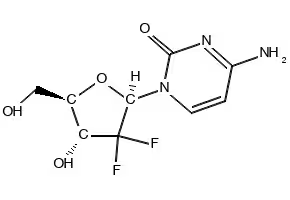
CAS Number95058-81-4
Synonyms4-AMINO-1-[(2R,4R,5R)-3,3-DIFLUORO-4-HYDROXY-5-(HYDROXYMETHYL)TETRAHYDROFURAN-2-YL]PYRIMIDIN-2-ONE; Gemcitabine; GEMCITABINE, FREE BASE; 2'-DESOXY-2',2'-DIFLUORCYTIDINE; CYTIDINE, 2'-DEOXY-2',2'-DIFLUORO; 3-DEOXY-2,2-DIFLUORO-D-RIBOFURANOSE-3,5-DIBENZOATE,0.97; 4-amino-1-[3,3-difluoro-4-hydroxy-5- (hydroxymethyl) tetrahydrofuran-2-yl]- 1H-pyrimidin- 2-one; GEMCITABINE (AS HCL); MFCD00869720; GEMCITABINE HCL; 3-DEOXY-2,2-DIFLUORO-D-RIBOFURANOSE-3,5-DIBENZOATE; 1-(2-deoxy-2,2-difluoro-β-D-erythropentofuranosyl)cytosine; GEMCITABINE API; 2'-DEOXY-2',2'-DIFLUOROCYTIDINE; EINECS 619-100-6
Molecular FormulaC9H11O4N3F2
Molecular Weight263.2
Purity98%
Density1.8±0.1 g/cm3
Boiling Point468.0±55.0 °C at 760 mmHg
Melting Point168.64°C
AppearanceSolid;White to Light yellow powder to crystal
| Chemical & Physical Properties | |
|---|---|
| CAS Number | 95058-81-4 |
| Catalog No. | 2A-9010704 |
| Chinese Name | 吉西他滨 |
| Synonyms | 4-AMINO-1-[(2R,4R,5R)-3,3-DIFLUORO-4-HYDROXY-5-(HYDROXYMETHYL)TETRAHYDROFURAN-2-YL]PYRIMIDIN-2-ONE; Gemcitabine; GEMCITABINE, FREE BASE; 2'-DESOXY-2',2'-DIFLUORCYTIDINE; CYTIDINE, 2'-DEOXY-2',2'-DIFLUORO; 3-DEOXY-2,2-DIFLUORO-D-RIBOFURANOSE-3,5-DIBENZOATE,0.97; 4-amino-1-[3,3-difluoro-4-hydroxy-5- (hydroxymethyl) tetrahydrofuran-2-yl]- 1H-pyrimidin- 2-one; GEMCITABINE (AS HCL); MFCD00869720; GEMCITABINE HCL; 3-DEOXY-2,2-DIFLUORO-D-RIBOFURANOSE-3,5-DIBENZOATE; 1-(2-deoxy-2,2-difluoro-β-D-erythropentofuranosyl)cytosine; GEMCITABINE API; 2'-DEOXY-2',2'-DIFLUOROCYTIDINE; EINECS 619-100-6 |
| Molecular Formula | C9H11O4N3F2 |
| Molecular Weight | 263.2 |
| Purity | 98 |
| Density | 1.8±0.1 g/cm3 |
| Boiling Point | 468.0±55.0 °C at 760 mmHg |
| Melting Point | 168.64°C |
| Appearance | Solid;White to Light yellow powder to crystal |
| Water Solubility | Water solubility: Practically insoluble |
| Storage Condition | <0°C; avoid heating |
| Application | Gemcitabine (NSC 613327; LY188011) is a DNA synthesis inhibitor that inhibits the growth of BxPC-3, Mia Paca-2, PANC-1, PL-45 and AsPC-1 cells with IC50 of 37.6, 42.9, 92.7, 89.3 and 131.4 nM respecti |
| MDL Number | MFCD00869720 |
| SMILES | Nc1ccn(C2OC(CO)C(O)C2(F)F)c(=O)n1 |
| InChI | InChI=1S/C9H11F2N3O4/c10-9(11)6(16)4(3-15)18-7(9)14-2-1-5(12)13-8(14)17/h1-2,4,6-7,15-16H,3H2,(H2,12,13,17)/t4-,6-,7-/m1/s1 |
| InChI Key | SDUQYLNIPVEERB-QPPQHZFASA-N |
| MSDS | msds/10704_1_95058_81_4.pdf |
| Bioactivity | Gemcitabine (NSC 613327;LY188011) is a DNA synthesis inhibitor which inhibits the growth of BxPC-3, Mia Paca-2, PANC-1, PL-45 and AsPC-1 cells with IC50s of 37.6, 42.9, 92.7, 89.3 and 131.4 nM, respectively. Related Catalog Signaling Pathways >> Autophagy >> Autophagy Signaling Pathways >> Cell Cycle/DNA Damage >> DNA/RNA Synthesis Signaling Pathways >> Cell Cycle/DNA Damage >> Nucleoside Antimetabolite/Analog Research Areas >> Cancer Target DNA synthesis[1] In Vitro MTS assay demonstrates that Gemcitabine at 15 nM, indole-3-carbinol (I3C) at 50 μM and the combination does not affect hTERT-HPNE cell viability. However, treatment with Gemcitabine at 15 nM, I3C at 50 μM and the combination results in 31%, 19% and 72% cell death of BxPC-3 cells, respectively[1]. In Vivo Treatment of the LSL-KrasG12D/+; LSL-Trp53R172H; Pdx-1-Cre mice with either Gemcitabine (50 mg/kg, i.p.) or the combination DMAPT/Gemcitabine significantly increased the median survival time by more than 30 days compared to the placebo group (254.5 [P=0.015] or 255 days [P=0.018] vs. 217.5 days, respectively)[2]. Gemcitabine can be administered via endotracheal spray in rats without marked toxicity with a maximum tolerated dose of 4 mg/kg once a week for 9 weeks. The toxicity of Gemcitabine is lower via lung than oral administration at dosages of 2, 4, and 6 mg/kg[3]. Cell Assay Cells (the human pancreatic cell lines, Mia PaCa-2, BxPC-3, AsPC-1, PANC-1, PL-45, and normal pancreatic ductal epithelial cells, hTERT-HPNE cells) are seeded into 96-well plates (3000 cells/well) in triplicate. After overnight incubation, the medium is changed and cells are treated with I3C and/or NBMPR for 24 h. The medium is changed again and cells are cultured in medium containing different concentrations of Gemcitabine in the presence or absence of the same concentrations of I3C and/or NBMPR for 48 h. The cells are then subjected to CellTiter 96 AQueous One Solution Cell Proliferation Assay (MTS) as per the manufacturer's instructions. Absorbance at 490 nm is measured 2 h after the addition of 20 μL of MTS reagent/well[1]. Animal Admin Mice[2] At 1 month of age, LSL-KrasG12D/+; LSL-Trp53R172H; Pdx-1-Cre mice are randomized into treatment groups (placebo, DMAPT, Gemcitabine, DMAPT/Gemcitabine). Placebo (vehicle=hydroxylpropyl methylcellulose, 0.2% Tween 80 [HPMT]) and DMAPT (40 mg/kg body weight in HPMT) are administered by oral gastric lavage once daily. Gemcitabine (50 mg/kg body weight in PBS) is administered by intraperitoneal injection twice weekly. Mouse weight is monitored weekly. Treatment is continued until mice show signs of lethargy, abdominal distension or weight loss at which time they are sacrificed. Successful excision-recombination events are confirmed in the pancreata of mice by detecting the presence of a single LoxP site. Rats[3] The study is conducted in 80 female Wistar rats, with an initial weight of approximately 250 g. Animals are identified by ear mark and divided into groups as follows. Forty rats are divided into five groups of eight: four groups had lung delivery of Gemcitabine via endotracheal spray at doses of 2, 4, 6, and 8 mg/kg, respectively (groups LD2, LD4, LD6, LD8), and one group receive a spray administration of the 0.9% saline vehicle solution (group LDv). The remaining 40 rats are divided into five groups of eight: four groups have oral delivery of Gemcitabine via gavage at doses of 2, 4, 6, and 8 mg/kg, respectively (groups OD2, OD4, OD6, OD8), and one group receive an identical volume of 0.9% saline via gavage (group ODv). The protocol includes nine sessions separated by 1-week intervals. Between sessions, the animals are kept under standard laboratory conditions and housed by groups of four animals in each cage with litter and free access to pellet food and tap water. Cages are placed in a closed chamber connected to an aspiration system. References [1]. Wang H, et al. Enhanced efficacy of Gemcitabine by indole-3-carbinol in pancreatic cell lines: the role of human equilibrativenucleoside transporter 1. Anticancer Res. 2011 Oct;31(10):3171-80. [2]. Yip-Schneider MT, et al. Dimethylaminoparthenolide and Gemcitabine: a survival study using a genetically engineered mouse model of pancreatic cancer. BMC Cancer. 2013 Apr 17;13:194. [3]. Gagnadoux F, et al. Safety of pulmonary administration of gemcitabine in rats. J Aerosol Med. 2005 Summer;18(2):198-206 [4]. Lou M, et al. Physical interaction between human ribonucleotide reductase large subunit and thioredoxin increases colorectal cancer malignancy. J Biol Chem. 2017 Jun 2;292(22):9136-9149. [5]. Wang Y, et al. Licoricidin enhances gemcitabine-induced cytotoxicity in osteosarcoma cells by suppressing the Akt and NF-κB signal pathways. Chem Biol Interact. 2018 May 18;290:44-51. Chemical & Physical Properties Density 1.8±0.1 g/cm3 Boiling Point 468.0±55.0 °C at 760 mmHg Melting Point 168.64°C Molecular Formula C9H11F2N3O4 Molecular Weight 263.198 Flash Point 236.8±31.5 °C Exact Mass 263.071747 PSA 110.60000 LogP -1.24 Vapour Pressure 0.0±2.6 mmHg at 25°C Index of Refraction 1.652 InChIKey SDUQYLNIPVEERB-QPPQHZFASA-N SMILES Nc1ccn(C2OC(CO)C(O)C2(F)F)c(=O)n1 |
| Use of | Properties Name gemcitabine Synonym More Synonyms Gemcitabine Biological Activity Related Catalog Signaling Pathways >> Autophagy >> Autophagy Signaling Pathways >> Cell Cycle/DNA Damage >> DNA/RNA Synthesis Signaling Pathways >> Cell Cycle/DNA Damage >> Nucleoside Antimetabolite/Analog Research Areas >> Cancer DNA synthesis[1] References [1]. Wang H, et al. Enhanced efficacy of Gemcitabine by indole-3-carbinol in pancreatic cell lines: the role of human equilibrativenucleoside transporter 1. Anticancer Res. 2011 Oct;31(10):3171-80. [2]. Yip-Schneider MT, et al. Dimethylaminoparthenolide and Gemcitabine: a survival study using a genetically engineered mouse model of pancreatic cancer. BMC Cancer. 2013 Apr 17;13:194. [3]. Gagnadoux F, et al. Safety of pulmonary administration of gemcitabine in rats. J Aerosol Med. 2005 Summer;18(2):198-206 [4]. Lou M, et al. Physical interaction between human ribonucleotide reductase large subunit and thioredoxin increases colorectal cancer malignancy. J Biol Chem. 2017 Jun 2;292(22):9136-9149. [5]. Wang Y, et al. Licoricidin enhances gemcitabine-induced cytotoxicity in osteosarcoma cells by suppressing the Akt and NF-κB signal pathways. Chem Biol Interact. 2018 May 18;290:44-51. Chemical & Physical Properties Molecular Formula C9H11F2N3O4 Exact Mass 263.071747 PSA 110.60000 LogP -1.24 Index of Refraction 1.652 InChIKey SDUQYLNIPVEERB-QPPQHZFASA-N |
| Transport Info | Product Name: Gemcitabine |
| Related Products in API & Advanced Intermediates | ||
|---|---|---|
| gamma-Lumicolchicine | 6901-14-0 | 2A-9010682 |
| Ganciclovir | 82410-32-0 | 2A-9010685 |
| Ganciclovir sodium | 107910-75-8 | 2A-9010686 |
| Gatifloxacin lactate | 160738-57-8 | 2A-9010698 |
| Gefitinib | 184475-35-2 | 2A-9010701 |
| Gemcitabine hydrochloride | 122111-03-9 | 2A-9010705 |
| Gemifloxacin | 175463-14-6 | 2A-9010708 |
| Gentamicin B | 36889-15-3 | 2A-9010715 |
| Gestodene | 60282-87-3 | 2A-9010720 |
| Glibenclamide | 10238-21-8 | 2A-9010753 |
| Browse all API & Advanced Intermediates products » | ||
Phone:
630-322-8886
630-322-8887
Email:
Office Locations:
Chicago, IL, USA
San Francisco, CA, USA


 EN
EN


 SDS
SDS