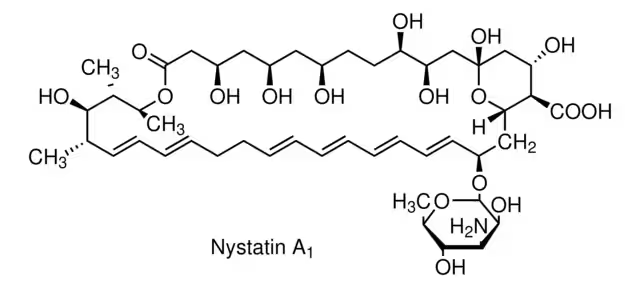
CAS Number1400-61-9
Synonymsbiofanal; 9,11,13,15-Octadecatetraenoic acid; stamycin; MFCD00036240; nystatin A1; Nystex; nilstat; nystatin A2; nystan; MORONAL; EINECS 215-749-0; Nystain; octadeca-9,11,13,15-tetraenoic acid; Fungicidin Mycostatin; Nyotran
Molecular FormulaC47H75NO17
Molecular Weight276.414
Purity99%
Density0.9±0.1 g/cm3
Boiling Point400.2±14.0 °C at 760 mmHg
Melting Point>155°C (dec.)
Appearancesuspension
| Chemical & Physical Properties | |
|---|---|
| CAS Number | 1400-61-9 |
| Catalog No. | 2A-9010650 |
| Chinese Name | 制霉菌素 |
| Synonyms | biofanal; 9,11,13,15-Octadecatetraenoic acid; stamycin; MFCD00036240; nystatin A1; Nystex; nilstat; nystatin A2; nystan; MORONAL; EINECS 215-749-0; Nystain; octadeca-9,11,13,15-tetraenoic acid; Fungicidin Mycostatin; Nyotran |
| Molecular Formula | C47H75NO17 |
| Molecular Weight | 276.414 |
| Purity | 99 |
| Density | 0.9±0.1 g/cm3 |
| Boiling Point | 400.2±14.0 °C at 760 mmHg |
| Melting Point | >155°C (dec.) |
| Appearance | suspension |
| Storage Condition | Seal and store at -20ºC |
| Application | Nystatin is a polyene antifungal antibiotic effective against yeast and mycoplasma. |
| HTC | 2942000000 |
| PubChem ID | 24897511 |
| SMILES | C[C@@H]1OC(=O)C[C@H](O)C[C@H](O)C[C@H](O)CC[C@@H](O)[C@H](O)C[C@]2(O)C[C@H](O)[C@H]([C@H](C[C@@H](O[C@@H]3O[C@H](C)[C@@H](O)[C@H](N)[C@@H]3O)\C=C\C=C\C=C\C=C\CC\C=C\C=C\[C@H](C)[C@@H](O)[C@@H]1C)O2)C(O)=O |
| InChI | 1S/C47H75NO17/c1-27-17-15-13-11-9-7-5-6-8-10-12-14-16-18-34(64-46-44(58)41(48)43(57)30(4)63-46)24-38-40(45(59)60)37(54)26-47(61,65-38)25-36(53)35(52)20-19-31(49)21-32(50)22-33(51)23-39(55)62-29(3)28(2)42(27)56/h5-6,8,10-18,27-38,40-44,46,49-54,56-58,61H,7,9,19-26,48H2,1-4H3,(H,59,60)/b6-5+,10-8+,13-11+,14-12+,17-15+,18-16+/t27-,28+,29-,30+,31+,32+,33+,34-,35+,36+,37-,38-,40+,41-,42+,43+,44-,46-,47+/m0/s1 |
| InChI Key | VQOXZBDYSJBXMA-QEKUPDCNSA-N |
| NACRES Code | NA.76 |
| UNSPSC | 12352207 |
| MSDS | msds/10650_1_1400_61_9.pdf |
| Bioactivity | Nystatin is a polyene antifungal antibiotic effective against yeast and mycoplasma. Related Catalog Signaling Pathways >> Anti-infection >> Fungal Research Areas >> Infection In Vitro Nystatin results in a significant reduction in buccal epithelial cell adhesion of all six Candida species[1]. Nystatin is an antibiotic that increases the permeability of plasma membranes to small monovalent ions, including chloridion. Nystatin increases apical chloridion permeability to the point where transepithelial chloridion transport is limited by transport across the basolateral membrane of tracheal epithelial cells, which reflects primarily the activity of the cotransporter. Nystatin (400 units/mL) increases the basal level of transepithelial 36Cl flux approximately 1.5-fold and eliminates UTP stimulation of this flux. Nystatin treatment also abolishes UTP stimulation of saturable, basolateral [3H]bumetanide binding, a measure of functioning Na-K-Cl cotransporters in these cells; isoproterenol stimulation of binding is only mildly inhibited by nystatin treatment[2]. Nystatin significantly enhances endostatin uptake by endothelial cells through switching endostatin internalization predominantly to the clathrin-mediated pathway. Nystatin-enhanced internalization of endostatin also increases its inhibitory effects on endothelial cell tube formation and migration[3]. In Vivo Nystatin combined with endostatin selectively enhances endostatin uptake and biodistribution in tumor blood vessels and tumor tissues but not in normal tissues of tumor-bearing mice, ultimately resulting in elevated antiangiogenic and antitumor efficacies of endostatin in vivo[3]. Liposomal Nystatin, at doses as low as 2 mg/kg of body weight/day, protects neutropenic mice against Aspergillus-induced death in a statistically significant manner at the 50-day time point compared to either the no-treatment, the saline, or the empty-liposome group[4]. References [1]. Ellepola AN, et al. Adhesion of oral Candida species to human buccal epithelial cells following brief exposure to nystatin. Oral Microbiol Immunol. 1999 Dec;14(6):358-63. [2]. Haas M, et al. Na-K-Cl cotransport in nystatin-treated tracheal cells: regulation by isoproterenol, apical UTP, and [Cl]i. Am J Physiol. 1994 May;266(5 Pt 1):C1440-52. [3]. Chen Y, et al. Cholesterol sequestration by nystatin enhances the uptake and activity of endostatin in endothelium via regulating distinct endocytic pathways. Blood. 2011 Jun 9;117(23):6392-403 [4]. Wallace TL, et al. Activity of liposomal nystatin against disseminated Aspergillus fumigatus infection in neutropenic mice. Antimicrob Agents Chemother. 1997 Oct;41(10):2238-43 Chemical & Physical Properties Density 0.9±0.1 g/cm3 Boiling Point 400.2±14.0 °C at 760 mmHg Melting Point >155°C (dec.) Molecular Formula C47H75NO17 Molecular Weight 276.414 Flash Point 297.0±15.2 °C Exact Mass 276.208923 PSA 327.45000 LogP 6.14 Vapour Pressure 0.0±2.0 mmHg at 25°C Index of Refraction 1.504 InChIKey VQOXZBDYSJBXMA-ITVVHGMISA-N SMILES CC1C=CC=CCCC=CC=CC=CC=CC(OC2OC(C)C(O)C(N)C2O)CC2OC(O)(CC(O)C(O)CCC(O)CC(O)CC(O)CC(=O)OC(C)C(C)C1O)CC(O)C2C(=O)O |
| Use of | Nystatin is a polyene antifungal antibiotic effective against yeast and mycoplasma. Properties Articles64 Name Nystatin Synonym More Synonyms Nystatin Biological Activity Description Nystatin is a polyene antifungal antibiotic effective against yeast and mycoplasma. Related Catalog Signaling Pathways >> Anti-infection >> Fungal Research Areas >> Infection References [1]. Ellepola AN, et al. Adhesion of oral Candida species to human buccal epithelial cells following brief exposure to nystatin. Oral Microbiol Immunol. 1999 Dec;14(6):358-63. [2]. Haas M, et al. Na-K-Cl cotransport in nystatin-treated tracheal cells: regulation by isoproterenol, apical UTP, and [Cl]i. Am J Physiol. 1994 May;266(5 Pt 1):C1440-52. [3]. Chen Y, et al. Cholesterol sequestration by nystatin enhances the uptake and activity of endostatin in endothelium via regulating distinct endocytic pathways. Blood. 2011 Jun 9;117(23):6392-403 [4]. Wallace TL, et al. Activity of liposomal nystatin against disseminated Aspergillus fumigatus infection in neutropenic mice. Antimicrob Agents Chemother. 1997 Oct;41(10):2238-43 Chemical & Physical Properties Molecular Formula C47H75NO17 Exact Mass 276.208923 PSA 327.45000 Index of Refraction 1.504 InChIKey VQOXZBDYSJBXMA-ITVVHGMISA-N |
| Transport Info | Product Name: Nystatin |
| Related Products in API & Advanced Intermediates | ||
|---|---|---|
| Fosinopril sodium | 88889-14-9 | 2A-9010618 |
| Fosinoprilat | 95399-71-6 | 2A-9010619 |
| Fosphenytoin | 93390-81-9 | 2A-9010621 |
| Fosphenytoin sodium | 92134-98-0 | 2A-9010622 |
| Fulvestrant | 129453-61-8 | 2A-9010646 |
| Furosemide | 54-31-9 | 2A-9010663 |
| Gabapentin hydrochloride | 60142-96-3 | 2A-0200168 |
| gamma-Lumicolchicine | 6901-14-0 | 2A-9010682 |
| Ganciclovir | 82410-32-0 | 2A-9010685 |
| Ganciclovir sodium | 107910-75-8 | 2A-9010686 |
| Browse all API & Advanced Intermediates products » | ||
Phone:
630-322-8886
630-322-8887
Email:
Office Locations:
Chicago, IL, USA
San Francisco, CA, USA


 EN
EN


 SDS
SDS