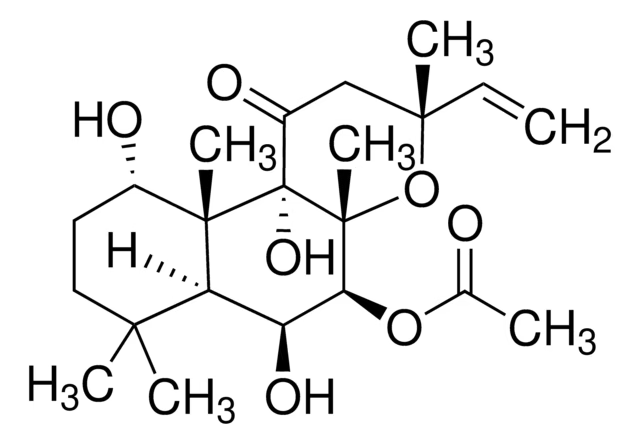
CAS Number66575-29-9
SynonymsHL 362; EINECS 266-410-9; Coleonol; L 75-1362B; Forskolin; ForsLean; FORSKOHLIN; boforsin; [3H]-Forskolin; COLFORSIN; MFCD00082317
Molecular FormulaC22H34O7
Molecular Weight410.50
Purity≥98 (HPLC)%
Density1.2±0.1 g/cm3
Boiling Point519.9±50.0 °C at 760 mmHg
Melting Point282-232ºC
Appearancepowder
EINECS266-410-9
Symbol
Signal WordWarning
| Chemical & Physical Properties | |
|---|---|
| CAS Number | 66575-29-9 |
| Catalog No. | 2A-9010610 |
| Chinese Name | 佛司可林 |
| Synonyms | HL 362; EINECS 266-410-9; Coleonol; L 75-1362B; Forskolin; ForsLean; FORSKOHLIN; boforsin; [3H]-Forskolin; COLFORSIN; MFCD00082317 |
| Molecular Formula | C22H34O7 |
| Molecular Weight | 410.50 |
| Purity | ≥98 (HPLC) |
| Density | 1.2±0.1 g/cm3 |
| Boiling Point | 519.9±50.0 °C at 760 mmHg |
| Melting Point | 282-232ºC |
| Appearance | powder |
| Storage Condition | Store in an airtight container in a cool, dry plac |
| Application | Forskolin is a potent adenylyl cyclase activator, binding to type I adenylyl cyclase with an IC50 of 41 nM and activating type I adenylyl cyclase with an EC50 of 0.5 μM. |
| EINECS | 266-410-9 |
| PubChem ID | 24278035 |
| MDL Number | MFCD00082317 |
| SMILES | CC(=O)O[C@H]1[C@@H](O)[C@H]2C(C)(C)CC[C@H](O)[C@]2(C)[C@@]3(O)C(=O)C[C@@](C)(O[C@]13C)C=C |
| InChI | 1S/C22H34O7/c1-8-19(5)11-14(25)22(27)20(6)13(24)9-10-18(3,4)16(20)15(26)17(28-12(2)23)21(22,7)29-19/h8,13,15-17,24,26-27H,1,9-11H2,2-7H3/t13-,15-,16-,17-,19-,20-,21+,22-/m0/s1 |
| InChI Key | OHCQJHSOBUTRHG-KGGHGJDLSA-N |
| Beilstein/REAXYS | 1692716 |
| NACRES Code | NA.77 |
| UNSPSC | 41106305 |
| Hazard Symbols | Transport |
| MSDS | msds/10610_1_66575_29_9.pdf |
| Bioactivity | Forskolin is a potent adenylate cyclase activator, with IC50 and EC50 of 41 nM and 0.5 μM for type I adenylyl cyclase, respectively. Related Catalog Signaling Pathways >> GPCR/G Protein >> Adenylate Cyclase Natural Products >> Terpenoids and Glycosides Research Areas >> Endocrinology Target IC50: 41 nM (Adenylyl cyclase)[1] EC50: 0.5 μM (Adenylyl cyclase)[1] In Vitro Forskolin (Fsk) is a naturally occurring diterpene isolated from Coleus forskholii, directly activates adenylyl cyclase (AC) through its catalytic subunit to increase intracellular levels of cyclic adenosine monophosphate (cAMP)[1]. Forskolin (Fsk) affects the proliferation of the human T-cell lines such as Kit 225 and MT-2. Forskolin treatment inhibits the proliferation of both Kit 225 and MT-2 cells in a dose-dependent manner with an IC50 equal to ~5 μM Fsk. Forskolin treatment (10-100 μM) increases cAMPi levels ~5- to 20-fold above basal levels, which reache maximum levels between 50-100 μM Forskolin[2]. In Vivo The Forskolin (Fsk)-treated Mrp4-/- mice shows an increased number of Ki67-positive and cleaved caspase 3-positive ECs, a significant decrease in the amount of pericyte coverage, and a reduced number of empty sleeves. In pups exposed to hyperoxia (75% oxygen) from P7 to P12, the Mrp4-/- mice shows a significant increase in the unvascularized retinal area[3]. The average blood glucose in the healthy rat group is 102.12±1.94 mg/dL, 101.25±3.56 for control group and 103±2.08 in forskolin group. The data shows that glucose levels at the end of the study are lower in forskolin group, with a significant difference according to the statistical tests applied (p=0.03)[4]. Kinase Assay For Jak3 kinase assays, Fsk-treated MT-2 cells are lysed, clarified, and immunoprecipitated using Jak3 antibody. Kinase reactions are carried out at 30°C for 20 min. For PKA kinase assays, untreated MT-2 cells are lysed, and Jak3 is immunoprecipitated and bound to PAS beads. Immunoprecipitated Jak3 is washed with kinase buffer (50 mM Hepes-NaOH (pH 7.4), 10 mM MgCl2, 0.5 mM EGTA, 0.5 mM DTT, 20 μg/mL aprotinin, 10 μg/mL leupeptin, 1 μg/mL pepstatin A) and incubated with 200 μM ATP and purified protein kinase A catalytic subunit (PKAc) as indicated in the figure legends. Kinase reactions are carried out at 32 °C for 30 min followed by vigorous washing of the beads with cold kinase wash buffer. For [γ-32P]ATP radiolabeled kinase assays using recombinant Jak3, Hek293 cells are transfected with wild type (WT) Jak3 or kinase-dead Jak3 K855A using Lipofectamine 2000 according to the manufacturer's instructions. Cells are lysed and immunoprecipitated with Jak3 antibody. Jak3-bound PAS beads are washed three times in cold lysis buffer followed by kinase buffer. Kinase reactions are initiated by adding 10 μCi [γ-32P]ATP, 10 μM unlabeled ATP, and 1 μg of purified PKAc to Jak3-bound PAS bead reaction mixtures. Kinase reactions are performed at 32°C for 30 min. Jak3-bound PAS beads are washed three times in radioimmunoassay buffer (10 mM Tris-HCl, pH 7.4, 75 mM NaCl, 20 mM EDTA, 10 mM EGTA, 20 mM Na4P2O7, 50 mM NaF, 20 mM 2-glycerolphosphate, 1 mM p-nitrophenylphosphate, 0.1% Triton X-100) and one time in kinase wash buffer. The reactions are stopped by adding 2× SDS-PAGE sample buffer followed by SDS-PAGE. Coomassie stainable Jak3 bands are excised from the PVDF membrane and subjected to phosphoamino acid analysis[2]. Cell Assay Quiescent Kit 225 or MT-2 cells are seeded into 96-well plates at 5×10⁴ cells per well. Cells are then pretreated for 1 h with 1% DMSO (vehicle) or Forskolin at 1, 5, 10, 25, 50, and 100 μMconcentrations. The cells are stimulated with IL-2 and cultured for an additional 20 h at 37°C. Control cells are treated with 1% DMSO for 20 h. During the final 4 h of incubation, the cells are pulsed with [3H]thymidine at a concentration of 0.5 μCi/200 μL. Cells are harvested onto fiberglass filters and analyzed using liquid scintillation counting[2]. Animal Admin Mice[3] C57BL/6J mice are used. Mrp4-knockout mice, which are established and repeatedly backcrossed to the C57BL/6J mice. Forskolin is injected intraperitoneally into neonatal mice at postnatal days 4 (P4) and 5 (P5). Mice injected with DMSO serve as the controls. The treated mice are euthanized at P6, and their retinas are isolated for whole-mount immunohistochemistry (IHC). The effect of different concentrations of Forskolin on the survival rate and retinal vasculature is first tested, and the optimal concentration is determined, 1.0 μg/50 μL (0.3 mg/kg) at P4 and 1.5 μg/50 μL (0.5 mg/kg) at P5, used to compare the retinal vascular phenotypes between WT mice and Mrp4-deficient mice. Rats[4] Male Wistar rats, aged 10-14 weeks old, with a mean weight of 300 g±50 g, are divided into four groups; 19 are experimentally induced to develop diabetes, and 8 are maintained in a healthy condition. Both diabetic and healthy rats receive no Forskolin (control), or 6 mg/kg per day of Forskolin, administered orally for 8 weeks. Blood glucose levels are determined in each group before and after Forskolin treatment. The diabetic rats are tested two weeks after confirming the presence of diabetes (three weeks after the induction) and after eight weeks of the designated treatment. References [1]. Robbins JD, et al. Forskolin carbamates: binding and activation studies with type I adenylyl cyclase. J Med Chem. 1996 Jul 5;39(14):2745-52. [2]. Rodriguez G, et al. Forskolin-inducible cAMP pathway negatively regulates T-cell proliferation by uncoupling the interleukin-2 receptor complex. J Biol Chem. 2013 Mar 8;288(10):7137-46. [3]. Matsumiya W, et al. Forskolin modifies retinal vascular development in Mrp4-knockout mice. Invest Ophthalmol Vis Sci. 2012 Dec 7;53(13):8029-35. [4]. Ríos-Silva M, et al. Effect of chronic administration of forskolin on glycemia and oxidative stress in rats with and without experimental diabetes. Int J Med Sci. 2014 Mar 11;11(5):448-52. Chemical & Physical Properties Density 1.2±0.1 g/cm3 Boiling Point 519.9±50.0 °C at 760 mmHg Melting Point 282-232ºC Molecular Formula C22H34O7 Molecular Weight 410.501 Flash Point 171.8±23.6 °C Exact Mass 410.230438 PSA 113.29000 LogP 3.40 Vapour Pressure 0.0±3.1 mmHg at 25°C Index of Refraction 1.552 InChIKey OHCQJHSOBUTRHG-KGGHGJDLSA-N SMILES C=CC1(C)CC(=O)C2(O)C(C)(O1)C(OC(C)=O)C(O)C1C(C)(C)CCC(O)C12C |
| Use of | Forskolin is a potent adenylate cyclase activator, with IC50 and EC50 of 41 nM and 0.5 μM for type I adenylyl cyclase, respectively. Properties Articles456 Name forskolin Synonym More Synonyms Forskolin Biological Activity Description Forskolin is a potent adenylate cyclase activator, with IC50 and EC50 of 41 nM and 0.5 μM for type I adenylyl cyclase, respectively. Related Catalog Signaling Pathways >> GPCR/G Protein >> Adenylate Cyclase Natural Products >> Terpenoids and Glycosides Research Areas >> Endocrinology IC50: 41 nM (Adenylyl cyclase)[1] EC50: 0.5 μM (Adenylyl cyclase)[1] References [1]. Robbins JD, et al. Forskolin carbamates: binding and activation studies with type I adenylyl cyclase. J Med Chem. 1996 Jul 5;39(14):2745-52. [2]. Rodriguez G, et al. Forskolin-inducible cAMP pathway negatively regulates T-cell proliferation by uncoupling the interleukin-2 receptor complex. J Biol Chem. 2013 Mar 8;288(10):7137-46. [3]. Matsumiya W, et al. Forskolin modifies retinal vascular development in Mrp4-knockout mice. Invest Ophthalmol Vis Sci. 2012 Dec 7;53(13):8029-35. [4]. Ríos-Silva M, et al. Effect of chronic administration of forskolin on glycemia and oxidative stress in rats with and without experimental diabetes. Int J Med Sci. 2014 Mar 11;11(5):448-52. Chemical & Physical Properties Molecular Formula C22H34O7 Exact Mass 410.230438 PSA 113.29000 Index of Refraction 1.552 InChIKey OHCQJHSOBUTRHG-KGGHGJDLSA-N |
| Transport Info | Shipping Name: UN |
| MSDS Transport Info | Module 14. Shipping information 14.1 UN dangerous goods number European Land Transport Dangerous Regulations: -International Maritime Dangerous Regulations: -International Air Transport Dangerous Regulations: - 14.2 United Nations shipping name European Land Transport Dangerous Regulations: Non-dangerous goods IMDG Code: Non-dangerous goods International air transport dangerous goods regulations: non-dangerous goods 14.3 Transport hazard categories European Land Transport Dangerous Regulations: -International Maritime Dangerous Regulations: -International Air Transport Dangerous Regulations: - 14.4 Package group European Land Transport Dangerous Regulations: -International Maritime Dangerous Regulations: -International Air Transport Dangerous Regulations: - 14.5 Environmental hazards European Land Transport Danger Regulations: No International Maritime Danger Regulations International Air Transport Danger Regulations: No Marine pollutants (yes/no): No 14.6 Special reminder to users No data available |
| Related Products in Specialty Chemicals | ||
|---|---|---|
| Fonophos | 944-22-9 | 2A-9010601 |
| Forasartan | 145216-43-9 | 2A-9010602 |
| Formetanate hydrochloride | 23422-53-9 | 2A-9010604 |
| Formothion | 2540-82-1 | 2A-9010607 |
| Foropafant | 136468-36-5 | 2A-9010609 |
| Fortimicin | 55779-06-1 | 2A-9010611 |
| Fotemustine | 92118-27-9 | 2A-9010626 |
| Fradafiban | 148396-36-5 | 2A-9010627 |
| Fraxidin | 525-21-3 | 2A-9010630 |
| Frentizole | 26130-02-9 | 2A-9010632 |
| Browse all Specialty Chemicals products » | ||
Phone:
630-322-8886
630-322-8887
Email:
Office Locations:
Chicago, IL, USA
San Francisco, CA, USA


 EN
EN


 SDS
SDS