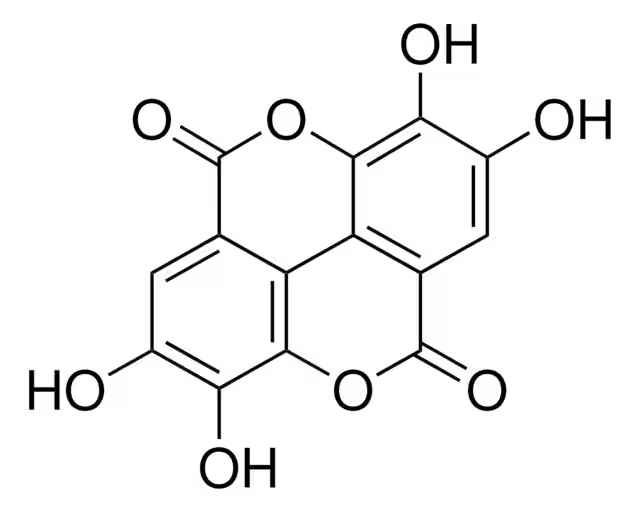
CAS Number476-66-4
Synonymslagistase; 2,3,7,8-Tetrahydroxychromeno[5,4,3-cde]chromene-5,10-dione; Ellagic acid; Elllagic Acid; elagostasine; MFCD00006914; EINECS 207-508-3; eleagicacid; Ellagic; BENZOARIC ACID
Molecular FormulaC14H6O8
Molecular Weight302.19
Purity≥95 (HPLC)%
Density2.1±0.1 g/cm3
Boiling Point796.5±60.0 °C at 760 mmHg
Melting Point≥350 °C
Appearancepowder
EINECS207-508-3
Symbol
Signal WordWarning
| Chemical & Physical Properties | |
|---|---|
| CAS Number | 476-66-4 |
| Catalog No. | 2A-9010299 |
| Chinese Name | 鞣花酸 |
| Synonyms | lagistase; 2,3,7,8-Tetrahydroxychromeno[5,4,3-cde]chromene-5,10-dione; Ellagic acid; Elllagic Acid; elagostasine; MFCD00006914; EINECS 207-508-3; eleagicacid; Ellagic; BENZOARIC ACID |
| Molecular Formula | C14H6O8 |
| Molecular Weight | 302.19 |
| Purity | ≥95 (HPLC) |
| Density | 2.1±0.1 g/cm3 |
| Boiling Point | 796.5±60.0 °C at 760 mmHg |
| Melting Point | ≥350 °C |
| Appearance | powder |
| Water Solubility | 1 M NaOH: 10 mg/mL, dark green | <0.1 g/100 mL at |
| Storage Condition | Store in a sealed container in a ventilated and dr |
| Application | Ellagic acid is a natural antioxidant and a potent, ATP-competitive CK2 inhibitor with IC50 and Ki values of 40 nM and 20 nM respectively. |
| EINECS | 207-508-3 |
| PubChem ID | 24894460 |
| MDL Number | MFCD00006914 |
| SMILES | Oc1cc2C(=O)Oc3c(O)c(O)cc4C(=O)Oc(c1O)c2-c34 |
| InChI | 1S/C14H6O8/c15-5-1-3-7-8-4(14(20)22-11(7)9(5)17)2-6(16)10(18)12(8)21-13(3)19/h1-2,15-18H |
| InChI Key | AFSDNFLWKVMVRB-UHFFFAOYSA-N |
| Beilstein/REAXYS | 47549 |
| NACRES Code | NA.77 |
| UNSPSC | 12352205 |
| Hazard Symbols | Transport |
| MSDS | msds/10299_1_476_66_4.pdf |
| Bioactivity | Ellagic acid is a natural antioxidant, and acts as a potent and ATP-competitive CK2 inhibitor, with an IC50 of 40 nM and a Ki of 20 nM. Related Catalog Signaling Pathways >> Cell Cycle/DNA Damage >> Casein Kinase Signaling Pathways >> Stem Cell/Wnt >> Casein Kinase Natural Products >> Phenols Research Areas >> Cancer Research Areas >> Neurological Disease Target CK2:40 nM (IC50) In Vitro Ellagic acid is a potent CK2 inhibitor, with an IC50 of 40 nM and a Ki of 20 nM. Ellagic acid also blocks other kinases such as LYN, PKA, SYK, GSK3, FGR and CK1, with IC50s of 2.9, 3.5, 4.3, 7.5, 9.4 and 13.0 μM, respectively, and shows no obvious effects on DYRK1a, CSK, NPM-ALK, RET and FLT3 (IC50s > 40 μM). Ellagic acid (5-100 μM) shows inhibitory activities against Karpas299, SUDHL1, SR786, and FE-PD cell lines[1]. Ellagic acid (10 μM) exhibits cytotoxic effects on MCF-7 cells after treatment of radiation. Ellagic acid (10 μM) in combination with Irradiation (IR) significantly abridges the capacity of MCF-7 cells to form colonies equated with individual treatments. Ellagic acid with IR also induces cell apoptosis, and facilitates the upregulation of pro-apopttotic Bax and downregulation of Bcl-2 in MCF-7 cells[3]. In Vivo Ellagic acid (EA; 10 mg/kg/day; p.o., 14 days) strongly decreases MDA brain content by 17%, and reduces the levels of brain TNF-α by 42% in rats. Ellagic acid markedly increases the reduced brain contents of 5-HT (39%), dopamine (DA, 71%), and norepinephrine (NE, 77%). Ellagic acid (10 mg/kg, p.o., 14 days) causes decreased histopathological changes induced by Doxorubicin in rats[2]. Kinase Assay CK2 and CK1 phosphorylation assays are carried out at 37°C in the presence of increasing amounts of each inhibitor (Ellagic acid) in a final volume of 25 µL containing 50 mM, Tris-HCl pH 7.5, 100 mM NaCl, 12 mM MgCl2, 0.02 mM [33P-ATP] (500-1000 cpm/pmol), unless otherwise indicated. The phosphorylatable substrates are the synthetic peptide substrate RRRADDSDDDDD (100 µM) and RRKHAAIGDDDDAYSITA (200 µM) for CK2 and CK1, respectively. Reaction started with the addition of the kinase and is stopped after 10 min. by addition of 5 µL of 0.5 M orthophosphoric acid before spotting aliquots onto phosphocellulose filters. Filters are washed in 75 mM phosphoric acid substrate following SDS-PAGE of the radiolabeled samples. DYRK1A, assayed on the peptide RRRFRPASPLRGPPK, and tyrosine kinase activities are determined[1]. Cell Assay ALCL cell viability is measured by MTT assay. Briefly, 0.1 × 10⁵ cells are seeded onto 96-well microculture plates 12 hrs before adding ellagic acid. The cells are grown in 200 µL of complete RPMI-1640 medium, under standard tissue-culture conditions, in the presence or absence of the drug (Ellagic acid) for 48 hours. Twenty µL of MTT solution (5 mg/mL) are then added to the cell suspension for 4h. The intracellular formazan crystals are dissolved with 150 µL of DMSO and optical density, measured on a spectrophotometer at 540 nm, represents the mean (± SD) of triplicate cultures[1]. Animal Admin Fifty male adult Sprague-Dawley rats are divided randomly into five groups as follow: Group (1) receives corn oil orally as a vehicle and served as normal control. Group (2) receives doxorubicin (DOX) injection (5 mg/kg, i.p.) twice a week for 14 days. Group (3) receives Ellagic acid (10 mg/kg, p.o.; daily) for 14 days and DOX (5 mg/kg, i.p.) twice a week for 14 days. Group (4) receives rosmarinic acid (RA; 75 mg/kg, p.o.; daily) for 14 days and DOX (5 mg/kg, i.p.) twice a week for 14 days. Group (5) receives Ellagic acid (10 mg/kg, p.o.; daily) with RA (75 mg/kg, p.o.; daily) for 14 days and DOX injection (5 mg/kg, i.p.) twice a week for 14 days[2]. References [1]. Cozza G, et al. Identification of ellagic acid as potent inhibitor of protein kinase CK2: a successful example of a virtual screening application. J Med Chem. 2006 Apr 20;49(8):2363-6. [2]. Rizk HA, et al. Prophylactic effects of ellagic acid and rosmarinic acid on doxorubicin-induced neurotoxicity in rats. J Biochem Mol Toxicol. 2017 Dec;31(12). [3]. Ahire V, et al. Ellagic Acid Enhances Apoptotic Sensitivity of Breast Cancer Cells to γ-Radiation. Nutr Cancer. 2017 Aug-Sep;69(6):904-910. Chemical & Physical Properties Density 2.1±0.1 g/cm3 Boiling Point 796.5±60.0 °C at 760 mmHg Melting Point ≥350 °C Molecular Formula C14H6O8 Molecular Weight 302.193 Flash Point 310.1±26.4 °C Exact Mass 302.006256 PSA 141.34000 LogP 0.52 Vapour Pressure 0.0±2.9 mmHg at 25°C Index of Refraction 1.895 InChIKey AFSDNFLWKVMVRB-UHFFFAOYSA-N SMILES O=c1oc2c(O)c(O)cc3c(=O)oc4c(O)c(O)cc1c4c23 Storage condition Store at RT Stability Stable. Combustible. Incompatible with strong oxidizing agents. Water Solubility 1 M NaOH: 10 mg/mL, dark green | <0.1 g/100 mL at 21 ºC |
| Use of | Ellagic acid is a natural antioxidant, and acts as a potent and ATP-competitive CK2 inhibitor, with an IC50 of 40 nM and a Ki of 20 nM. Properties Articles130 Name ellagic acid Synonym More Synonyms Ellagic acid Biological Activity Description Ellagic acid is a natural antioxidant, and acts as a potent and ATP-competitive CK2 inhibitor, with an IC50 of 40 nM and a Ki of 20 nM. Related Catalog Signaling Pathways >> Cell Cycle/DNA Damage >> Casein Kinase Signaling Pathways >> Stem Cell/Wnt >> Casein Kinase Natural Products >> Phenols Research Areas >> Cancer Research Areas >> Neurological Disease CK2:40 nM (IC50) References [1]. Cozza G, et al. Identification of ellagic acid as potent inhibitor of protein kinase CK2: a successful example of a virtual screening application. J Med Chem. 2006 Apr 20;49(8):2363-6. [2]. Rizk HA, et al. Prophylactic effects of ellagic acid and rosmarinic acid on doxorubicin-induced neurotoxicity in rats. J Biochem Mol Toxicol. 2017 Dec;31(12). [3]. Ahire V, et al. Ellagic Acid Enhances Apoptotic Sensitivity of Breast Cancer Cells to γ-Radiation. Nutr Cancer. 2017 Aug-Sep;69(6):904-910. Chemical & Physical Properties Molecular Formula C14H6O8 Exact Mass 302.006256 PSA 141.34000 Index of Refraction 1.895 InChIKey AFSDNFLWKVMVRB-UHFFFAOYSA-N Storage condition Store at RT Stability Stable. Combustible. Incompatible with strong oxidizing agents. |
| Transport Info | Shipping Name: UN |
| MSDS Transport Info | Module 14. Shipping information 14.1 UN dangerous goods number European Land Transport Dangerous Regulations: -International Maritime Dangerous Regulations: -International Air Transport Dangerous Regulations: - 14.2 United Nations shipping name European Land Transport Dangerous Regulations: Non-dangerous goods IMDG Code: Non-dangerous goods International air transport dangerous goods regulations: non-dangerous goods 14.3 Transport hazard categories European Land Transport Dangerous Regulations: -International Maritime Dangerous Regulations: -International Air Transport Dangerous Regulations: - 14.4 Package group European Land Transport Dangerous Regulations: -International Maritime Dangerous Regulations: -International Air Transport Dangerous Regulations: - 14.5 Environmental hazards European Land Transport Danger Regulations: No International Maritime Danger Regulations International Air Transport Danger Regulations: No Marine pollutants (yes/no): No 14.6 Special reminder to users No data available |
| Related Products in Botanical Reference Standards | ||
|---|---|---|
| Dihydrokaempferol 3-O-arabinoside | 2A-301239 | 2A-9010156 |
| Diosmetin | 520-34-3 | 2A-9010189 |
| Diosmin | 520-27-4 | 2A-9010190 |
| Dipotassium glycyrrhizinate | 68797-35-3 | 2A-9010198 |
| Ecdysterone | 5289-74-7 | 2A-9010273 |
| Ent-epifisetinidol | 895-23-8 | 2A-9010336 |
| Eriocitrin | 13463-28-0 | 2A-9010366 |
| Escin | 11072-93-8 | 2A-9010376 |
| Esculin | 531-75-9 | 2A-9010379 |
| Eucommia ulmoides Oliver | 2A-301514 | 2A-9010431 |
| Browse all Botanical Reference Standards products » | ||
Phone:
630-322-8886
630-322-8887
Email:
Office Locations:
Chicago, IL, USA
San Francisco, CA, USA


 EN
EN


 SDS
SDS