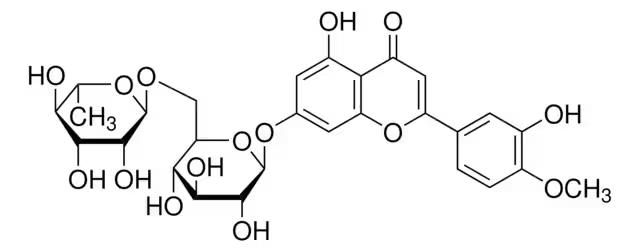
CAS Number520-27-4
SynonymsUNII-7QM776WJ5N; Venosmine; EINECS 208-289-7; 3',5,7-trihydroxy-4'-methoxyflavone 7-rutinoside; Diosmin; 5-Hydroxy-2-(3-hydroxy-4-methoxyphenyl)-7-b-rutinosyloxy-4H-chromen-4-one; Ven-Detrex; 3',5,7-Trihydroxy-4'-methoxyflavone-7-rutinoside; Veno-V; MFCD00009772; Diosmine; Diosmetin 7-b-Rutinoside; Diosimin; diosmetin-7-rhamnoglucoside; Barosmin
Molecular FormulaC28H32O15
Molecular Weight608.54
Purity90%
Density1.7±0.1 g/cm3
Boiling Point926.8±65.0 °C at 760 mmHg
Melting Point277-278°C
AppearanceSolid;White to Gray to Brown powder to crystal
| Chemical & Physical Properties | |
|---|---|
| CAS Number | 520-27-4 |
| Catalog No. | 2A-9010190 |
| Chinese Name | 地奥司明 |
| Synonyms | UNII-7QM776WJ5N; Venosmine; EINECS 208-289-7; 3',5,7-trihydroxy-4'-methoxyflavone 7-rutinoside; Diosmin; 5-Hydroxy-2-(3-hydroxy-4-methoxyphenyl)-7-b-rutinosyloxy-4H-chromen-4-one; Ven-Detrex; 3',5,7-Trihydroxy-4'-methoxyflavone-7-rutinoside; Veno-V; MFCD00009772; Diosmine; Diosmetin 7-b-Rutinoside; Diosimin; diosmetin-7-rhamnoglucoside; Barosmin |
| Molecular Formula | C28H32O15 |
| Molecular Weight | 608.54 |
| Purity | 90 |
| Density | 1.7±0.1 g/cm3 |
| Boiling Point | 926.8±65.0 °C at 760 mmHg |
| Melting Point | 277-278°C |
| Appearance | Solid;White to Gray to Brown powder to crystal |
| Storage Condition | Store in a cool, dry, well-ventilated warehouse. K |
| Application | Diosmin is a flavonoid found in various citrus fruits and is an agonist of the aryl hydrocarbon receptor (AhR). |
| HTC | 2932999099 |
| MDL Number | MFCD00009772 |
| SMILES | COc1ccc(cc1O)C2=CC(=O)c3c(O)cc(O[C@@H]4O[C@H](CO[C@@H]5O[C@@H](C)[C@H](O)[C@@H](O)[C@H]5O)[C@@H](O)[C@H](O)[C@H]4O)cc3O2 |
| InChI | 1S/C28H32O15/c1-10-21(32)23(34)25(36)27(40-10)39-9-19-22(33)24(35)26(37)28(43-19)41-12-6-14(30)20-15(31)8-17(42-18(20)7-12)11-3-4-16(38-2)13(29)5-11/h3-8,10,19,21-30,32-37H,9H2,1-2H3/t10-,19+,21-,22+,23+,24-,25+,26+,27+,28+/m0/s1 |
| InChI Key | GZSOSUNBTXMUFQ-YFAPSIMESA-N |
| NACRES Code | NA.24 |
| UNSPSC | 41116107 |
| MSDS | msds/10190_1_520_27_4.pdf |
| Bioactivity | Diosmin is a flavonoid found in a variety of citrus fruits and also an agonist of the aryl hydrocarbon receptor (AhR). Related Catalog Signaling Pathways >> Immunology/Inflammation >> Aryl Hydrocarbon Receptor Research Areas >> Cancer Natural Products >> Flavonoids Research Areas >> Cardiovascular Disease Target AhR[1] In Vitro Treatment with Diosmin causes a dose dependent increase in the amount of adducts formed (up to a 7-fold increase in adducts at 5 μM Diosmin). At 5 μM, Diosmin increases the cytotoxicity of 7,12-dimethylbenz(a)anthracene (DMBA), shifting the IC50 of DMBA from an estimated 1.2 μM to 400 nM. Diosmin is not cytotoxic in itself at the concentrations tested. Diosmin causes an increase in CYPIAI activity in MCF-7 cells in a time- and dose-dependent fashion. Diosmin causes a dose-dependent increase in CYPIAI mRNA after 24 h of incubation, causes a long-lasting increase in CYPIAI mRNA accumulation that reaches its peak after 48 h of incubation[1]. In Vivo Diosmin significantly decreases the malondialdehyde (MDA) levels and increases the activities of total-superoxide dismutase (T-SOD), glutathione peroxidase (GSH-Px), and catalase (CAT) in the retina of rats compare with the ischemia group (P<0.05), and suppresses the ischemia/reperfusion (I/R)-induced reduction in the a- and b-wave amplitudes of the electroretinograms (ERGs) (P<0.05). The thickness of the entire retina, inner nuclear layer, inner plexiform layer, and outer retinal layer and the number of cells in the ganglion cell layer are significantly less after I/R injury (P<0.05), and Diosmin remarkably ameliorates these changes on retinal morphology. Diosmin also attenuates the I/R-induced loss of retinal ganglion cells (RGCs) of the rat retina (P<0.05)[2]. Cell Assay MCF-7 cells are plated at 25,000 cells/well in 24-well plates. After 24 h, the medium is changed to medium containing 5 μM Diosmin. After an additional 24 h, the medium is again changed with medium containing 5 μM Diosmin. After 3 days, the total cell growth is assessed by sulforhodamine[1]. Animal Admin Healthy male Wistar rats (n=112) weighing 180 to 200 g each are used in this study. The animals are randomly assigned to the following 4 groups, which include combinations of the ischemia/reperfusion (I/R) injury model or sham injury with the i.g. administration of Diosmin or vehicle solution: sham+vehicle (SV) group, sham+Diosmin (SD) group, model+vehicle (MV) group, and model+Diosmin (MD) group. For intragastric administration, 5 mL of 2% Diosmin per kilogram weight of the rat, or the same volume of vehicle solution, is administered intragastrically 30 min before the onset of ischemia, and then daily after I/R injury until the animals are sacrificed. Using an overdose of anesthesia, 8 rats from each group are sacrificed 24 h after I/R injury, and their eyeballs harvested for determination of the malondialdehyde (MDA) level and the activities of total-superoxide dismutase (T-SOD), glutathione peroxidase (GSH-Px), and catalase (CAT). At 7 days post-I/R injury, electroretinograms (ERGs) are recorded in 6 rats per group. Meanwhile, 6 rats in each group are randomly chosen for retrograde labeling of retinal ganglion cells (RGCs) , and the remaining 8 rats from each group are histopathologically examined[2]. References [1]. Ciolino HP, et al. Diosmin and diosmetin are agonists of the aryl hydrocarbon receptor that differentially affectcytochrome P450 1A1 activity. Cancer Res. 1998 Jul 1;58(13):2754-60. [2]. Tong N, et al. Diosmin protects rat retina from ischemia/reperfusion injury. J Ocul Pharmacol Ther. 2012 Oct;28(5):459-66. Chemical & Physical Properties Density 1.7±0.1 g/cm3 Boiling Point 926.8±65.0 °C at 760 mmHg Melting Point 277-278°C Molecular Formula C28H32O15 Molecular Weight 608.545 Flash Point 305.2±27.8 °C Exact Mass 608.174133 PSA 238.20000 LogP 2.05 Vapour Pressure 0.0±0.3 mmHg at 25°C Index of Refraction 1.712 Storage condition 2-8°C |
| Use of | Diosmin is a flavonoid found in a variety of citrus fruits and also an agonist of the aryl hydrocarbon receptor (AhR). Properties Articles36 Name diosmin Synonym More Synonyms Diosmin Biological Activity Description Diosmin is a flavonoid found in a variety of citrus fruits and also an agonist of the aryl hydrocarbon receptor (AhR). Related Catalog Signaling Pathways >> Immunology/Inflammation >> Aryl Hydrocarbon Receptor Research Areas >> Cancer Natural Products >> Flavonoids Research Areas >> Cardiovascular Disease In Vivo Diosmin significantly decreases the malondialdehyde (MDA) levels and increases the activities of total-superoxide dismutase (T-SOD), glutathione peroxidase (GSH-Px), and catalase (CAT) in the retina of rats compare with the ischemia group (P<0.05), and suppresses the ischemia/reperfusion (I/R)-induced reduction in the a- and b-wave amplitudes of the electroretinograms (ERGs) (P<0.05). The thickness of the entire retina, inner nuclear layer, inner plexiform layer, and outer retinal layer and the number of cells in the ganglion cell layer are significantly less after I/R injury (P<0.05), and Diosmin remarkably ameliorates these changes on retinal morphology. Diosmin also attenuates the I/R-induced loss of retinal ganglion cells (RGCs) of the rat retina (P<0.05)[2]. References [1]. Ciolino HP, et al. Diosmin and diosmetin are agonists of the aryl hydrocarbon receptor that differentially affectcytochrome P450 1A1 activity. Cancer Res. 1998 Jul 1;58(13):2754-60. [2]. Tong N, et al. Diosmin protects rat retina from ischemia/reperfusion injury. J Ocul Pharmacol Ther. 2012 Oct;28(5):459-66. Chemical & Physical Properties Molecular Formula C28H32O15 Exact Mass 608.174133 PSA 238.20000 Index of Refraction 1.712 |
| Tax Rebate | 13.0% |
| Supervision | None. MFN tariff: 6.5%. Ordinary tariff: 20.0% |
| Transport Info | Product name: Purity: 98.0% |
| MSDS Transport Info | Module 14. Shipping information United Nations classification: inconsistent with United Nations classification standards UN number: not specified |
| Related Products in Botanical Reference Standards | ||
|---|---|---|
| Daphnetin | 486-35-1 | 2A-9010002 |
| Dehydroandrographolide | 134418-28-3 | 2A-9010031 |
| Diethylstilbesterol | 56-53-1 | 2A-9010134 |
| Dihydrokaempferol 3-O-arabinoside | 2A-301239 | 2A-9010156 |
| Diosmetin | 520-34-3 | 2A-9010189 |
| Dipotassium glycyrrhizinate | 68797-35-3 | 2A-9010198 |
| Ecdysterone | 5289-74-7 | 2A-9010273 |
| Ellagic acid | 476-66-4 | 2A-9010299 |
| Ent-epifisetinidol | 895-23-8 | 2A-9010336 |
| Eriocitrin | 13463-28-0 | 2A-9010366 |
| Browse all Botanical Reference Standards products » | ||
Phone:
630-322-8886
630-322-8887
Email:
Office Locations:
Chicago, IL, USA
San Francisco, CA, USA


 EN
EN


 SDS
SDS