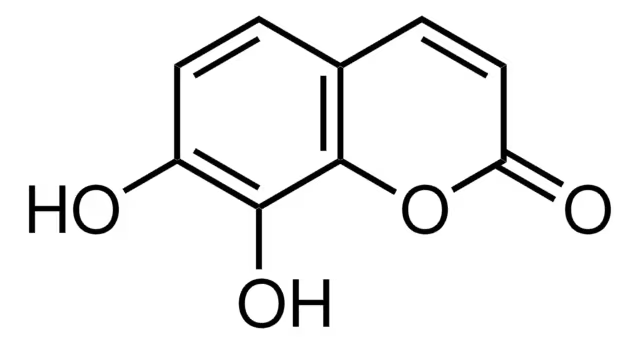
CAS Number486-35-1
SynonymsDaphnetin; 7,8-Dihydroxychromen-2-one; 7,8-Dihydroxycoumarin; 7,8-dihydroxy-coumarin; EINECS 207-632-8; 7,8-Dihydroxy-2H-chromen-2-one; 7,8-Dihydroxy-2H-1-benzopyran-2-one; MFCD00016977; TCMDC-125839
Molecular FormulaC9H6O4
Molecular Weight178.14
Purity≥97%
Density1.6±0.1 g/cm3
Boiling Point430.4±45.0 °C at 760 mmHg
Melting Point265-268°C (dec.)
Appearancepowder
EINECS207-632-8
| Chemical & Physical Properties | |
|---|---|
| CAS Number | 486-35-1 |
| Catalog No. | 2A-9010002 |
| Chinese Name | 瑞香素 |
| Synonyms | Daphnetin; 7,8-Dihydroxychromen-2-one; 7,8-Dihydroxycoumarin; 7,8-dihydroxy-coumarin; EINECS 207-632-8; 7,8-Dihydroxy-2H-chromen-2-one; 7,8-Dihydroxy-2H-1-benzopyran-2-one; MFCD00016977; TCMDC-125839 |
| Molecular Formula | C9H6O4 |
| Molecular Weight | 178.14 |
| Purity | ≥97 |
| Density | 1.6±0.1 g/cm3 |
| Boiling Point | 430.4±45.0 °C at 760 mmHg |
| Melting Point | 265-268°C (dec.) |
| Appearance | powder |
| Water Solubility | Soluble in: methanol; very slightly soluble in: be |
| Storage Condition | Sealed and stored in a cool, dry warehouse. |
| Application | Daphnetin (7,8-dihydroxycoumarin) is a coumarin derivative isolated from Genus Daphne. It is a protease (protein kinase) inhibitor with IC50 values of 7.67 μM, 9.33 μM and 25.01 μM for EGFR, PKA and |
| EINECS | 207-632-8 |
| HTC | 2942000000 |
| PubChem ID | 24278375 |
| MDL Number | MFCD00016977 |
| SMILES | Oc1ccc2C=CC(=O)Oc2c1O |
| InChI | 1S/C9H6O4/c10-6-3-1-5-2-4-7(11)13-9(5)8(6)12/h1-4,10,12H |
| InChI Key | ATEFPOUAMCWAQS-UHFFFAOYSA-N |
| NACRES Code | NA.77 |
| UNSPSC | 12352200 |
| MSDS | msds/10002_1_486_35_1.pdf |
| Bioactivity | Daphnetin (7,8-dihydroxycoumarin), one coumarin derivative isolated from plants of the Genus Daphne, is a protein kinase inhibitor, with IC50s of 7.67 μM, 9.33 μM and 25.01 μM for EGFR, PKA and PKC in vitro, respectively[1][2]. Daphnetin (7,8-dihydroxycoumarin) is a secondary metabolite of plants used in folk medicine to counter inflammatory and allergic diseases, also has been clinically used in the treatment of coagulation disorders, rheumatoid arthritis with anti-malarian and anti-pyretic properties[3]. Related Catalog Signaling Pathways >> Epigenetics >> PKC Signaling Pathways >> JAK/STAT Signaling >> EGFR Signaling Pathways >> Protein Tyrosine Kinase/RTK >> PKA Signaling Pathways >> Protein Tyrosine Kinase/RTK >> EGFR Signaling Pathways >> Stem Cell/Wnt >> PKA Research Areas >> Inflammation/Immunology Signaling Pathways >> TGF-beta/Smad >> PKC Target EGFR:7.67 μM (IC50) PKA:9.33 μM (IC50) PKC:25.01 μM (IC50) References [1]. Yang EB, et al. Daphnetin, one of coumarin derivatives, is a protein kinase inhibitor. Biochem Biophys Res Commun. 1999 Jul 14;260(3):682-5. [2]. Lv H, et al. Daphnetin-mediated Nrf2 antioxidant signaling pathways ameliorate tert-butyl hydroperoxide (t-BHP)-induced mitochondrial dysfunction and cell death. Free Radic Biol Med. 2017 May;106:38-52. [3]. Jiménez-Orozco FA, et al. Differential effects of esculetin and daphnetin on in vitro cell proliferation and in vivo estrogenicity. Eur J Pharmacol. 2011 Oct 1;668(1-2):35-41. Chemical & Physical Properties Density 1.6±0.1 g/cm3 Boiling Point 430.4±45.0 °C at 760 mmHg Melting Point 265-268°C (dec.) Molecular Formula C9H6O4 Molecular Weight 178.14 Flash Point 184.5±22.2 °C Exact Mass 178.026611 PSA 70.67000 LogP 0.77 Vapour Pressure 0.0±1.1 mmHg at 25°C Index of Refraction 1.689 |
| Use of | Daphnetin (7,8-dihydroxycoumarin), one coumarin derivative isolated from plants of the Genus Daphne, is a protein kinase inhibitor, with IC50s of 7.67 μM, 9.33 μM and 25.01 μM for EGFR, PKA and PKC in vitro, respectively[1][2]. Daphnetin (7,8-dihydroxycoumarin) is a secondary metabolite of plants used in folk medicine to counter inflammatory and allergic diseases, also has been clinically used in the treatment of coagulation disorders, rheumatoid arthritis with anti-malarian and anti-pyretic properties[3]. Properties Articles39 Name 7,8-dihydroxycoumarin Synonym More Synonyms Daphnetin Biological Activity Description Daphnetin (7,8-dihydroxycoumarin), one coumarin derivative isolated from plants of the Genus Daphne, is a protein kinase inhibitor, with IC50s of 7.67 μM, 9.33 μM and 25.01 μM for EGFR, PKA and PKC in vitro, respectively[1][2]. Daphnetin (7,8-dihydroxycoumarin) is a secondary metabolite of plants used in folk medicine to counter inflammatory and allergic diseases, also has been clinically used in the treatment of coagulation disorders, rheumatoid arthritis with anti-malarian and anti-pyretic properties[3]. Related Catalog Signaling Pathways >> Epigenetics >> PKC Signaling Pathways >> JAK/STAT Signaling >> EGFR Signaling Pathways >> Protein Tyrosine Kinase/RTK >> PKA Signaling Pathways >> Protein Tyrosine Kinase/RTK >> EGFR Signaling Pathways >> Stem Cell/Wnt >> PKA Research Areas >> Inflammation/Immunology Signaling Pathways >> TGF-beta/Smad >> PKC EGFR:7.67 μM (IC50) PKA:9.33 μM (IC50) PKC:25.01 μM (IC50) References [1]. Yang EB, et al. Daphnetin, one of coumarin derivatives, is a protein kinase inhibitor. Biochem Biophys Res Commun. 1999 Jul 14;260(3):682-5. [2]. Lv H, et al. Daphnetin-mediated Nrf2 antioxidant signaling pathways ameliorate tert-butyl hydroperoxide (t-BHP)-induced mitochondrial dysfunction and cell death. Free Radic Biol Med. 2017 May;106:38-52. [3]. Jiménez-Orozco FA, et al. Differential effects of esculetin and daphnetin on in vitro cell proliferation and in vivo estrogenicity. Eur J Pharmacol. 2011 Oct 1;668(1-2):35-41. Chemical & Physical Properties Molecular Formula C9H6O4 Exact Mass 178.026611 PSA 70.67000 Index of Refraction 1.689 |
| Tax Rebate | 13.0% |
| Supervision | None. MFN tariff: 6.5%. Ordinary tariff: 20.0% |
| Transport Info | Product name: Purity: 98.0% |
| MSDS Transport Info | Module 14. Shipping information United Nations classification: inconsistent with United Nations classification standards UN number: not specified |
| Related Products in Botanical Reference Standards | ||
|---|---|---|
| DL-CATECHIN | 88191-48-4 | 2A-9009615 |
| Chicoric acid | 70831-56-0 | 2A-9009716 |
| coprosterol | 360-68-9 | 2A-9009913 |
| Cryptotanshinone | 35825-57-1 | 2A-9009933 |
| Daidzin | 552-66-9 | 2A-9009987 |
| Dehydroandrographolide | 134418-28-3 | 2A-9010031 |
| Diethylstilbesterol | 56-53-1 | 2A-9010134 |
| Dihydrokaempferol 3-O-arabinoside | 2A-301239 | 2A-9010156 |
| Diosmetin | 520-34-3 | 2A-9010189 |
| Diosmin | 520-27-4 | 2A-9010190 |
| Browse all Botanical Reference Standards products » | ||
Phone:
630-322-8886
630-322-8887
Email:
Office Locations:
Chicago, IL, USA
San Francisco, CA, USA


 EN
EN


 SDS
SDS