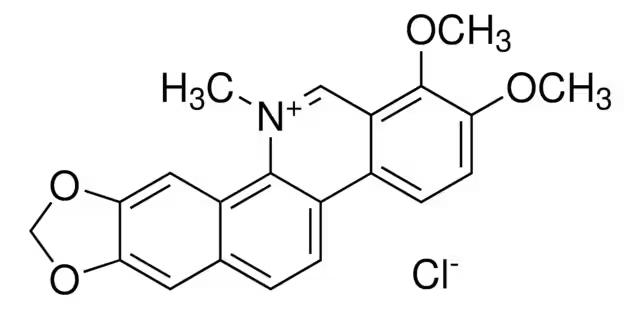
CAS Number3895-92-9
Synonyms[1,3]Benzodioxolo[5,6-c]phenanthridinium, 1,2-dimethoxy-12-methyl-, chloride (1:1); MFCD00060717; 1,2-Dimethoxy-12-methyl[1,3]dioxolo[4,5]benzo[1,2-c]phenanthridin-12-iumchlorid; 1,2-dimethoxy-12-methyl[1,3]benzodioxolo[5,6-c]phenanthridiniumchloride; 1,2-Dimethoxy-12-methyl[1,3]benzodioxolo[5,6-c]phenanthridin-12-ium chloride; 1,2-Dimethoxy-N-methyl(1,3)benzodioxolo(5,6-c)phenanthridinium chloride; 1,2-dimethoxy-12-methyl-[1,3]benzodioxolo[5,6-c]phenanthridin-12-ium,chloride; Chelerythrine chloride; EINECS 223-444-9
Molecular FormulaC21H18ClNO4
Molecular Weight383.82
Purity≥95 (TLC)%
Density1.36g/cm3
Boiling Point711.4ºC at 760 mmHg
Melting Point213.0-214.0 °C
Appearancepowder
| Chemical & Physical Properties | |
|---|---|
| CAS Number | 3895-92-9 |
| Catalog No. | 2A-9009714 |
| Chinese Name | 氯化白屈菜红碱 |
| Synonyms | [1,3]Benzodioxolo[5,6-c]phenanthridinium, 1,2-dimethoxy-12-methyl-, chloride (1:1); MFCD00060717; 1,2-Dimethoxy-12-methyl[1,3]dioxolo[4,5]benzo[1,2-c]phenanthridin-12-iumchlorid; 1,2-dimethoxy-12-methyl[1,3]benzodioxolo[5,6-c]phenanthridiniumchloride; 1,2-Dimethoxy-12-methyl[1,3]benzodioxolo[5,6-c]phenanthridin-12-ium chloride; 1,2-Dimethoxy-N-methyl(1,3)benzodioxolo(5,6-c)phenanthridinium chloride; 1,2-dimethoxy-12-methyl-[1,3]benzodioxolo[5,6-c]phenanthridin-12-ium,chloride; Chelerythrine chloride; EINECS 223-444-9 |
| Molecular Formula | C21H18ClNO4 |
| Molecular Weight | 383.82 |
| Purity | ≥95 (TLC) |
| Density | 1.36g/cm3 |
| Boiling Point | 711.4ºC at 760 mmHg |
| Melting Point | 213.0-214.0 °C |
| Appearance | powder |
| Water Solubility | DMSO: ≥10 mg/mL |
| Storage Condition | Store at room temperature, away from light, in a v |
| Application | Chelerythrine Chloride is a potent, cell-permeable protein kinase C inhibitor that inhibits PKC activity with an IC50 value of 660 nM. |
| HTC | 2933990090 |
| PubChem ID | 24278305 |
| MDL Number | MFCD00060717 |
| SMILES | Cl.COc1ccc2-c3ccc4cc5OCOc5cc4c3[N](C)=Cc2c1OC |
| InChI | 1S/C21H18NO4.ClH/c1-22-10-16-13(6-7-17(23-2)21(16)24-3)14-5-4-12-8-18-19(26-11-25-18)9-15(12)20(14)22;/h4-10H,11H2,1-3H3;1H |
| InChI Key | SUPBMPBJXZDANZ-UHFFFAOYSA-N |
| NACRES Code | NA.77 |
| UNSPSC | 12352200 |
| MSDS | msds/9714_1_3895_92_9.pdf |
| Bioactivity | Chelerythrine Chloride is a potent, cell-permeable inhibitor of protein kinase C, with an IC50 of 660 nM. Related Catalog Signaling Pathways >> Autophagy >> Autophagy Signaling Pathways >> Epigenetics >> PKC Signaling Pathways >> TGF-beta/Smad >> PKC Research Areas >> Inflammation/Immunology Natural Products >> Alkaloid Target PKC:660 nM (IC50) PKA:0.17 mM (IC50) TPK:0.1 mM (IC50) In Vitro Chelerythrine inhibits the BclXL-Bak BH3 peptide binding with IC50 of 1.5 μM and displaces Bax, a BH3-containing protein, from BclXL. Mammalian cells treated with Chelerythrine undergoes apoptosis with characteristic features that suggest involvement of the mitochondrial pathway[1]. Chelerythrine treatment inhibits LPS-induced TNF-α level and NO production in LPS-induced murine peritoneal macrophages through selective inhibition of p38 mitogen-activated protein kinase (MAPK) and extracellular signal-regulated protein kinases 1 and 2 (ERK1/2) activation. Moreover, the effects of chelerythrine on NO and cytokine TNF-α production can possibly be explained by the role of p38 MAPK and ERK1/2 in the regulation of inflammatory mediators expression[2]. Chelerythrine shows cytotoxic effect on the human monocytic leukaemia cells with LD50 value of 3.46 μM. Two hours after LPS stimulation, cells influenced by sanguinarine and Chelerythrine significantly decline the CCL-2 expression by a factors of 3.5 and 1.9[3]. Chelerythrine chloride significantly enhances the phosphorylation of ERK1/2 in a dose-dependent manner. In addition, chelerythrine chloride inhibits the phosphorylation of p38[4]. In Vivo Chelerythrine displays significant anti-inflammatory effects in experimentally induced mice endotoxic shock model in vivo through inhibition of LPS-induced tumor necrosis factor-alpha (TNF-α) level and nitric oxide (NO) production in serum[2]. Chelerythrine chloride (5 mg/kg/day, i.p.) induces apoptosis of RCC cells without significant toxicity to mice. Chelerythrine Chloride treatment leads to a dose-dependent accumulation of p53[4]. Cell Assay Cell viability is evaluated via MTT assay. Cells (2×10³ HEK-293 cells/well and 3×10³ SW-839 cells/well) in 100 µL medium are seeded into 96-well plates, and incubated for 12 h. Next, the medium in each well is replaced with medium containing various concentrations of Chelerythrine Chloride, and the cells are incubated at 37°C for an additional 24 and 48 h. Subsequently, 20 µL MTT (5 mg/mL) is added to each well. Following an additional incubation at 37°C for 4 h, the supernatant is removed, and 100 µL DMSO is added to each well. The absorbance values (read at 540 nm) are determined using the iMark™ Microplate Absorbance Reader. The data are analyzed using Microplate Manager software (ver. 6.3; 1689520). Animal Admin A total of 5×10⁶ SW-839 cells are mixed with Matrigel®, and injected subcutaneously into the flanks of 14 5-week-old male BALB/c nude mice. The mice are maintained in 18×30-cm cages containing three mice each, at a temperature of 22°C using a 12 h light/dark cycle. Food and water is available ad libitum. The mice are randomLy divided into two groups (n=7). As previously described, the mice are administrated with chelerythrine chloride at a dose of 5 mg/kg/day via intraperitoneal injection for 5 weeks, with the first injection of chelerythrine chlorideurring 24 h after injection with the SW-839 cells. The control mice are administered with the same volume of PBS containing 1% DMSO. The volume and weight of the mouse tumors are measured once a week. All the mice are sacrificed 36 days subsequent to inoculation of the cancer cells, when the tumors are resected. References [1]. Chan, et al. Identification of chelerythrine as an inhibitor of BclXL function. J Biol Chem. 2003 Jun 6;278(23):20453-6. [2]. Li W, et al. Effect of Chelerythrine Against Endotoxic Shock in Mice and Its Modulation of Inflammatory Mediators in Peritoneal Macrophages Through the Modulation of Mitogen-Activated Protein Kinase (MAPK) Pathway. Inflammation. 2012 Jul 24. [3]. Pencikova K, et al. Investigation of sanguinarine and chelerythrine effects on LPS-induced inflammatory gene expression in THP-1 cell line. Phytomedicine. 2012 Jul 15;19(10):890-5. Epub 2012 May 14. [4]. Chen XM, et al. Chelerythrine chloride induces apoptosis in renal cancer HEK-293 and SW-839 cell lines. Oncol Lett. 2016 Jun;11(6):3917-3924 [5]. Herbert JM, et al. Chelerythrine is a potent and specific inhibitor of protein kinase C. Biochem Biophys Res Commun. 1990 Nov 15;172(3):993-9. Chemical & Physical Properties Density 1.36g/cm3 Boiling Point 711.4ºC at 760 mmHg Melting Point 195-205ºC Molecular Formula C21H18ClNO4 Molecular Weight 383.825 Flash Point 219.3ºC Exact Mass 383.092438 PSA 40.80000 LogP 0.72060 Index of Refraction 1.681 InChIKey WEEFNMFMNMASJY-UHFFFAOYSA-M SMILES COc1ccc2c(c[n+](C)c3c4cc5c(cc4ccc23)OCO5)c1OC.[Cl-] Storage condition −20°C Water Solubility DMSO: ≥10 mg/mL |
| Use of | Chelerythrine Chloride is a potent, cell-permeable inhibitor of protein kinase C, with an IC50 of 660 nM. Properties Articles53 Name 1,2-Dimethoxy-12-methyl-[1,3]dioxolo[4',5':4,5]benzo[1,2-c]phenanthridin-12-ium chloride Synonym More Synonyms Chelerythrine chloride Biological Activity Description Chelerythrine Chloride is a potent, cell-permeable inhibitor of protein kinase C, with an IC50 of 660 nM. Related Catalog Signaling Pathways >> Autophagy >> Autophagy Signaling Pathways >> Epigenetics >> PKC Signaling Pathways >> TGF-beta/Smad >> PKC Research Areas >> Inflammation/Immunology Natural Products >> Alkaloid PKC:660 nM (IC50) References [1]. Chan, et al. Identification of chelerythrine as an inhibitor of BclXL function. J Biol Chem. 2003 Jun 6;278(23):20453-6. [2]. Li W, et al. Effect of Chelerythrine Against Endotoxic Shock in Mice and Its Modulation of Inflammatory Mediators in Peritoneal Macrophages Through the Modulation of Mitogen-Activated Protein Kinase (MAPK) Pathway. Inflammation. 2012 Jul 24. [5]. Herbert JM, et al. Chelerythrine is a potent and specific inhibitor of protein kinase C. Biochem Biophys Res Commun. 1990 Nov 15;172(3):993-9. Chemical & Physical Properties Exact Mass 383.092438 PSA 40.80000 LogP 0.72060 Index of Refraction 1.681 InChIKey WEEFNMFMNMASJY-UHFFFAOYSA-M |
| Tax Rebate | 13.0% |
| Supervision | None. MFN tariff: 6.5%. Ordinary tariff: 20.0% |
| Transport Info | Product name: Summary 2933990090. heterocyclic compounds with nitrogen hetero-atom(s) only. VAT:17.0%. Tax rebate rate:13.0%. . MFN tariff:6.5%. General tariff:20.0% |
| Related Products in Alkaloids | ||
|---|---|---|
| Anabasine hydrochloride | 15251-47-5 | 2A-9009188 |
| Berberine | 2086-83-1 | 2A-9009367 |
| Betaxolol | 63659-18-7 | 2A-9009386 |
| Bulleyaconitine A | 107668-79-1 | 2A-9009481 |
| Caffeine | 58-08-2 | 2A-9009535 |
| Cinchonidine sulfate | 549-56-4 | 2A-9009800 |
| D-(+)-Norephedrine | 37577-28-9 | 2A-9009979 |
| D-(+)-Norephedrine hydrochloride | 40626-29-7 | 2A-9009980 |
| Deacetyltaxol | 78432-77-6 | 2A-9010017 |
| Dehydromonocrotaline | 23291-96-5 | 2A-9010033 |
| Browse all Alkaloids products » | ||
Phone:
630-322-8886
630-322-8887
Email:
Office Locations:
Chicago, IL, USA
San Francisco, CA, USA


 EN
EN


 SDS
SDS