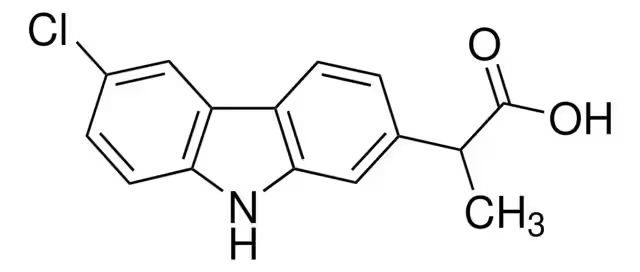
CAS Number53716-49-7
SynonymsUNII:FFL0D546HO; Imadyl; Rimadyl; MFCD00079028; 2-(6-Chloro-9H-carbazol-2-yl)propanoic acid; EINECS 258-712-4; Carprofen; 6-Chloro-α-methyl-9H-carbazole-2-acetic Acid; c5720
Molecular FormulaC15H12ClNO2
Molecular Weight273.71
Purity98%
Density1.4±0.1 g/cm3
Boiling Point509.1±35.0 °C at 760 mmHg
Melting Point186-188ºC
Appearancecrystalline powder
EINECS258-712-4
Symbol
Signal WordWarning
| Chemical & Physical Properties | |
|---|---|
| CAS Number | 53716-49-7 |
| Catalog No. | 2A-9009604 |
| Chinese Name | 卡洛芬 |
| Synonyms | UNII:FFL0D546HO; Imadyl; Rimadyl; MFCD00079028; 2-(6-Chloro-9H-carbazol-2-yl)propanoic acid; EINECS 258-712-4; Carprofen; 6-Chloro-α-methyl-9H-carbazole-2-acetic Acid; c5720 |
| Molecular Formula | C15H12ClNO2 |
| Molecular Weight | 273.71 |
| Purity | 98 |
| Density | 1.4±0.1 g/cm3 |
| Boiling Point | 509.1±35.0 °C at 760 mmHg |
| Melting Point | 186-188ºC |
| Appearance | crystalline powder |
| Water Solubility | Soluble in: methanol |
| Storage Condition | 0-6°C |
| Application | Carprofen is a nonsteroidal anti-inflammatory agent and a multi-target FAAH/COX inhibitor that can inhibit the activities of COX-2, COX-1 and FAAH, with IC50 values of 3.9 μM, 22.3 μM and 78.6 μM re |
| EINECS | 258-712-4 |
| HTC | 2933990090 |
| PubChem ID | 329822612 |
| MDL Number | MFCD00079028 |
| SMILES | CC(C(O)=O)c1ccc2c(c1)[nH]c3ccc(Cl)cc23 |
| InChI | 1S/C15H12ClNO2/c1-8(15(18)19)9-2-4-11-12-7-10(16)3-5-13(12)17-14(11)6-9/h2-8,17H,1H3,(H,18,19) |
| InChI Key | PUXBGTOOZJQSKH-UHFFFAOYSA-N |
| NACRES Code | NA.24 |
| UNSPSC | 41116107 |
| Hazard Symbols | Transport |
| MSDS | msds/9604_1_53716_49_7.pdf |
| Bioactivity | Carprofen is a nonsteroid anti-inflammatory agent, acts as a multi-target FAAH/COX inhibitor, with IC50s of 3.9 μM, 22.3 μM and 78.6 μM for COX-2, COX-1 and FAAH, respectively. Related Catalog Signaling Pathways >> Autophagy >> Autophagy Research Areas >> Inflammation/Immunology Signaling Pathways >> Immunology/Inflammation >> COX Signaling Pathways >> Metabolic Enzyme/Protease >> FAAH Signaling Pathways >> Neuronal Signaling >> FAAH Target COX-2:3.9 μM (IC50) COX-1:22.3 μM (IC50) FAAH:78.6 μM (IC50) In Vitro Carprofen (Compound 1) is a nonsteroid anti-inflammatory agent, acts as a multi-target FAAH/COX inhibitor, with IC50s of 3.9 μM, 22.3 μM and 78.6 μM for COX-2, COX-1 and FAAH, respectively[1]. Carprofen (10 µg/mL) shows cytoprotective effects in CCL and CaCL cells and decreases apoptosis of both cells. Carprofen (10 µg/mL) exhibits nonsignificant increase in PGE2 concentration, compared with that of the respective CCL or CaCL controls[2]. In Vivo Carprofen (2.2 mg/kg, p.o.) significantly decreases PGE2 concentration in blood of dogs on days 3 and 10. Carprofen also decreases amounts of gastric PGE2 synthesis on day 3, but the inhibition is not obvious on day 10. In addition, Carprofen shows no activity against gastric PGE1 synthesis in dogs on day 3 and 10[3]. Cell Assay Cruciate ligament cells are used and incubated with DMEM supplemented with 10% FCS for 24 hours to synchronize cell cycles. The cell cultures are then preincubated without (control) or with a nonselective COX inhibitor (acetylsalicylic acid) or a preferential COX-2 inhibitor (Carprofen, meloxicam, or robenacoxib) to ssess whether NSAIDs prevented apoptosis when the cells are subsequently incubated with SNP. For all cell cultures except those designated as controls, 1 of 3 concentrations of 1 of the 4 NSAIDs (10, 100, or 200 µg of acetylsalicylic acid/mL; 0.1, 1, or 10 µg of Carprofend/mL; 0.1, 1, or 10 µg of meloxicame/mL; or 0.1, 1, or 10 µg of robenacoxibf/mL) is added to the culture media of each cell culture, and the cells are incubated for 2 hours[2]. Animal Admin Dogs[3] Each dog receives Carprofen (2.2 mg/kg, PO, q 12 h), deracoxib (2 mg/kg, PO, q 24 h), or etodolac (10 to 15 mg/kg, PO, q 24 h) for 10 days in a crossover design with a 30- to 60-day washout period between treatments. On days 0, 3, and 10 of each treatment period, blood is collected for evaluation of TXB2 and PGE2 concentrations. In addition, anesthesia is induced with propofol (4 mg/kg) and maintained with isoflurane. Synovial fluid is collected from both stifle joints by use of a standard arthrocentesis technique for evaluation of PGE2 concentrations. Gastroscopy is performed during each anesthetic episode, and 3 to 6 endoscopic biopsy specimens are collected from the gastric antrum for evaluation of PGE1 and PGE2 synthesis. On day 0 for each dog, a gastric biopsy specimen is placed into a Campylobacter-like organism test kit and evaluated for up to 24 hours for Helicobacter spp. Stained slides (H&E) of gastric biopsy specimens are also evaluated for the presence of underlying inflammation[3]. References [1]. Favia AD, et al. Identification and characterization of carprofen as a multitarget fatty acid amide hydrolase/cyclooxygenase inhibitor. J Med Chem. 2012 Oct 25;55(20):8807-26. [2]. Waldherr K, et al. In vitro cytoprotective effects of acetylsalicylic acid, carprofen, meloxicam, or robenacoxib against apoptosis induced by sodium nitroprusside in canine cruciate ligament cells. Am J Vet Res. 2012 Nov;73(11):1752-8. [3]. Sessions JK, et al. In vivo effects of carprofen, deracoxib, and etodolac on prostanoid production in blood, gastric mucosa, and synovial fluid in dogs with chronic osteoarthritis. Am J Vet Res. 2005 May;66(5):812-7. Chemical & Physical Properties Density 1.4±0.1 g/cm3 Boiling Point 509.1±35.0 °C at 760 mmHg Melting Point 186-188ºC Molecular Formula C15H12ClNO2 Molecular Weight 273.714 Flash Point 261.7±25.9 °C Exact Mass 273.055664 PSA 53.09000 LogP 4.03 Vapour Pressure 0.0±1.4 mmHg at 25°C Index of Refraction 1.732 InChIKey PUXBGTOOZJQSKH-UHFFFAOYSA-N SMILES CC(C(=O)O)c1ccc2c(c1)[nH]c1ccc(Cl)cc12 Storage condition 0-6°C |
| Use of | Carprofen is a nonsteroid anti-inflammatory agent, acts as a multi-target FAAH/COX inhibitor, with IC50s of 3.9 μM, 22.3 μM and 78.6 μM for COX-2, COX-1 and FAAH, respectively. Properties Articles83 Name carprofen Synonym More Synonyms Carprofen Biological Activity Description Carprofen is a nonsteroid anti-inflammatory agent, acts as a multi-target FAAH/COX inhibitor, with IC50s of 3.9 μM, 22.3 μM and 78.6 μM for COX-2, COX-1 and FAAH, respectively. Related Catalog Signaling Pathways >> Autophagy >> Autophagy Research Areas >> Inflammation/Immunology Signaling Pathways >> Immunology/Inflammation >> COX Signaling Pathways >> Metabolic Enzyme/Protease >> FAAH Signaling Pathways >> Neuronal Signaling >> FAAH COX-2:3.9 μM (IC50) COX-1:22.3 μM (IC50) FAAH:78.6 μM (IC50) References [1]. Favia AD, et al. Identification and characterization of carprofen as a multitarget fatty acid amide hydrolase/cyclooxygenase inhibitor. J Med Chem. 2012 Oct 25;55(20):8807-26. [2]. Waldherr K, et al. In vitro cytoprotective effects of acetylsalicylic acid, carprofen, meloxicam, or robenacoxib against apoptosis induced by sodium nitroprusside in canine cruciate ligament cells. Am J Vet Res. 2012 Nov;73(11):1752-8. [3]. Sessions JK, et al. In vivo effects of carprofen, deracoxib, and etodolac on prostanoid production in blood, gastric mucosa, and synovial fluid in dogs with chronic osteoarthritis. Am J Vet Res. 2005 May;66(5):812-7. Chemical & Physical Properties Exact Mass 273.055664 PSA 53.09000 Index of Refraction 1.732 InChIKey PUXBGTOOZJQSKH-UHFFFAOYSA-N |
| Tax Rebate | 13.0% |
| Supervision | None. MFN tariff: 6.5%. Ordinary tariff: 20.0% |
| Transport Info | Shipping Name: UN |
| MSDS Transport Info | Module 14. Shipping information 14.1 United Nations number European Dangerous Regulations for land transport: 2811 International Dangerous Regulations for sea transport: 2811 International Dangerous Regulations for air transport: 2811 14.2 United Nations shipping name European Land Transport Dangerous Regulations: TOXIC SOLID, ORGANIC, N.O.S. (Carprofen) IMDG: TOXIC SOLID, ORGANIC, N.O.S. (Carprofen) International air transport hazard regulations: Toxic solid, organic, n.o.s. (Carprofen) 14.3 Transport hazard categories European Land Transport Danger Regulations: 6.1 International Maritime Transport Danger Regulations: 6.1 International Air Transport Danger Regulations: 6.1 14.4 Package group European Land Transport Danger Regulations: III International Maritime Transport Danger Regulations: III International Air Transport Danger Regulations: III 14.5 Environmental hazards European Land Transport Danger Regulations: No International Maritime Danger Regulations International Air Transport Danger Regulations: No Marine pollutants (yes/no): No 14.6 Special precautions No data available |
| Related Products in Specialty Chemicals | ||
|---|---|---|
| Carmustine | 154-93-8 | 2A-9009599 |
| Carnosic acid | 3650-09-7 | 2A-9009600 |
| Carocainide | 66203-00-7 | 2A-9009601 |
| Caroverine | 23465-76-1 | 2A-9009602 |
| Carprazidil | 68020-77-9 | 2A-9009603 |
| Carsatrin | 125363-87-3 | 2A-9009606 |
| Cartap | 15263-53-3 | 2A-9009607 |
| Cartap hydrochloride | 15263-52-2 | 2A-9009608 |
| Cartasteine | 149079-51-6 | 2A-9009609 |
| Carumonam | 87638-04-8 | 2A-9009610 |
| Browse all Specialty Chemicals products » | ||
Phone:
630-322-8886
630-322-8887
Email:
Office Locations:
Chicago, IL, USA
San Francisco, CA, USA


 EN
EN


 SDS
SDS