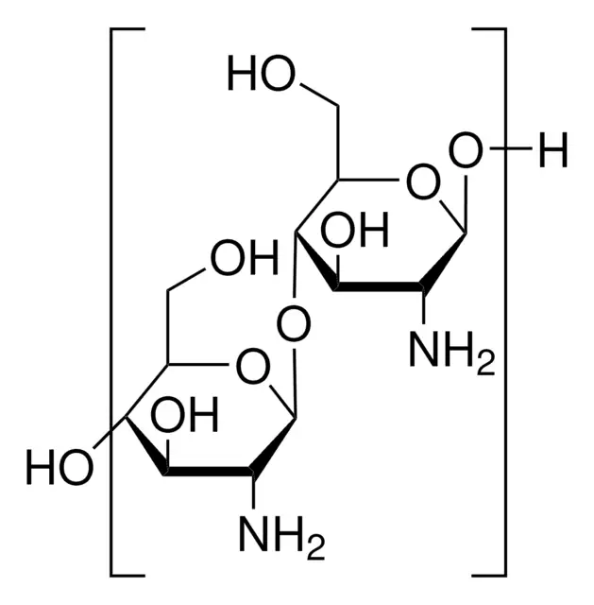
| Chemical & Physical Properties | |
|---|---|
| CAS Number | 148411-57-8 |
| Catalog No. | 2A-9093958 |
| Chinese Name | 壳寡糖 |
| Synonyms | MFCD02097973; Chitosan oligosaccharide lactate; Chitosan oligosaccharide (COS) |
| Molecular Formula | (C12H24N2O9)n |
| Molecular Weight | 340.32700 |
| Purity | 96 |
| Storage Condition | Store airtight in a cool, dry warehouse. |
| Application | Chitosan oligosaccharide (COS) is an oligomer of D-glucosamine linked by β-(1→4) glycosidic bonds. Chitosan oligosaccharide (COS) activates AMPK and inhibits inflammatory signaling pathways including |
| HTC | 2106909090 |
| PubChem ID | 24874360 |
| MDL Number | MFCD02097973 |
| SMILES | N[C@H]1[C@H](O)O[C@H](CO)[C@@H](O[C@@H]2O[C@H](CO)[C@@H](O)[C@H](O)[C@H]2N)[C@@H]1O |
| InChI | 1S/C12H24N2O9/c13-5-9(19)10(4(2-16)21-11(5)20)23-12-6(14)8(18)7(17)3(1-15)22-12/h3-12,15-20H,1-2,13-14H2/t3-,4-,5-,6-,7-,8-,9-,10-,11-,12+/m1/s1 |
| InChI Key | QLTSDROPCWIKKY-PMCTYKHCSA-N |
| NACRES Code | NA.23 |
| UNSPSC | 12162002 |
| Hazard Symbols | transportation |
| MSDS | msds/93958_1_148411_57_8.pdf |
| Bioactivity | Chitosan oligosaccharide (COS) is an oligomer of β-(1→4)-linked D-glucosamine. Chitosan oligosaccharide (COS) activates AMPK and inhibits inflammatory signaling pathways including NF-κB and MAPK pathways. Related Catalog Research Areas >> Cancer Research Areas >> Metabolic Disease Target AMPK[1] In Vitro Chitosan oligosaccharide (COS) represents a class of natural polymers that holds therapeutic promise in several diseases due to not only its physiochemical properties including water-solubility and low viscosity but also its favorable pharmacological properties including good pharmacokinetics and safety profiles and diverse beneficial biological activities. Activation of AMPK and inhibition of inflammatory signaling pathways including NF-κB and MAPK pathways are recognized as major mechanisms responsible for several effects of Chitosan oligosaccharide (COS) including anti-inflammation, anti-cancer, and anti-diabetes. COS can interrupt cancer progression at multiple stages by modulating several signaling proteins/pathways including NF-κB, AMPK, mTOR, caspase-3, CD147, MMP-2, MMP-9, and VEGF. In vitro experiments have demonstrated that Chitosan oligosaccharide (COS) induced the death of several cancer cell types including ascites, bladder cancer, prostate cancer, lung cancer, liver cancer, leukemia, cervical cancer and colorectal cancer. The values of IC50 of Chitosan oligosaccharide (COS) in inducing cytotoxicity are 25 μg/mL-50 μg/mL depending on types of cancer cells[1]. In Vivo The oral administration of Chitosan oligosaccharide (16 mg/kg/day) suppresses the production of the proinflammatory cytokines involved in allergic reactions, i.e., IL-4, IL-13 and TNF-α, in the lung tissues and bronchoalveolar lavage fluid of the mice. Last, an anti-inflammatory effect of Chitosan oligosaccharide (COS) on lymphocyte activation has been documented in a rat model of autoimmune anterior uveitis induced by immunization with bovine melanin-associated antigen[1]. Chitosan oligosaccharide (COS) inhibits UV-induced macroscopic appearance in mice skin. Compared with healthy dorsal skin with smoothness and some shallow wrinkles of hairless mice in normal control group, UV exposure for 10 weeks triggers skin erythema, dry, thickening, sagging and coarse wrinkles, and even leathery appearance and slight flesh-colored lesion in the model mice, the visual score of which is markedly higher than that of the normal control group (p<0.05), indicating that UV induces photoaging in skin surface[2]. Animal Admin Mice[2] Seven-week-old female hairless BALB/c mice (n=12), weighing approximately 16 g, are used. After a week of acclimation, the hairless mice are randomly divided into five groups of 6 mice per group: Normal control group (without UV irradiation but with double-distilled water treatment); Model group (UV irradiation with double-distilled water treatment); COS-L group, COS-M group and COS-H group (UV irradiation with 50 mg/mL, 100 mg/mL and 200 mg/mL COS treatment, respectively). For mice used for topical application, 100 μL are applied to each mouse dorsal skin every time after UV-radiation. The dorsal treated skin area of mice is carefully wiped with soft absorbent cotton soaked in distilled water, and then wiped with dry cotton before each UV-radiation to remove any remaining Chitosan oligosaccharide (COS)[2]. References [1]. Muanprasat C, et al. Chitosan oligosaccharide: Biological activities and potential therapeutic applications. Pharmacol Ther. 2017 Feb;170:80-97 [2]. Kong SZ, et al. Anti-photoaging effects of chitosan oligosaccharide in ultraviolet-irradiated hairless mouse skin. Exp Gerontol. 2018 Mar;103:27-34. Chemical & Physical Properties Molecular Formula C12H24N2O9 Molecular Weight 340.32700 Exact Mass 340.14800 PSA 201.11000 |
| Use of | Chitosan oligosaccharide (COS) is an oligomer of β-(1→4)-linked D-glucosamine. Chitosan oligosaccharide (COS) activates AMPK and inhibits inflammatory signaling pathways including NF-κB and MAPK pathways. Properties Name (2R,3S,4R,5R,6S)-5-amino-6-[(2R,3S,4R,5R,6R)-5-amino-4,6-dihydroxy-2-(hydroxymethyl)oxan-3-yl]oxy-2-(hydroxymethyl)oxane-3,4-diol Synonym More Synonyms Chitosan oligosaccharide (COS) Biological Activity Description Chitosan oligosaccharide (COS) is an oligomer of β-(1→4)-linked D-glucosamine. Chitosan oligosaccharide (COS) activates AMPK and inhibits inflammatory signaling pathways including NF-κB and MAPK pathways. Related Catalog Research Areas >> Cancer Research Areas >> Metabolic Disease In Vitro Chitosan oligosaccharide (COS) represents a class of natural polymers that holds therapeutic promise in several diseases due to not only its physiochemical properties including water-solubility and low viscosity but also its favorable pharmacological properties including good pharmacokinetics and safety profiles and diverse beneficial biological activities. Activation of AMPK and inhibition of inflammatory signaling pathways including NF-κB and MAPK pathways are recognized as major mechanisms responsible for several effects of Chitosan oligosaccharide (COS) including anti-inflammation, anti-cancer, and anti-diabetes. COS can interrupt cancer progression at multiple stages by modulating several signaling proteins/pathways including NF-κB, AMPK, mTOR, caspase-3, CD147, MMP-2, MMP-9, and VEGF. In vitro experiments have demonstrated that Chitosan oligosaccharide (COS) induced the death of several cancer cell types including ascites, bladder cancer, prostate cancer, lung cancer, liver cancer, leukemia, cervical cancer and colorectal cancer. The values of IC50 of Chitosan oligosaccharide (COS) in inducing cytotoxicity are 25 μg/mL-50 μg/mL depending on types of cancer cells[1]. References [1]. Muanprasat C, et al. Chitosan oligosaccharide: Biological activities and potential therapeutic applications. Pharmacol Ther. 2017 Feb;170:80-97 [2]. Kong SZ, et al. Anti-photoaging effects of chitosan oligosaccharide in ultraviolet-irradiated hairless mouse skin. Exp Gerontol. 2018 Mar;103:27-34. Chemical & Physical Properties Molecular Formula C12H24N2O9 Exact Mass 340.14800 PSA 201.11000 |
| Transport Info | Shipping Name: UN |
| MSDS Transport Info | Module 14. Shipping information 14.1 UN dangerous goods number European Land Transport Dangerous Regulations: -International Maritime Dangerous Regulations: -International Air Transport Dangerous Regulations: - 14.2 United Nations shipping name European Land Transport Dangerous Regulations: Non-dangerous goods IMDG Code: Non-dangerous goods International air transport dangerous goods regulations: non-dangerous goods 14.3 Transport hazard categories European Land Transport Dangerous Regulations: -International Maritime Dangerous Regulations: -International Air Transport Dangerous Regulations: - 14.4 Package group European Land Transport Dangerous Regulations: -International Maritime Dangerous Regulations: -International Air Transport Dangerous Regulations: - 14.5 Environmental hazards European Land Transport Danger Regulations: No International Maritime Danger Regulations International Air Transport Danger Regulations: No Marine pollutants (yes/no): No 14.6 Special reminder to users No data available |
| Related Products in Nutritional Ingredients | ||
|---|---|---|
| Acetyl-Resveratrol | 2A-175362 | 2A-9093715 |
| INOSITOL | 6917-35-7 | 2A-9093719 |
| Diclazepam | 2894-68-0 | 2A-9093819 |
| HYDROXOCOBALAMIN HYDROCHLORIDE | 58288-50-9 | 2A-9093859 |
| A-METHYL-L-TRYPTOPHAN | 153-91-3 | 2A-9093947 |
| VITAMIN K | 12001-79-5 | 2A-9093982 |
| EGG LECITHIN | 97281-47-5 | 2A-9093991 |
| Glucosamine 2KCL | 2A-175667 | 2A-9094024 |
| N-[4-[3-[2-Amino-4-(formylamino)-1,6-dihydro-6-oxo-5-pyrimidinyl]-3-oxopropyl]benzoyl]-L-glutamic Acid | 1644286-35-0 | 2A-9094051 |
| NARINGENIN | 67604-48-2 | 2A-9094075 |
| Browse all Nutritional Ingredients products » | ||
Phone:
630-322-8886
630-322-8887
Email:
Office Locations:
Chicago, IL, USA
San Francisco, CA, USA


 EN
EN


 SDS
SDS