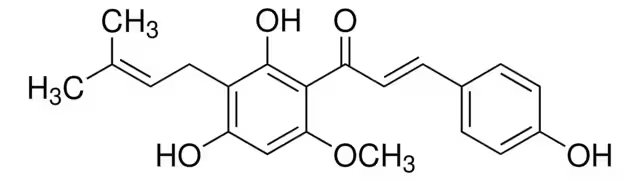
CAS Number6754-58-1
Synonyms(E)-1-[2,4-dihydroxy-6-methoxy-3-(3-methylbut-2-enyl)phenyl]-3-(4-hydroxyphenyl)prop-2-en-1-one; MFCD00210576; (2E)-1-[2,4-Dihydroxy-6-methoxy-3-(3-methylbut-2-en-1-yl)phenyl]-3-(4-hydroxyphenyl)prop-2-en-1-one; Xanthohumol; (2E)-1-[2,4-Dihydroxy-6-methoxy-3-(3-methyl-2-buten-1-yl)phenyl]-3-(4-hydroxyphenyl)-2-propen-1-one
Molecular FormulaC21H22O5
Molecular Weight354.40
Density1.2±0.1 g/cm3
Boiling Point576.5±50.0 °C at 760 mmHg
Melting Point157-159ºC
Appearanceorange powder
| Chemical & Physical Properties | |
|---|---|
| CAS Number | 6754-58-1 |
| Catalog No. | 2A-9093136 |
| Chinese Name | 黄腐酚 |
| Synonyms | (E)-1-[2,4-dihydroxy-6-methoxy-3-(3-methylbut-2-enyl)phenyl]-3-(4-hydroxyphenyl)prop-2-en-1-one; MFCD00210576; (2E)-1-[2,4-Dihydroxy-6-methoxy-3-(3-methylbut-2-en-1-yl)phenyl]-3-(4-hydroxyphenyl)prop-2-en-1-one; Xanthohumol; (2E)-1-[2,4-Dihydroxy-6-methoxy-3-(3-methyl-2-buten-1-yl)phenyl]-3-(4-hydroxyphenyl)-2-propen-1-one |
| Molecular Formula | C21H22O5 |
| Molecular Weight | 354.40 |
| Density | 1.2±0.1 g/cm3 |
| Boiling Point | 576.5±50.0 °C at 760 mmHg |
| Melting Point | 157-159ºC |
| Appearance | orange powder |
| Water Solubility | ethanol: soluble10mg/mL |
| Storage Condition | 2-8°C |
| Application | Xanthohumol is a flavonoid compound isolated from hops. It is an inhibitor of DGAT, COX-1 and COX-2, and has anti-tumor and anti-angiogenic effects. |
| PubChem ID | 591726 |
| SMILES | COc1cc(O)c(CC=C(C)C)c(O)c1C(=O)C=Cc1ccc(O)cc1 |
| InChI | InChI=1S/C21H22O5/c1-13(2)4-10-16-18(24)12-19(26-3)20(21(16)25)17(23)11-7-14-5-8-15(22)9-6-14/h4-9,11-12,22,24-25H,10H2,1-3H3/b11-7+ |
| InChI Key | ORXQGKIUCDPEAJ-YRNVUSSQSA-N |
| Bioactivity | Xanthohumol is one of the principal flavonoids isolated from hops, the inhibitor of diacylglycerol acetyltransferase (DGAT), COX-1 and COX-2, and shows anti-cancer and anti-angiogenic activities. Related Catalog Signaling Pathways >> Metabolic Enzyme/Protease >> Acyltransferase Signaling Pathways >> Immunology/Inflammation >> COX Research Areas >> Cancer Natural Products >> Flavonoids In Vitro Xanthohumol significantly attenuates ADP-induced blood platelet aggregation, and significantly reduces the expression of fibrinogen receptor (activated form of GPIIbIIIa) on platelets' surface[1]. Xanthohumol (5-50 nM) reduces the frequency of spontaneously occurring Ca2+ sparks and Ca2+ waves in control myocytes and in cells subjected to Ca2+ overload caused by: (1) exposure to low K+ solutions, (2) periods of high frequency electrical stimulation, (3) exposures to isoproterenol or (4) caffeine. Xanthohumol (50-100 nM) reduces the rate of relaxation of electrically- or caffeine-triggered Ca2+ transients, without suppressing ICa, but this effect is small and reversed by isoproterenol at physiological temperatures. Xanthohumol also suppresses the Ca2+ content of the SR, and its rate of recirculation[2]. Treatment of endothelial cells with Xanthohumol leads to increased AMPK phosphorylation and activity. Functional studies using biochemical approaches confirm that AMPK mediates Xanthohumol anti-angiogenic activity. AMPK activation by Xanthohumol is mediated by CAMMKβ, but not LKB1. Analysis of the downstream mechanisms shows that Xanthohumol-induced AMPK activation reduces nitric oxide (NO) levels in endothelial cells by decreasing eNOS phosphorylation. Finally, AKT pathway is inactivated by Xanthohumol as part of its anti-angiogenic activity, but independently from AMPK, suggesting that these two signaling pathways proceed autonomously[3]. Xanthohumol significantly reduces cell viability and induces apoptosis via pro-caspase-3/8 cleavage and poly(ADP ribose) polymerase (PARP) degradation. Pro-caspase-9 cleavage, Bcl2 family expression changes, mitochondrial dysfunction, and intracellular ROS generation also participate in Xanthohumol-induced glioma cell death. Xanthohumol's inhibition of the IGFBP2/AKT/Bcl2 pathway via miR-204-3p targeting plays a critical role in mediating glioma cell death[4]. Cell Assay In vitro cell proliferation/viability is measured by the MTT test at different time points. 1000 cells/well are plated into 96-multiwell plates in complete medium. Following adhesion, medium is replaced with fresh medium containing the different treatments or vehicle (DMSO in medium). Xanthohumol and EGCG are used in a concentration range from 2.5 to 40 μM, up to 96 hours. 3 hours before each time point, MTT reagent (3-(4,5-dimethylthiazol-2-yl)-2,5-diphenyltetrazolium bromide) is added to the wells and plates are incubated at 37°C. At the indicated time points, absorbance at 540 nm is then measured by a FLUOstar spectrophotometer. References [1]. Luzak B, et al. Xanthohumol from hop cones (Humulus lupulus L.) prevents ADP-induced platelet reactivity. Arch Physiol Biochem. 2016 Nov 18:1-7. [2]. Arnaiz-Cot JJ, et al. Xanthohumol modulates calcium signaling in rat ventricular myocytes: Possible Antiarrhythmic properties. J Pharmacol Exp Ther. 2016 Nov 4. pii: jpet.116.236588. [3]. Gallo C, et al. Hop derived flavonoid xanthohumol inhibits endothelial cell functions via AMPK activation. Oncotarget. 2016 Aug 1. [4]. Chen PH, et al. The miR-204-3p-targeted IGFBP2 pathway is involved in xanthohumol-induced glioma cell apoptotic death. Neuropharmacology. 2016 Nov;110(Pt A):362-75. Chemical & Physical Properties Density 1.2±0.1 g/cm3 Boiling Point 576.5±50.0 °C at 760 mmHg Melting Point 157-159ºC Molecular Formula C21H22O5 Molecular Weight 354.396 Flash Point 203.4±23.6 °C Exact Mass 354.146729 PSA 86.99000 LogP 5.17 Vapour Pressure 0.0±1.7 mmHg at 25°C Index of Refraction 1.641 InChIKey ORXQGKIUCDPEAJ-YRNVUSSQSA-N SMILES COc1cc(O)c(CC=C(C)C)c(O)c1C(=O)C=Cc1ccc(O)cc1 Storage condition 2-8°C Water Solubility ethanol: soluble10mg/mL |
| Use of | Xanthohumol is one of the principal flavonoids isolated from hops, the inhibitor of diacylglycerol acetyltransferase (DGAT), COX-1 and COX-2, and shows anti-cancer and anti-angiogenic activities. Properties Articles34 Name xanthohumol Synonym More Synonyms Xanthohumol Biological Activity Description Xanthohumol is one of the principal flavonoids isolated from hops, the inhibitor of diacylglycerol acetyltransferase (DGAT), COX-1 and COX-2, and shows anti-cancer and anti-angiogenic activities. Related Catalog Signaling Pathways >> Metabolic Enzyme/Protease >> Acyltransferase Signaling Pathways >> Immunology/Inflammation >> COX Research Areas >> Cancer Natural Products >> Flavonoids References [1]. Luzak B, et al. Xanthohumol from hop cones (Humulus lupulus L.) prevents ADP-induced platelet reactivity. Arch Physiol Biochem. 2016 Nov 18:1-7. [2]. Arnaiz-Cot JJ, et al. Xanthohumol modulates calcium signaling in rat ventricular myocytes: Possible Antiarrhythmic properties. J Pharmacol Exp Ther. 2016 Nov 4. pii: jpet.116.236588. [3]. Gallo C, et al. Hop derived flavonoid xanthohumol inhibits endothelial cell functions via AMPK activation. Oncotarget. 2016 Aug 1. [4]. Chen PH, et al. The miR-204-3p-targeted IGFBP2 pathway is involved in xanthohumol-induced glioma cell apoptotic death. Neuropharmacology. 2016 Nov;110(Pt A):362-75. Chemical & Physical Properties Molecular Formula C21H22O5 Exact Mass 354.146729 PSA 86.99000 Index of Refraction 1.641 InChIKey ORXQGKIUCDPEAJ-YRNVUSSQSA-N |
| Transport Info | Product name: Purity: 98.0% |
| MSDS Transport Info | Module 14. Shipping information United Nations classification: inconsistent with United Nations classification standards UN number: not specified |
| Related Products in Botanical Reference Standards | ||
|---|---|---|
| Bilirubin Di-acyl-b-D-glucuronide | 17459-92-6 | 2A-9093091 |
| CYCLOASTRAGENOL | 78574-94-4 | 2A-9093119 |
| 23-HYDROXYBETULINIC ACID | 85999-40-2 | 2A-9093123 |
| ALPHA-HEDERIN | 27013-91-8 | 2A-9093128 |
| Hederacoside C | 14216-03-6 | 2A-9093129 |
| TanshinoneIIA | 69659-80-9 | 2A-9093154 |
| SOYASAPONIN III | 55304-02-4 | 2A-9093175 |
| Soyasaponin V | 114590-20-4 | 2A-9093176 |
| SOYASAPONIN IV | 108906-97-4 | 2A-9093177 |
| Deoxynivalenol 15-Glucuronide | 1372859-16-9 | 2A-9093228 |
| Browse all Botanical Reference Standards products » | ||
Phone:
630-322-8886
630-322-8887
Email:
Office Locations:
Chicago, IL, USA
San Francisco, CA, USA


 EN
EN


 SDS
SDS