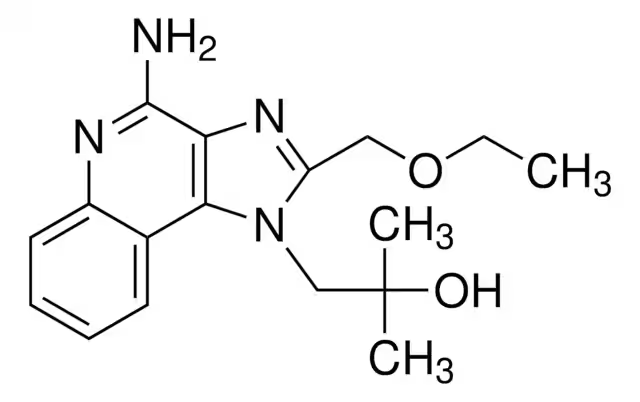
CAS Number144875-48-9
Synonyms1-[4-Amino-2-(ethoxymethyl)-1H-imidazo[4,5-c]quinolin-1-yl]-2-methyl-2-propanol; Resiquimod; 1-[4-amino-2-(ethoxymethyl)imidazo[4,5-c]quinolin-1-yl]-2-methylpropan-2-ol; 1-(4-Amino-2-(ethoxymethyl)-1H-imidazo[4,5-c]quinolin-1-yl)-2-methylpropan-2-ol; 4-amino-2-(ethoxymethyl)-a,a-dimethyl-1h-imidazo[4,5-c]quinoline-1-ethanol; 1-[4-Amino-2-(ethoxymethyl)-1H-imidazo[4,5-c]quinolin-1-yl]-2-methylpropan-2-ol; R848
Molecular FormulaC17H22N4O2
Molecular Weight314.38
Purity≥98 (HPLC)%
Density1.3±0.1 g/cm3
Boiling Point553.6±50.0 °C at 760 mmHg
Melting Point193 °C
Appearancepowder
| Chemical & Physical Properties | |
|---|---|
| CAS Number | 144875-48-9 |
| Catalog No. | 2A-9092747 |
| Chinese Name | 雷西莫特 |
| Synonyms | 1-[4-Amino-2-(ethoxymethyl)-1H-imidazo[4,5-c]quinolin-1-yl]-2-methyl-2-propanol; Resiquimod; 1-[4-amino-2-(ethoxymethyl)imidazo[4,5-c]quinolin-1-yl]-2-methylpropan-2-ol; 1-(4-Amino-2-(ethoxymethyl)-1H-imidazo[4,5-c]quinolin-1-yl)-2-methylpropan-2-ol; 4-amino-2-(ethoxymethyl)-a,a-dimethyl-1h-imidazo[4,5-c]quinoline-1-ethanol; 1-[4-Amino-2-(ethoxymethyl)-1H-imidazo[4,5-c]quinolin-1-yl]-2-methylpropan-2-ol; R848 |
| Molecular Formula | C17H22N4O2 |
| Molecular Weight | 314.38 |
| Purity | ≥98 (HPLC) |
| Density | 1.3±0.1 g/cm3 |
| Boiling Point | 553.6±50.0 °C at 760 mmHg |
| Melting Point | 193 °C |
| Appearance | powder |
| Storage Condition | -20°C; store under inert gas; avoid moisture (hygr |
| Application | Resiquimod is an agonist of Toll-like receptors 7 and 8 (TLR7/TLR8), inducing the upregulation of cytokines such as TNF-α, IL-6 and IFN-α. |
| HTC | 2933990090 |
| PubChem ID | 329825221 |
| MDL Number | MFCD00937759 |
| SMILES | CCOCc1nc2c(N)nc3ccccc3c2n1CC(C)(C)O |
| InChI | 1S/C17H22N4O2/c1-4-23-9-13-20-14-15(21(13)10-17(2,3)22)11-7-5-6-8-12(11)19-16(14)18/h5-8,22H,4,9-10H2,1-3H3,(H2,18,19) |
| InChI Key | BXNMTOQRYBFHNZ-UHFFFAOYSA-N |
| NACRES Code | NA.77 |
| UNSPSC | 51111800 |
| MSDS | msds/92747_1_144875_48_9.pdf |
| Bioactivity | Resiquimod is a Toll-like receptor 7 and 8 (TLR7/TLR8) agonist that induces the upregulation of cytokines such as TNF-α, IL-6 and IFN-α. Related Catalog Signaling Pathways >> Immunology/Inflammation >> Toll-like Receptor (TLR) Research Areas >> Inflammation/Immunology In Vitro Resiquimod (R-848) induces both hapten- and allergen-specific circulating T cells, including TH2 effectors, to produce IFN-γ and even to lose the ability to produce IL-4[2]. Resiquimod (R848) enhances PBL proliferation in a dose-dependent manner, and increases the number of BrdU-positive cells in BrdU incorporation assay. Cells treated with R848 exhibits significantly increased (3.5-fold) luciferase (a reporter of NF-κB activity) activity[3]. In Vivo Resiquimod (R-848) (50 μg/bird, i.m. route) significantly up-regulates the expression of IFN-α, IFN-β, IFN-γ, IL-1β, IL-4, iNOS and MHC-II genes in SPF chicken[1]. Kinase Assay For luciferase assay, FG-9307 cells are transfected with the firefly NF-κB-specific luciferase reporter vector pNFκB-Met-Luc2. Transfection efficiency is monitored by co-transfection with the pSEAP2 control vector, which constitutively expresses the human secreted enhanced alkaline phosphatase (SEAP). Then the cells are treated with Resiquimod (R848, 1 µg/mL), CQ (10 µM), CQ plus R848 or PBS and incubated at 22°C for 24 h. The culture medium of the transfectants is then analyzed for luciferase activity and SEAP activity using Luciferase Assay Kit and the Great EscAPe™ SEAP Chemiluminescence Detection Kit, respectively. The assay is performed three times. Cell Assay For inhibition of lysosomal acidification, cells are incubated with 10 µM CQ for 1 h before Resiquimod (R848) treatment. After treatment, 20 µL of 5 mg/mL MTT is added to the plate. The plate is incubated at 22°C for 4 h, and 200 µL dimethyl sulfoxide is added to the plate to dissolve the reduced formazan. The plate is then read at 490 nm with a microplate reader. To determine the effect of Myd88 inhibition on R848-induced cell proliferation, the Myd88 inhibitor Pepinh-MYD and the control peptide Pepinh-Control are added to PBL at the concentration of 50 µM, and the plate is incubated at 22°C for 6 h. After incubation, the cells are treated with R848 and subjected to MTT assay as above. To determine the effect of NF-κB inactivation on R848-induced cell proliferation, BAY-11-7082, an irreversible inhibitor of IκB-α phosphorylation, is added to the cells at the concentration of 1 µM, and the plate is incubated at 22°C for 1 h. After incubation, the cells are treated with R848 and subjected to MTT assay as earlier. All experiments are performed three times. Animal Admin A total of 40 SPF chickens of two-week old are allotted to one of the following four experimental groups (n=10/group): Group A: PBS control; Group B: inactivated NDV vaccine; Group C: commercial oil adjuvanted inactivated NDV vaccine prepared from lentogenic strain and Group D: combination of inactivated NDV vaccine and R-848 (50 μg/bird). Vaccine or PBS is administered by intramuscular route in the thigh muscle. A booster dose is given 14-day post immunization (d.p.i). Two weeks post-booster, experimental SPF birds are challenged with velogenic strain of NDV (105 ELD50 per bird) intramuscularly. Clinical signs and mortality are observed daily till 14 day post-challenge (d.p.c). Cloacal swabs (n=6/group) are collected from the birds on day 0, 4, 7 and 14 post-challenge and inoculated into 10-day old embryonated chicken eggs (n=3 eggs/sample) through intra-allantoic route. Three day post-inoculation, the allantoic fluid is checked for the NDV growth by spot haemagglutination using 10% chicken RBC. References [1]. Sachan S, et al. Adjuvant potential of resiquimod with inactivated Newcastle disease vaccine and its mechanism of action in chicken. Vaccine. 2015 Aug 26;33(36):4526-32. [2]. Brugnolo F, et al. The novel synthetic immune response modifier R-848 (Resiquimod) shifts human allergen-specific CD4+ TH2 lymphocytes into IFN-gamma-producing cells. J Allergy Clin Immunol. 2003 Feb;111(2):380-8. [3]. Zhou ZX, et al. Immune effects of R848: evidences that suggest an essential role of TLR7/8-induced, Myd88- and NF-κB-dependent signaling in the antiviral immunity of Japanese flounder (Paralichthys olivaceus). Dev Comp Immunol. 2015 Mar;49(1):113-20. Chemical & Physical Properties Density 1.3±0.1 g/cm3 Boiling Point 553.6±50.0 °C at 760 mmHg Melting Point 193 °C Molecular Formula C17H22N4O2 Molecular Weight 314.382 Flash Point 288.6±30.1 °C Exact Mass 314.174286 PSA 86.19000 LogP 2.15 Vapour Pressure 0.0±1.6 mmHg at 25°C Index of Refraction 1.635 InChIKey BXNMTOQRYBFHNZ-UHFFFAOYSA-N SMILES CCOCc1nc2c(N)nc3ccccc3c2n1CC(C)(C)O |
| Use of | Properties Articles100 Name resiquimod Synonym More Synonyms Resiquimod Biological Activity Related Catalog Signaling Pathways >> Immunology/Inflammation >> Toll-like Receptor (TLR) Research Areas >> Inflammation/Immunology In Vitro Resiquimod (R-848) induces both hapten- and allergen-specific circulating T cells, including TH2 effectors, to produce IFN-γ and even to lose the ability to produce IL-4[2]. Resiquimod (R848) enhances PBL proliferation in a dose-dependent manner, and increases the number of BrdU-positive cells in BrdU incorporation assay. Cells treated with R848 exhibits significantly increased (3.5-fold) luciferase (a reporter of NF-κB activity) activity[3]. In Vivo Resiquimod (R-848) (50 μg/bird, i.m. route) significantly up-regulates the expression of IFN-α, IFN-β, IFN-γ, IL-1β, IL-4, iNOS and MHC-II genes in SPF chicken[1]. References [1]. Sachan S, et al. Adjuvant potential of resiquimod with inactivated Newcastle disease vaccine and its mechanism of action in chicken. Vaccine. 2015 Aug 26;33(36):4526-32. Chemical & Physical Properties Molecular Formula C17H22N4O2 Exact Mass 314.174286 PSA 86.19000 Index of Refraction 1.635 InChIKey BXNMTOQRYBFHNZ-UHFFFAOYSA-N |
| Tax Rebate | 13.0% |
| Supervision | None. MFN tariff: 6.5%. Ordinary tariff: 20.0% |
| Transport Info | Product name: Summary 2933990090. heterocyclic compounds with nitrogen hetero-atom(s) only. VAT:17.0%. Tax rebate rate:13.0%. . MFN tariff:6.5%. General tariff:20.0% |
| Related Products in Specialty Chemicals | ||
|---|---|---|
| Faldaprevir | 801283-95-4 | 2A-9092739 |
| VX-770 | 873054-44-5 | 2A-9092741 |
| RDEA 594 | 878672-00-5 | 2A-9092742 |
| Intedanib | 656247-17-5 | 2A-9092743 |
| MK-3102 | 1226781-44-7 | 2A-9092744 |
| AZD-9291 | 1421373-65-0 | 2A-9092748 |
| 3-(1-Biphenyl-4-ylMethyl-3-ethoxycarbonyl-1-butylcarbaMoyl)propionate-3'-Methyl-2'-(pentanoyl(2'-(tetrazol-5-ylate)biphenyl-4'-ylMethyl)aMino)butyrate | 936623-90-4 | 2A-9092749 |
| Silodosin | 160970-64-9 | 2A-9092750 |
| Simeprevir | 923604-59-5 | 2A-9092751 |
| Suvorexant (MK-4305) | 1030377-33-3 | 2A-9092752 |
| Browse all Specialty Chemicals products » | ||
Phone:
630-322-8886
630-322-8887
Email:
Office Locations:
Chicago, IL, USA
San Francisco, CA, USA


 EN
EN


 SDS
SDS